
Air quality governance: NCAP, AQI, CPCB, CAQM and GRAP
Why in news: From 1 October 2026, CAQM's 50 mg/Nm³ particulate emission limit binds all polluting industries it targets in Delhi-NCR, the government said on 7 September 2026.
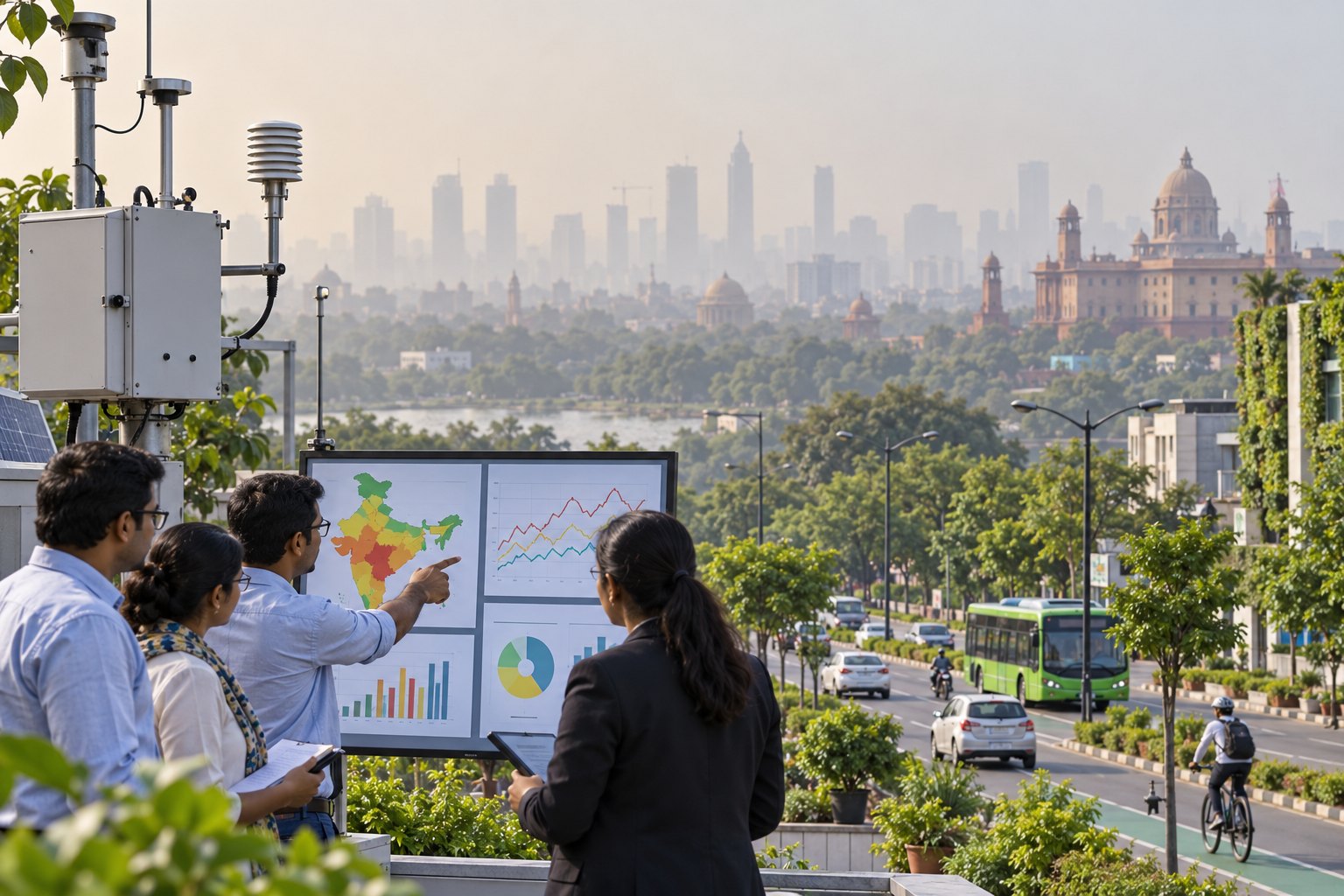
India's clean-air framework combines the National Clean Air Programme (NCAP), launched in 2019 and now covering 130 cities, the Air Quality Index, the Central Pollution Control Board and, for the NCR, the Commission for Air Quality Management (CAQM), which coordinates the Graded Response Action Plan. From 1 October 2026, CAQM's stricter particulate norm binds all the polluting industries it targets.
Syllabus: Prelims · Environment & Ecology; GS2 · Statutory & Regulatory Bodies; GS3 · Environment & Conservation
In short
India's air-quality governance rests on the Water Act, 1974 and Air Act, 1981: CPCB monitors, NCAP funds city plans, and CAQM, under a 2021 Act, manages the NCR's airshed.
India has built monitoring, money and an airshed body; cleaner air now needs finer-particle targets and firmer State enforcement all year.
Why it matters
A child walking to school in an Indian city breathes PM2.5 particles small enough to lodge deep in the lungs, and some reach the blood. Who measures that air, who sets the limit and who can shut a polluting unit decides how fast anything changes. NCAP links money to results: a city that controls road and construction dust and shows lower PM10 earns more of its grant. In the NCR, GRAP means a family may see construction halted or some vehicles kept off the roads when the AQI crosses set levels. The larger issue is federal: polluted air crosses State lines, so the NCR has a commission that can direct four neighbouring States.
Prelims pointers
- CPCB: statutory body first constituted under the Water (Prevention and Control of Pollution) Act, 1974; also exercises powers under the Air Act, 1981; advises MoEFCC.
- Air (Prevention and Control of Pollution) Act, 1981: enacted under Article 253 to implement the 1972 Stockholm Conference decisions; States may declare air pollution control areas.
- NAAQS (CPCB, 2009) cover 12 pollutants; the annual limit is 60 µg/m³ for PM10 and 40 µg/m³ for PM2.5.
- National AQI: eight pollutants (PM10, PM2.5, NO2, SO2, CO, O3, NH3, lead), six categories; the pollutant with the worst sub-index sets the overall AQI.
- CAQM: statutory body under its own Act of 2021; replaced EPCA; covers the NCR and adjoining areas of Punjab, Haryana, Rajasthan and Uttar Pradesh; appeals go to the NGT.
- GRAP stages: I Poor (201-300), II Very Poor (301-400), III Severe (401-450), IV Severe+ (above 450); CAQM coordinates it across the NCR.
- Swachh Vayu Survekshan: MoEFCC's annual assessment of NCAP cities since 2022-23, in three population categories; Swachh Survekshan, the cleanliness survey, belongs to MoHUA.
- OCEMS: online monitors at industrial stacks, mandated by CPCB for 17 categories of highly polluting industries; data flows to the CPCB server.
Practise a UPSC-style question
With reference to air-quality monitoring in India, consider the following statements:
1. The Central Pollution Control Board was first constituted under the Water (Prevention and Control of Pollution) Act, 1974.
2. Online Continuous Emission Monitoring Systems are installed at ambient stations to measure a city's outdoor air quality.
Which of the statements given above is/are correct?
- (a) 1 only
- (b) 2 only
- (c) Both 1 and 2
- (d) Neither 1 nor 2
Show the answer
Answer: (a) 1 only
1 is correct: the CPCB was set up under the Water Act, 1974 and later given powers under the Air Act, 1981. 2 is incorrect: OCEMS are fitted at industrial sources such as the 17 categories of highly polluting industries; outdoor air is tracked by ambient stations such as CAAQMS.
In the news
More Explainers
- State Legislative Councils: Articles 168-172 and the graduates' and teachers' seats Polity
- Whales and dolphins in Indian waters: legal protection, IUCN status and strandings Environment
- The Aligarh Movement, AMU and the Article 30 minority test Polity
- Environmental clearance by States: SEIAA, SEAC and the EIA Notification, 2006 Environment
- Software vulnerabilities: CVE, CVSS, coordinated disclosure and CERT-In's role Sci-Tech
- Drug trafficking law in India: NDPS Act, PIT-NDPS, NCB and NCORD National
- Choosing the UN Secretary-General: Article 97, UNSC veto and straw polls World & IR
- UN Convention against Torture, and why India has not ratified it Polity
- NavIC: why India's navigation constellation cannot give a standalone position Sci-Tech
- International Energy Agency: membership, 90-day oil stocks and India's status World & IR
- PM Surya Ghar: Muft Bijli Yojana and the rooftop solar subsidy Economy
- HFSS foods: FSSAI's draft limits and front-of-pack warning labels National