
Wild water buffalo: reintroduction from Kaziranga to Kanha
Why in news: On 11 October 2026, eight wild buffaloes from Kaziranga moved from a quarantine enclosure into a 17-hectare enclosure in Kanha's Supkhar range.
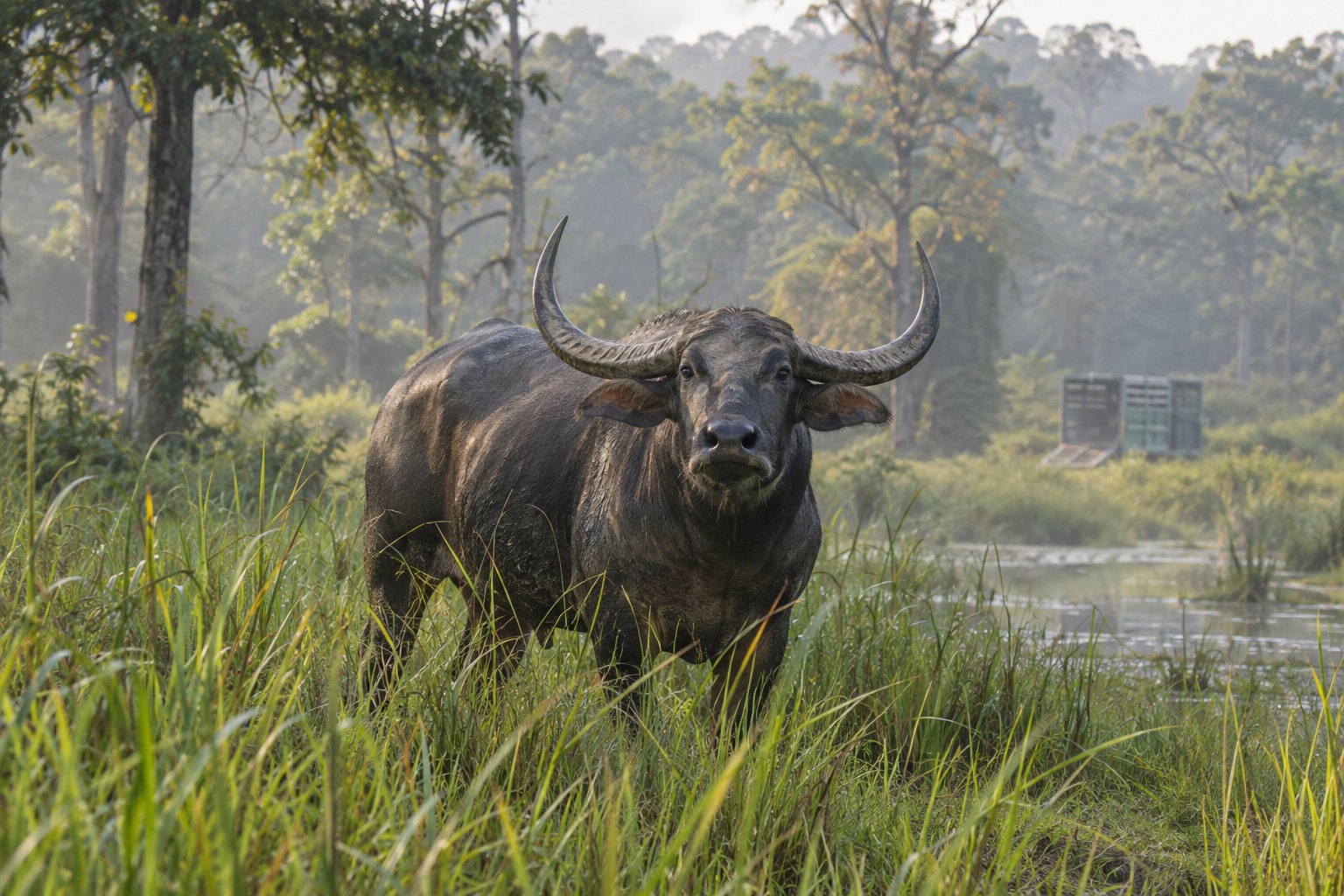
The wild water buffalo (Bubalus arnee) is Endangered on the IUCN Red List and protected under Schedule I of the Wild Life (Protection) Act, 1972. Madhya Pradesh is reintroducing it to Kanha Tiger Reserve with animals from Kaziranga National Park. On 11 October 2026, eight buffaloes moved from quarantine into a 17-hectare enclosure at Supkhar.
Syllabus: Prelims · Geography; Prelims · Environment & Ecology; GS3 · Environment & Conservation
In short
The wild water buffalo (Bubalus arnee), an Endangered wet-grassland grazer, is being reintroduced from Assam's Kaziranga to Madhya Pradesh's Kanha, testing translocation as a conservation tool.
Kanha's buffaloes succeed only as a free-ranging, genetically wild herd: screening founders and keeping domestic stock away matter more than reaching 50.
Why it matters
A herd of wild buffaloes is a grassland's lawnmower: grazing and wallowing keep meadows open and wet hollows full, which helps deer, birds and the tigers that hunt them. Madhya Pradesh lost that grazer about a century ago, by the Chief Minister's account, and he says its return will help grassland conservation and bring eco-tourism jobs to local communities. For the species, a second home matters because nearly all wild buffaloes live in a few sites in Assam, so one disease outbreak or a flood could hit most of them at once. The larger issue is genetic purity: wherever wild herds meet village buffaloes, they interbreed, so the new population must be kept apart from domestic stock.
Prelims pointers
- Bubalus arnee is the wild water buffalo; the domestic water buffalo is Bubalus bubalis in IUCN's taxonomy.
- IUCN Red List: wild water buffalo is Endangered; its main threat is interbreeding with domestic and feral buffaloes.
- Wild Life (Protection) Amendment Act, 2022 cut the schedules from six to four: Schedule I and II animals, Schedule III plants, Schedule IV CITES specimens.
- CITES: the wild water buffalo is in Appendix III, listed at Nepal's request.
- Kaziranga National Park, Assam: UNESCO natural World Heritage Site (1985) in the Brahmaputra floodplain; Tiger Reserve since 2007; largest one-horned rhinoceros population.
- Kanha Tiger Reserve: Mandla and Balaghat districts of Madhya Pradesh, in the Maikal hills of the Satpuras; home of the hard-ground barasingha.
- IUCN 2013 Guidelines: reintroduction is within the indigenous range where a species disappeared; reinforcement adds to an existing population; conservation introduction goes outside the range.
- Chhattisgarh's State animal is the wild water buffalo; its remnant herds are in Udanti Wildlife Sanctuary and Indravati National Park.
Practise a UPSC-style question
With reference to the wild water buffalo (Bubalus arnee), consider the following statements:
1. The IUCN Red List classifies the wild water buffalo as Vulnerable.
2. It is listed in Schedule I of the Wild Life (Protection) Act, 1972, as amended in 2022.
3. Interbreeding with domestic and feral buffaloes is a major threat to its genetic purity.
Which of the statements given above is/are correct?
- (a) 1 and 2 only
- (b) 2 and 3 only
- (c) 1 and 3 only
- (d) 1, 2 and 3
Show the answer
Answer: (b) 2 and 3 only
1 is incorrect: the IUCN Red List classes the wild water buffalo as Endangered, not Vulnerable. 2 is correct: it is in Schedule I, Part A, under wild cattle with the gaur and the wild yak. 3 is correct: the IUCN names introgression from domestic and feral buffaloes as its main threat.
More Explainers
- State Legislative Councils: Articles 168-172 and the graduates' and teachers' seats Polity
- Whales and dolphins in Indian waters: legal protection, IUCN status and strandings Environment
- The Aligarh Movement, AMU and the Article 30 minority test Polity
- Environmental clearance by States: SEIAA, SEAC and the EIA Notification, 2006 Environment
- Software vulnerabilities: CVE, CVSS, coordinated disclosure and CERT-In's role Sci-Tech
- Drug trafficking law in India: NDPS Act, PIT-NDPS, NCB and NCORD National
- Choosing the UN Secretary-General: Article 97, UNSC veto and straw polls World & IR
- UN Convention against Torture, and why India has not ratified it Polity
- NavIC: why India's navigation constellation cannot give a standalone position Sci-Tech
- International Energy Agency: membership, 90-day oil stocks and India's status World & IR
- PM Surya Ghar: Muft Bijli Yojana and the rooftop solar subsidy Economy
- HFSS foods: FSSAI's draft limits and front-of-pack warning labels National