
Western hoolock gibbon and the Hollongapar Gibbon Sanctuary
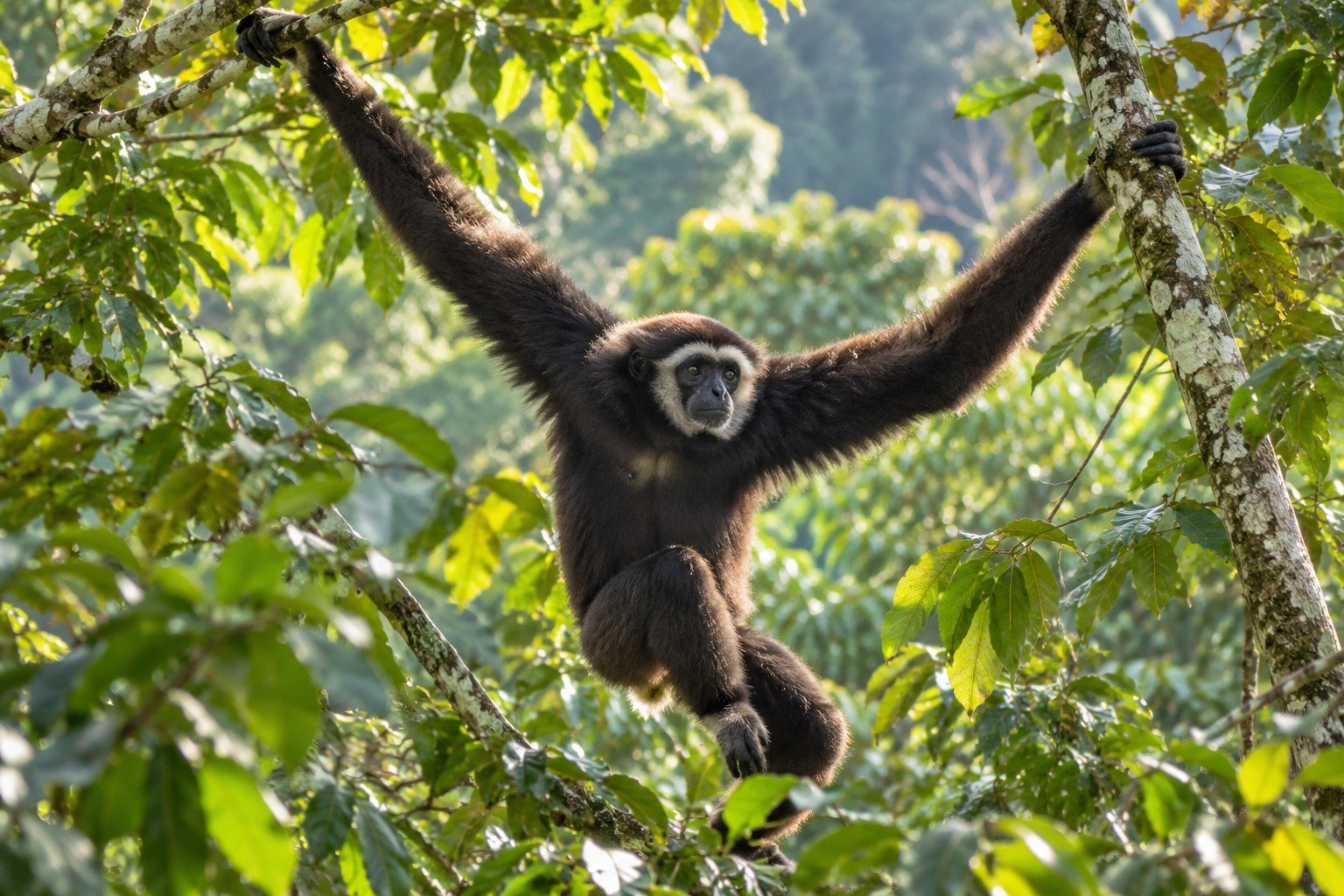
The western hoolock gibbon (Hoolock hoolock) is India's only ape, an Endangered tree-dweller of the Northeast that seldom touches the ground. In Assam's Hollongapar Gibbon Sanctuary a railway line splits its forest, so canopy bridges are built to let family groups cross. Rope bridges over the line, whose first gibbon crossing was reported in May 2026, are in the news.
Syllabus: Prelims · Environment & Ecology; GS3 · Infrastructure; GS3 · Environment & Conservation
Why this matters for UPSC
GS3 conservation and infrastructure: Prelims asks a species' IUCN status, Schedule and range, and where Hollongapar Gibbon Sanctuary lies; Mains asks how railways and roads can cross protected areas without breaking habitat connectivity.
In short
The western hoolock gibbon (Hoolock hoolock) is India's only ape, an Endangered canopy-dweller of the Northeast whose survival turns on unbroken tree cover that railways and roads can sever.
Canopy bridges buy time, but only moving the line and rejoining forests can keep Hollongapar's gibbons genetically viable as rail traffic grows.
Why it matters
A gibbon family that cannot reach its neighbours cannot find mates outside its own small group. Over generations that means weaker, inbred young and, in the end, empty trees. Hollongapar shows the problem at its sharpest: a forest smaller than many towns, an old railway through it, and wires that now carry power above the track. The same choice faces every new highway, power line and railway built through India's forests. Planning a crossing before the trees are cut costs far less than trying to stitch a canopy back together afterwards, and a sanctuary that keeps its apes also keeps the seed-dispersing service that renews the forest for nearby villages.
Prelims pointers
- Hoolock hoolock: India's only ape; IUCN Red List status Endangered; family Hylobatidae, the gibbons, with 20 species.
- Range: Northeast India south and east of the Brahmaputra, plus Bangladesh and Myanmar; the eastern hoolock is Hoolock leuconedys.
- Hollongapar Gibbon Sanctuary: Jorhat district, Assam; 20.98 sq km; notified on 30 July 1997; semi-evergreen forest with evergreen patches.
- Hollongapar's primates: hoolock gibbon, capped langur, slow loris, and Assamese, rhesus, pig-tailed and stump-tailed macaques.
- Wild Life (Protection) Amendment Act, 2022: cut the schedules to four; Schedule III covers specified plants, Schedule IV CITES-listed specimens.
- Section 9 of the amended Act bars hunting of animals in Schedules I and II; section 6A provides for the Board's Standing Committee.
- Eco-friendly Measures to Mitigate Impacts of Linear Infrastructure on Wildlife (2016): WII's guide, funded by NHAI and the World Bank, with an MoEFCC technical advisory panel.
Practise a UPSC-style question
With reference to the hoolock gibbon in India, consider the following statements:
1. It is the only ape species found in India and belongs to the family Hylobatidae.
2. A 2021 genetic study led by CSIR-CCMB, Hyderabad found two separate hoolock gibbon species in India.
3. The western hoolock gibbon is listed as Endangered on the IUCN Red List.
Which of the statements given above is/are correct?
- (a) 1 and 2 only
- (b) 2 and 3 only
- (c) 1 and 3 only
- (d) 1, 2 and 3
Show the answer
Answer: (c) 1 and 3 only
Answer: (c) 1 and 3 only. The 2021 study found one species in India, not two.
Statement 1: correct. Hoolock hoolock is India's only ape and its only gibbon, of the family Hylobatidae.
Statement 2: incorrect. The CCMB study found no genetic difference between Hoolock hoolock and the Lohit-Dibang population once called eastern hoolock, so India has one species.
Statement 3: correct. The IUCN Red List places the western hoolock gibbon in the Endangered category.
Eliminate: statement 2 is wrong, since the study's whole finding was a single species. Out: (a), (b), (d).
Trap: Near-miss figure. The statement keeps the right lab and year but flips the count of species from one to two, the number earlier reports gave.
Remember: CCMB 2021 genetics: one hoolock species in India, Hoolock hoolock.
More Explainers
- State Legislative Councils: Articles 168-172 and the graduates' and teachers' seats Polity
- Whales and dolphins in Indian waters: legal protection, IUCN status and strandings Environment
- The Aligarh Movement, AMU and the Article 30 minority test Polity
- Environmental clearance by States: SEIAA, SEAC and the EIA Notification, 2006 Environment
- Software vulnerabilities: CVE, CVSS, coordinated disclosure and CERT-In's role Sci-Tech
- Drug trafficking law in India: NDPS Act, PIT-NDPS, NCB and NCORD National
- Choosing the UN Secretary-General: Article 97, UNSC veto and straw polls World & IR
- UN Convention against Torture, and why India has not ratified it Polity
- NavIC: why India's navigation constellation cannot give a standalone position Sci-Tech
- International Energy Agency: membership, 90-day oil stocks and India's status World & IR
- PM Surya Ghar: Muft Bijli Yojana and the rooftop solar subsidy Economy
- HFSS foods: FSSAI's draft limits and front-of-pack warning labels National