
Western Ghats Ecologically Sensitive Area: Gadgil, Kasturirangan and the draft
Why in news: Planters' bodies renewed objections in October 2026 to the Centre's seventh draft Western Ghats ESA notification, issued on 27 July 2026.
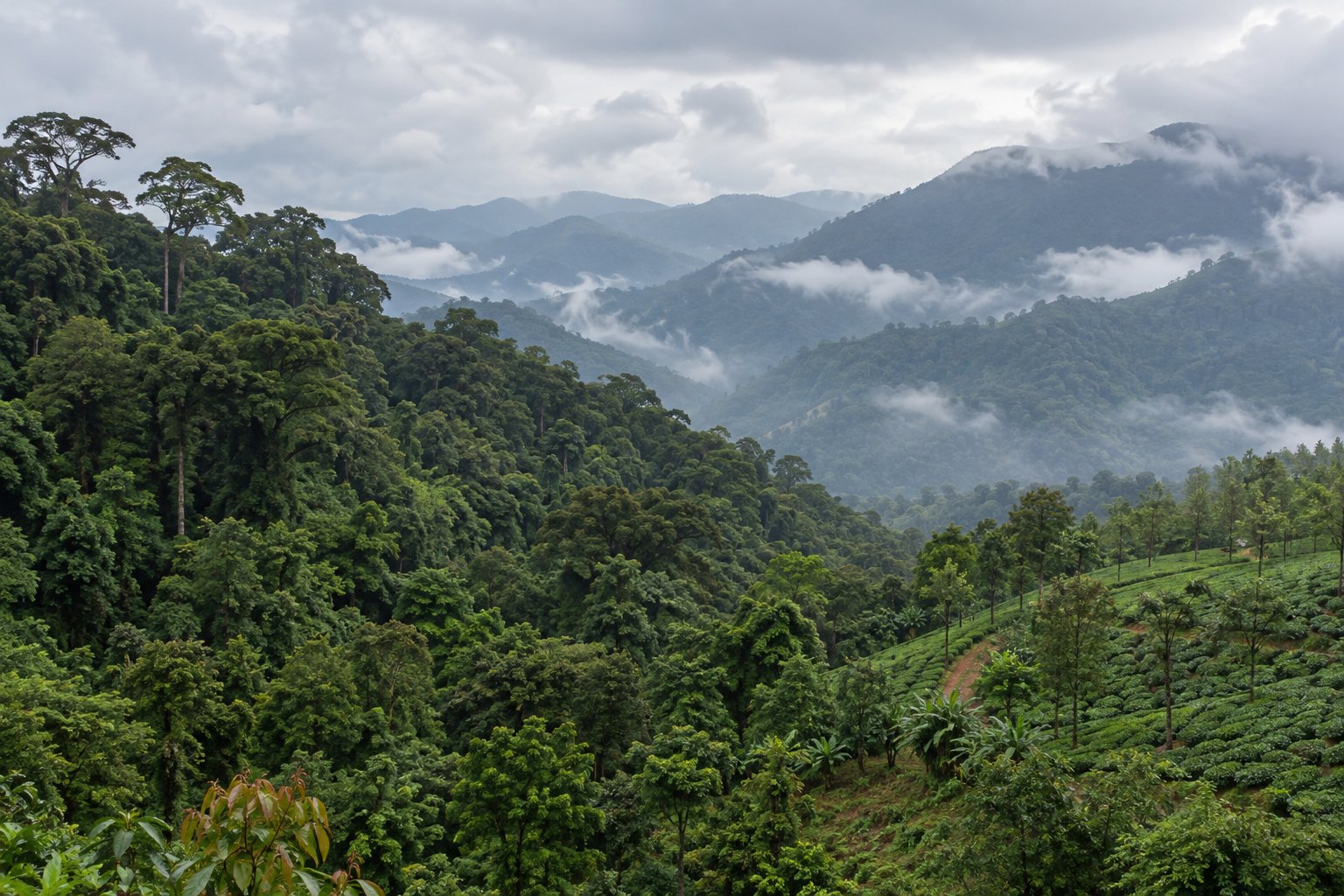
An Ecologically Sensitive Area (ESA) is land where the Union government bans or regulates mining, polluting industry and large construction to protect fragile ecology. For the Western Ghats, the Gadgil panel (2011) and the Kasturirangan group (2013) proposed limits, and drafts have lapsed since 2014. The seventh draft, now facing planters' objections, proposes 56,825.7 sq km across six States.
Syllabus: GS2 · Federalism & Local Government; Prelims · Geography; Prelims · Environment & Ecology
Why this matters for UPSC
GS3 conservation and GS1 geography: Prelims can ask what an Ecologically Sensitive Area bans, which Act it rests on and how the Gadgil and Kasturirangan reports differ; GS3 Mains, about balancing conservation with livelihoods.
In short
An Ecologically Sensitive Area (ESA) is land where the Centre bans or regulates harmful activities under the Environment (Protection) Act, 1986; in the Ghats, it pits conservation against livelihoods.
Ground-checked boundaries that spare farms and villages but hold firm on mines and polluters can end the stalemate dating from 2014.
Why it matters
About 50 million people live in the Western Ghats, the 2018 draft notification said, and an ESA decides what may be built around them. A village inside it could keep farming and repairing houses, but could not host a new quarry, a thermal power plant, a polluting red-category factory or a large township. Planters and State governments therefore push to keep populated land and plantations out. On the other side, the range feeds peninsular India's major rivers, and quarrying and construction on its steep slopes raise the risk of landslides. The larger question is how to protect a biodiversity hotspot while protecting livelihoods, and who decides land use when the Centre and the States disagree.
Prelims pointers
- Environment (Protection) Act, 1986: Section 3 empowers the Central Government to restrict the areas where industries, operations or processes may be carried out; ESAs rest on it.
- Gadgil panel = Western Ghats Ecology Expert Panel (WGEEP), report 2011; Kasturirangan panel = High-Level Working Group (HLWG), report 2013.
- Gadgil: whole range ecologically sensitive in three zones, gram sabhas central. Kasturirangan: about 37% (59,940 sq km) as ESA. Drafts follow Kasturirangan.
- Western Ghats States: Gujarat, Maharashtra, Goa, Karnataka, Kerala and Tamil Nadu; Karnataka has the largest proposed ESA share, Gujarat the smallest.
- Western Ghats: UNESCO World Heritage Site (natural) since 2012; part of the Western Ghats and Sri Lanka biodiversity hotspot.
- The range runs about 1,500 km from the Tapti river to Kanyakumari; the Godavari, Krishna and Cauvery rise in it.
- Red category: the most polluting industries in the Pollution Control Boards' classification; orange and white categories are less polluting.
- National Green Tribunal: set up under the National Green Tribunal Act, 2010; in 2014 it was hearing a Goa Foundation petition on the Western Ghats, pending since 2012.
Practise a UPSC-style question
With reference to the Western Ghats Ecology Expert Panel, consider the following statements:
1. It was set up by the Union environment ministry and headed by ecologist Madhav Gadgil.
2. It graded the Western Ghats into four Ecologically Sensitive Zones according to their level of sensitivity.
Which of the statements given above is/are correct?
- (a) 1 only
- (b) 2 only
- (c) Both 1 and 2
- (d) Neither 1 nor 2
Show the answer
Answer: (a) 1 only
1 is correct: the environment ministry set up the panel in 2010 under Madhav Gadgil; it reported in 2011. 2 is incorrect: it used three Ecologically Sensitive Zones (ESZ 1, 2 and 3), not four, and treated the whole range as sensitive.
More Explainers
- State Legislative Councils: Articles 168-172 and the graduates' and teachers' seats Polity
- Whales and dolphins in Indian waters: legal protection, IUCN status and strandings Environment
- The Aligarh Movement, AMU and the Article 30 minority test Polity
- Environmental clearance by States: SEIAA, SEAC and the EIA Notification, 2006 Environment
- Software vulnerabilities: CVE, CVSS, coordinated disclosure and CERT-In's role Sci-Tech
- Drug trafficking law in India: NDPS Act, PIT-NDPS, NCB and NCORD National
- Choosing the UN Secretary-General: Article 97, UNSC veto and straw polls World & IR
- UN Convention against Torture, and why India has not ratified it Polity
- NavIC: why India's navigation constellation cannot give a standalone position Sci-Tech
- International Energy Agency: membership, 90-day oil stocks and India's status World & IR
- PM Surya Ghar: Muft Bijli Yojana and the rooftop solar subsidy Economy
- HFSS foods: FSSAI's draft limits and front-of-pack warning labels National