
Waste to Wealth: circular economy in urban solid waste management
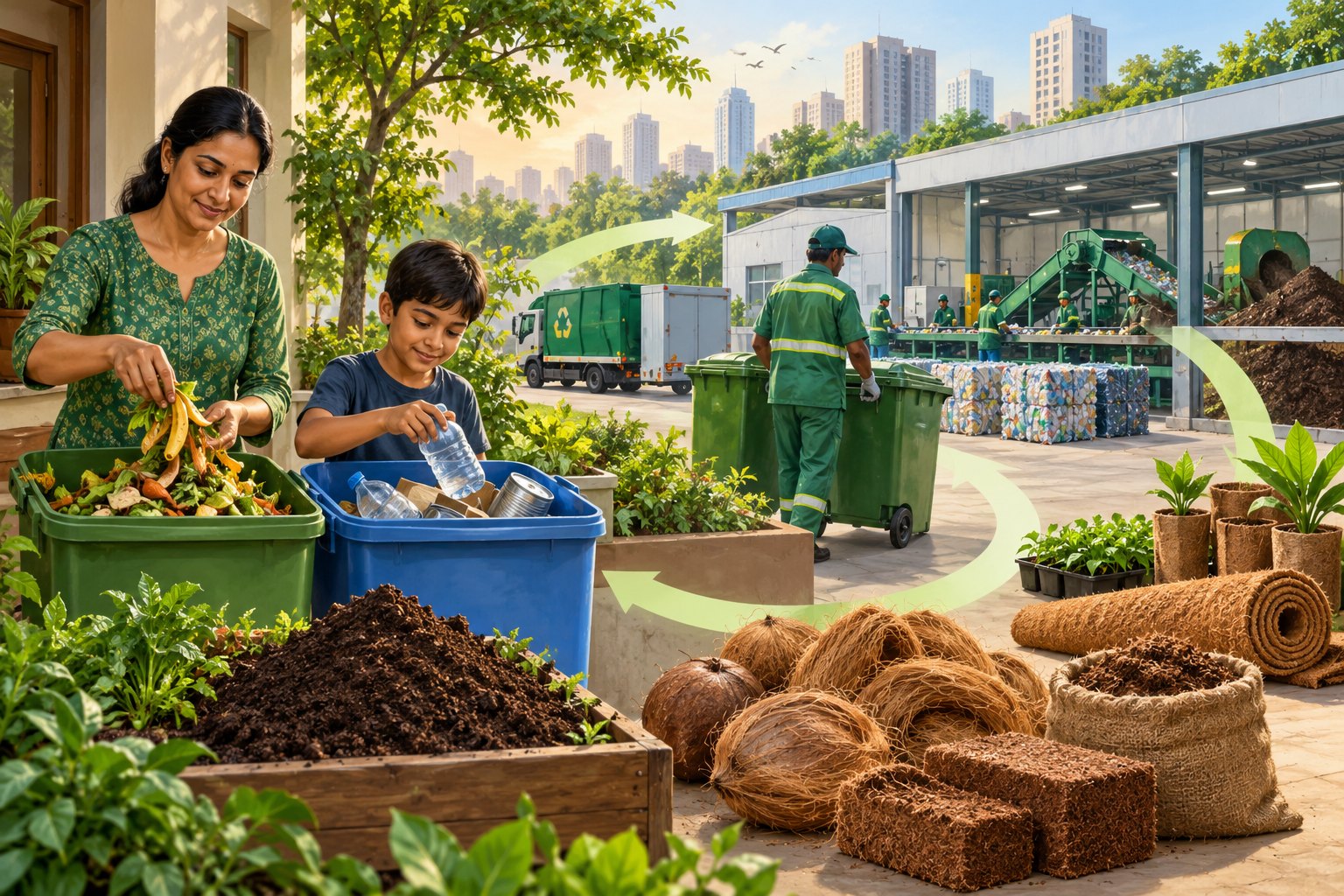
Waste to Wealth treats discarded material as a resource, turning kitchen scraps into compost and coconut husk into coir and cocopeat. Under Swachh Bharat Mission-Urban 2.0, cities are pushed to segregate waste at source, process it and recover value, so less reaches landfills. On 1 October 2026 the government profiled projects in Patna, Chandigarh and Assam.
Syllabus: Prelims · Environment & Ecology; GS2 · Government Policies; GS3 · Environment & Conservation
In short
Waste to Wealth treats discards as resources to recover, reuse or remake, applying the circular economy to urban solid waste under Swachh Bharat Mission-Urban 2.0.
Waste to Wealth succeeds only when segregation becomes a household habit, enforcement reaches bulk generators and recovered compost, coir and recyclables find buyers.
Why it matters
A household that composts its kitchen waste sends less to the city dump and gets free manure for its plants. Across a city, that means fewer garbage trucks, slower-filling landfills and less wet waste rotting without air into methane, a strong greenhouse gas, or seeping out as leachate that fouls groundwater. Waste can also pay: the government says women in Borchila village in Assam earn at least ₹10,000 a month from water hyacinth crafts, and Patna's plant turns coconut husks into compost, coir and cocopeat. Segregation decides all of this, because mixed waste can be neither composted nor recycled well. The larger issue is resource efficiency in growing cities that are short of land for dumps.
Prelims pointers
- Solid Waste Management Rules, 2026: notified by the Ministry of Environment, Forest and Climate Change under the Environment (Protection) Act, 1986.
- Four streams: wet (composted or bio-methanated), dry (to Material Recovery Facilities), sanitary (wrapped separately), special care (paint cans, bulbs, mercury thermometers, medicines).
- Extended Bulk Waste Generator Responsibility: bulk waste generators process wet waste on site where they can, or obtain an EBWGR certificate.
- Refuse-derived fuel: shredded, dried high-calorific waste such as non-recyclable plastic, paper and textiles; cement and waste-to-energy plants must substitute it for part of their solid fuel.
- Extended Producer Responsibility makes producers answer for their products or packaging after use; it underpins the Plastic Waste Management Rules, 2016 and the e-waste rules.
- Swachh Bharat Mission-Urban 2.0: Ministry of Housing and Urban Affairs; Swachh Bharat Mission (Grameen): Department of Drinking Water and Sanitation, Ministry of Jal Shakti.
- Water hyacinth (Eichhornia crassipes): free-floating invasive plant native to the Amazon basin of South America; it thrives in nutrient-rich water and cuts light and oxygen.
- Coir Board: statutory body under the Coir Industry Act, 1953, under the Ministry of Micro, Small and Medium Enterprises, headquartered in Kochi.
Practise a UPSC-style question
With reference to the Swachh Bharat Mission, consider the following statements:
1. Swachh Bharat Mission (Grameen) is implemented by the Ministry of Housing and Urban Affairs.
2. Swachh Bharat Mission-Urban 2.0 aims to make cities garbage-free.
3. Remediation of legacy dumpsites is a component of Swachh Bharat Mission-Urban 2.0.
Which of the statements given above is/are correct?
- (a) 1 and 2 only
- (b) 2 and 3 only
- (c) 1 and 3 only
- (d) 1, 2 and 3
Show the answer
Answer: (b) 2 and 3 only
1 is incorrect: Swachh Bharat Mission (Grameen) is run by the Department of Drinking Water and Sanitation in the Ministry of Jal Shakti; the Ministry of Housing and Urban Affairs runs the urban mission. 2 is correct: garbage-free cities are the central goal of SBM-Urban 2.0, launched in October 2021. 3 is correct: the mission covers clearing legacy dumpsites alongside source segregation and scientific processing.
More Explainers
- State Legislative Councils: Articles 168-172 and the graduates' and teachers' seats Polity
- Whales and dolphins in Indian waters: legal protection, IUCN status and strandings Environment
- The Aligarh Movement, AMU and the Article 30 minority test Polity
- Environmental clearance by States: SEIAA, SEAC and the EIA Notification, 2006 Environment
- Software vulnerabilities: CVE, CVSS, coordinated disclosure and CERT-In's role Sci-Tech
- Drug trafficking law in India: NDPS Act, PIT-NDPS, NCB and NCORD National
- Choosing the UN Secretary-General: Article 97, UNSC veto and straw polls World & IR
- UN Convention against Torture, and why India has not ratified it Polity
- NavIC: why India's navigation constellation cannot give a standalone position Sci-Tech
- International Energy Agency: membership, 90-day oil stocks and India's status World & IR
- PM Surya Ghar: Muft Bijli Yojana and the rooftop solar subsidy Economy
- HFSS foods: FSSAI's draft limits and front-of-pack warning labels National