
Transboundary haze and the ASEAN Agreement on Transboundary Haze Pollution
Why in news: On 9 October 2026, haze from Indonesian forest fires closed schools for about two million students in Kuala Lumpur, Putrajaya and five Malaysian states.
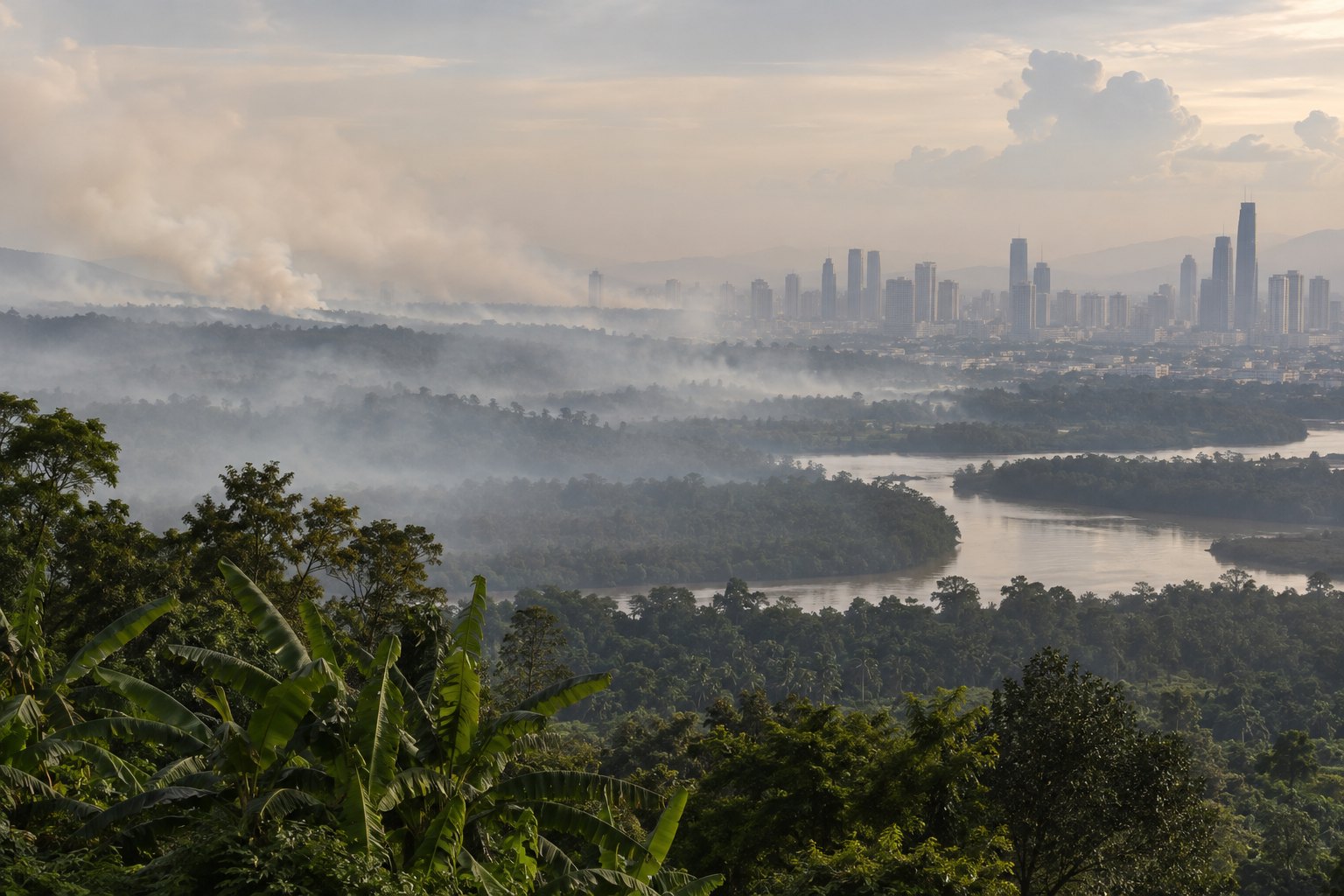
The ASEAN Agreement on Transboundary Haze Pollution, signed in 2002 and in force since 2003, binds ASEAN states to prevent and monitor smoke from land and forest fires that crosses borders. Indonesia, the last member to ratify, joined in 2015. On 9 October 2026, haze from Indonesian fires closed schools in Kuala Lumpur and five Malaysian states.
Syllabus: Prelims · Geography; Prelims · Environment & Ecology; GS3 · Environment & Conservation
In short
Transboundary haze is smoke from land and forest fires that crosses borders; the 2002 ASEAN Agreement binds members to prevent and monitor it through national effort and regional cooperation.
The haze pact has built cooperation but not compliance; until burning stops paying and peat stays wet, each El Niño will test ASEAN's neighbourliness.
Why it matters
A schoolchild in Kuala Lumpur lost classes on 9 October 2026 because of fires burning in Indonesia, where slash-and-burn is often a cheap way to clear land for oil palm. Smoke ignores borders, so one country's land use becomes its neighbours' health bill: Indonesia's Ministry of Health had recorded more than 170,000 respiratory infections by early October. The ASEAN pact shows what a regional treaty can and cannot do. It binds states to share information, warn early and help each other, but the country where the fires burn acts first and disputes end in negotiation. Any region whose air pollution crosses borders faces the same choice between cooperation and enforcement.
Prelims pointers
- AATHP Article 5: sets up the ASEAN Co-ordinating Centre for Transboundary Haze Pollution Control; national authorities act first, the Centre assists on request.
- AATHP Article 27: disputes over the Agreement are settled amicably by consultation or negotiation; it names no international court.
- AATHP Article 3: Parties take precautionary measures against haze even without full scientific certainty.
- Zero burning policy (AATHP Article 1): prohibits open burning but may allow some forms of controlled burning.
- El Niño: unusual warming of the central and eastern equatorial Pacific; it brings drought to Indonesia and worsens its fire seasons.
- Peatland: waterlogged soil of partly decayed plant matter; once drained it dries, catches fire and smoulders below ground, giving dense smoke.
- Borneo is shared by Indonesia (Kalimantan), Malaysia (Sabah and Sarawak) and Brunei; the Strait of Malacca separates Sumatra from the Malay Peninsula.
- ASEAN was founded by the Bangkok Declaration, 1967; under the AATHP a Party is an ASEAN member state bound by the Agreement.
Practise a UPSC-style question
With reference to the ASEAN Agreement on Transboundary Haze Pollution, consider the following statements:
1. It was signed in Kuala Lumpur.
2. Indonesia was the first ASEAN member state to ratify it.
3. The Secretary-General of ASEAN is the depositary of the Agreement.
Which of the statements given above is/are correct?
- (a) 1 and 2 only
- (b) 2 and 3 only
- (c) 1 and 3 only
- (d) 1, 2 and 3
Show the answer
Answer: (c) 1 and 3 only
1 is correct: the ten ASEAN governments signed it in Kuala Lumpur, Malaysia. 2 is incorrect: Indonesia was the last member to ratify, depositing its instrument in 2015, after which all members were parties. 3 is correct: Article 31 deposits the Agreement with the Secretary-General of ASEAN.
More Explainers
- State Legislative Councils: Articles 168-172 and the graduates' and teachers' seats Polity
- Whales and dolphins in Indian waters: legal protection, IUCN status and strandings Environment
- The Aligarh Movement, AMU and the Article 30 minority test Polity
- Environmental clearance by States: SEIAA, SEAC and the EIA Notification, 2006 Environment
- Software vulnerabilities: CVE, CVSS, coordinated disclosure and CERT-In's role Sci-Tech
- Drug trafficking law in India: NDPS Act, PIT-NDPS, NCB and NCORD National
- Choosing the UN Secretary-General: Article 97, UNSC veto and straw polls World & IR
- UN Convention against Torture, and why India has not ratified it Polity
- NavIC: why India's navigation constellation cannot give a standalone position Sci-Tech
- International Energy Agency: membership, 90-day oil stocks and India's status World & IR
- PM Surya Ghar: Muft Bijli Yojana and the rooftop solar subsidy Economy
- HFSS foods: FSSAI's draft limits and front-of-pack warning labels National