
Traditional Knowledge Digital Library (TKDL) and the fight against biopiracy
Why in news: Nalanda University and CSIR's TKDL Unit signed an MoU on 1 October 2026 for research and training on traditional knowledge and IPR, the government said.
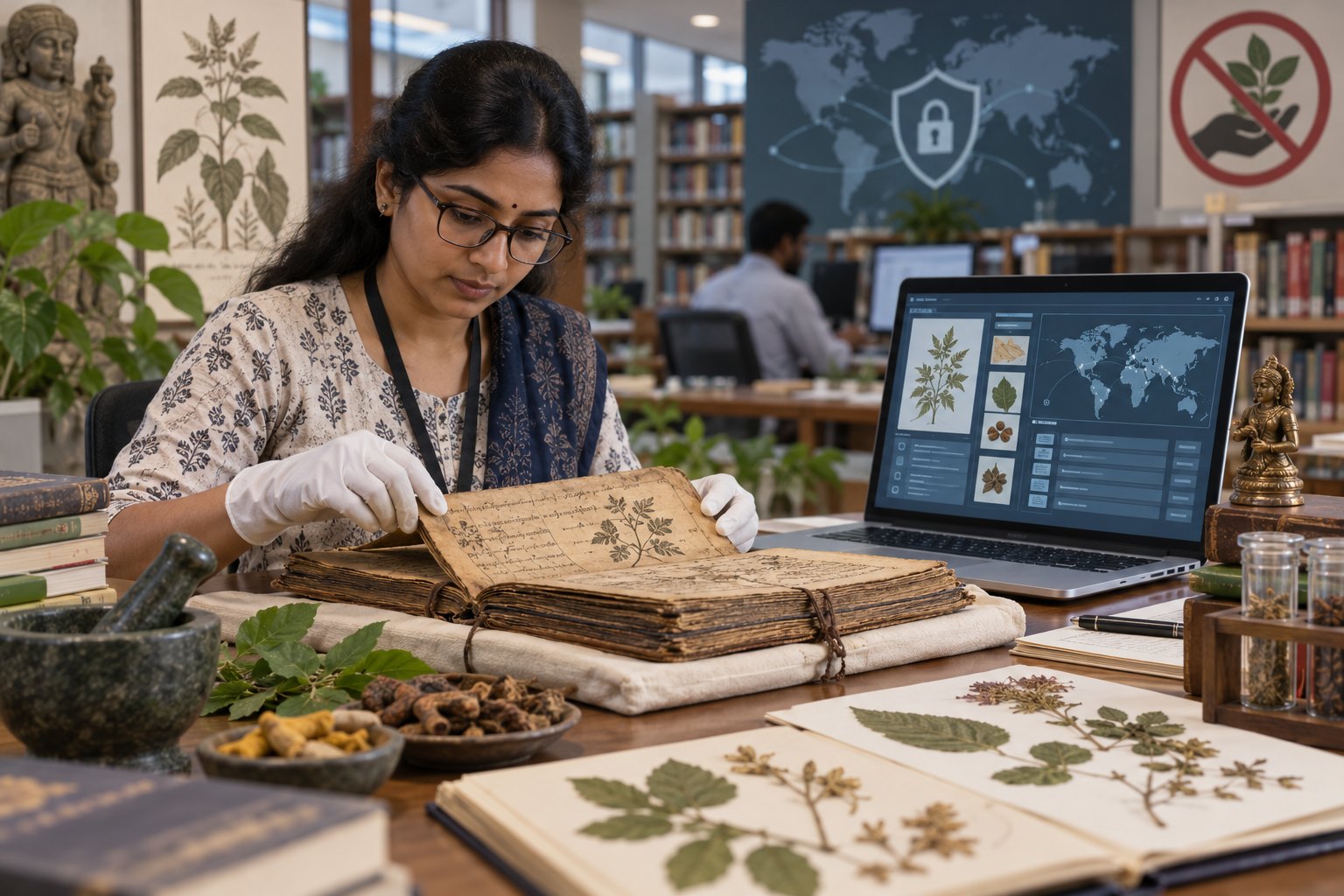
The Traditional Knowledge Digital Library (TKDL), set up in 2001 by CSIR and what is now the Ministry of AYUSH, renders India's traditional medicine and Yoga texts in five languages so patent examiners abroad can cite them as prior art and refuse wrong patents. Nalanda University signed an MoU with its CSIR unit on 1 October 2026.
Syllabus: GS1 · Art & Culture; Prelims · Current Affairs & IR; GS3 · IT, Space, Biotech & IPR
In short
Biopiracy is patenting a community's knowledge without its consent or a fair share; the Traditional Knowledge Digital Library (TKDL) fights it by supplying patent examiners with prior art.
TKDL has made wrong patents harder to obtain; fairness now needs positive rights and benefit sharing for the communities whose knowledge it guards.
Why it matters
A firm that patents a turmeric paste abroad could block Indian makers from selling a similar remedy in that market, or charge them licence fees, for knowledge Indian households have used for centuries. Undoing such a patent after grant is slow and costly: getting a few claims of the basmati patent revoked cost India's Agricultural and Processed Food Products Export Development Authority about Rs 7 crore in legal fees, by TKDL's own account. The library moves the fight to the examiner's desk, before a patent is granted, at little cost. The larger question is fairness in the global patent system: who owns knowledge no single inventor created, and whether the communities that hold it share in the gains.
Prelims pointers
- TKDL: a CSIR database of Indian traditional medicine and Yoga, set up in 2001; a defensive-protection tool that gives patent examiners prior art.
- Patents Act, 1970, Section 3(p): an invention that is in effect traditional knowledge, or an aggregation or duplication of its known properties, is not an invention.
- Patents Act, 1970, Section 25: anticipation by knowledge, oral or otherwise, within any local or indigenous community in India or elsewhere is a ground of opposition.
- WIPO Treaty on Intellectual Property, Genetic Resources and Associated Traditional Knowledge: adopted in Geneva on 24 May 2024; patent applicants must disclose the origin of such resources and knowledge.
- The 2024 WIPO treaty enters into force three months after 15 eligible parties ratify or accede; it is WIPO's first treaty with provisions for Indigenous Peoples and local communities.
- Biological Diversity Act, 2002: set up the National Biodiversity Authority, headquartered in Chennai, to regulate access to biological resources and benefit sharing.
- Nagoya Protocol (2010): the supplementary agreement to the Convention on Biological Diversity on access to genetic resources and fair sharing of benefits.
- Sowa Rigpa: the Himalayan (Amchi) system of medicine, practised in regions such as Ladakh, Sikkim and Himachal Pradesh; covered by TKDL.
Practise a UPSC-style question
With reference to the Traditional Knowledge Digital Library (TKDL), consider the following statements:
1. It was set up by the Indian Council of Medical Research together with the Department of Science and Technology.
2. It renders traditional texts in international languages so that patent examiners can use them as prior art.
3. Foreign patent offices are given access to it under non-disclosure agreements.
Which of the statements given above is/are correct?
- (a) 1 and 2 only
- (b) 2 and 3 only
- (c) 1 and 3 only
- (d) 1, 2 and 3
Show the answer
Answer: (b) 2 and 3 only
1 is incorrect: TKDL was set up in 2001 by the Council of Scientific and Industrial Research (CSIR) with the Department of Indian Systems of Medicine and Homoeopathy, now the Ministry of AYUSH. 2 is correct: it presents the texts in English, German, French, Japanese and Spanish, in modern terms, for patent examiners. 3 is correct: patent offices use it under non-disclosure agreements, for search and examination only.
More Explainers
- State Legislative Councils: Articles 168-172 and the graduates' and teachers' seats Polity
- Whales and dolphins in Indian waters: legal protection, IUCN status and strandings Environment
- The Aligarh Movement, AMU and the Article 30 minority test Polity
- Environmental clearance by States: SEIAA, SEAC and the EIA Notification, 2006 Environment
- Software vulnerabilities: CVE, CVSS, coordinated disclosure and CERT-In's role Sci-Tech
- Drug trafficking law in India: NDPS Act, PIT-NDPS, NCB and NCORD National
- Choosing the UN Secretary-General: Article 97, UNSC veto and straw polls World & IR
- UN Convention against Torture, and why India has not ratified it Polity
- NavIC: why India's navigation constellation cannot give a standalone position Sci-Tech
- International Energy Agency: membership, 90-day oil stocks and India's status World & IR
- PM Surya Ghar: Muft Bijli Yojana and the rooftop solar subsidy Economy
- HFSS foods: FSSAI's draft limits and front-of-pack warning labels National