
Topological qubits and Majorana zero modes, with India's National Quantum Mission
Why in news: On 22 September 2026, Microsoft said it had opened its Majorana 2 topological-qubit chip to independent testing by the US agency DARPA.
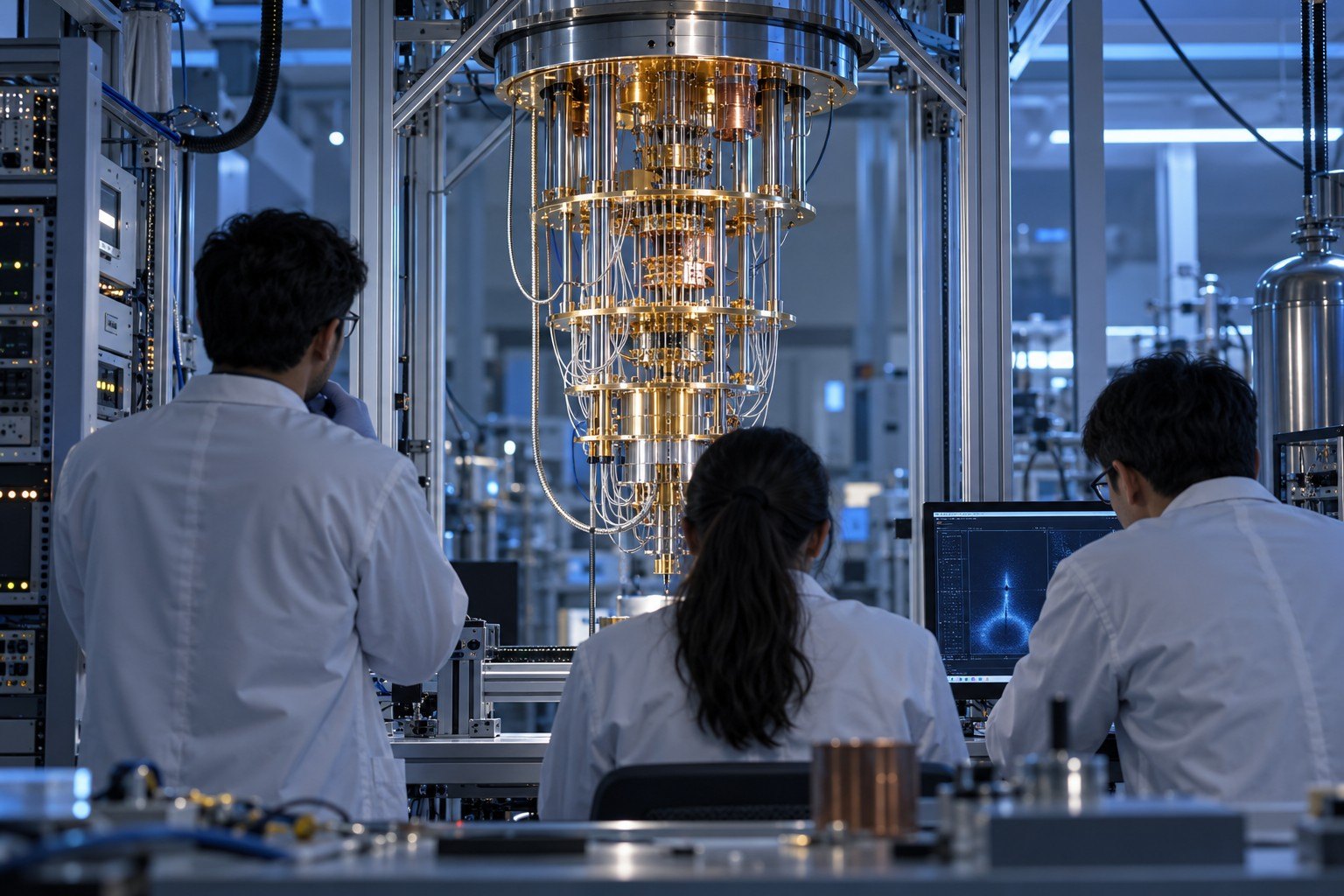
A topological qubit is meant to store quantum information in pairs of Majorana zero modes at the ends of superconducting nanowires, shielding it from local noise. India's National Quantum Mission backs research on topological materials but targets other qubit types. Microsoft says its Majorana 2 chip, opened to DARPA testing in September 2026, uses such qubits; none is independently confirmed.
Syllabus: GS3 · Science & Technology; GS3 · Indian Achievements in S&T; GS3 · IT, Space, Biotech & IPR
Why this matters for UPSC
GS Paper III, science and technology (computers, indigenisation of technology). Prelims can ask how qubit platforms and Majorana zero modes work and the National Quantum Mission's department, period and hubs; Mains, about funding unproven frontier technology.
In short
A topological qubit stores quantum information non-locally, in the shared parity of paired Majorana zero modes, to resist local noise; none has yet been independently confirmed.
Topology promises error protection built into hardware; until independent tests confirm it, India is wise to spread its quantum bets across platforms.
Why it matters
A drug designer hoping to simulate molecules on a quantum computer is really waiting for error control: today's qubits are so easily disturbed by their surroundings that many must be spent checking one another. If topological qubits work, that protection would come from the hardware itself, and useful machines could be smaller and arrive sooner. If they do not, the money and talent spent chasing them are lost. For India the question is practical: the National Quantum Mission must decide where limited funds and researchers go, and its computing targets rest on other qubit types. Reading a company's claim against peer review protects policymakers, investors and students from betting on hype.
Prelims pointers
- Main qubit platforms: superconducting circuits, electron spins, trapped ions, neutral atoms, photons and topological qubits; superconducting devices are the most commercially advanced.
- Trapped ions are confined by electric fields and have shown the best-quality logic gates; neutral atoms are held by optical tweezers but have lower gate accuracy.
- Photons are 'flying qubits' suited to quantum networks; photon loss is the main limit on scaling them.
- Majorana particle: predicted by Italian physicist Ettore Majorana in 1937 as a fermion that is its own antiparticle; never confirmed as an elementary particle.
- Non-Abelian anyons are neither bosons nor fermions; fractional quantum Hall states, chiefly the 5/2 state, are the only natural states thought to host them.
- National Quantum Mission: approved by the Union Cabinet on 19 April 2023 with Rs 6,003.65 crore for 2023-24 to 2030-31; implemented by the Department of Science and Technology.
- NQM computing targets: 20-50 physical qubits in 3 years, 50-100 in 5 and 50-1,000 in 8, on platforms like superconducting and photonic.
- NQM Thematic Hubs: computing at IISc Bengaluru, communication at IIT Madras with C-DOT, sensing and metrology at IIT Bombay, materials and devices at IIT Delhi.
Practise a UPSC-style question
With reference to qubit technologies, consider the following statements:
1. Neutral-atom qubits are held in place by electric fields, in the same way as trapped-ion qubits.
2. Superconducting qubits need Josephson junctions, and the transmon has been the most successful type among them.
Which of the statements given above is/are correct?
- (a) 1 only
- (b) 2 only
- (c) Both 1 and 2
- (d) Neither 1 nor 2
Show the answer
Answer: (b) 2 only
Answer: (b) 2 only. Neutral atoms are held by optical tweezers, not the electric-field traps used for ions; the superconducting statement is accurate.
Statement 1: incorrect. Neutral atoms carry no charge, so they are held by focused light beams called optical tweezers; electric fields trap charged ions.
Statement 2: correct. A superconducting qubit needs cold circuits, superconducting material and Josephson junctions; the transmon has been its most successful form.
Eliminate: Judge statement 1 first: an uncharged atom cannot be trapped electrically the way an ion is, so statement 1 is incorrect. Out: (a), (c).
Eliminate: Judge statement 2: Josephson junctions isolate the 0 and 1 states of a superconducting qubit, so it is correct. Out: (d).
Trap: Swapped attribution. The trapping method of ions is pinned on neutral atoms, two laser-controlled platforms that are easy to confuse.
Remember: Ions: electric-field traps, best gates. Neutral atoms: optical tweezers. Superconducting: Josephson junctions, transmon.
More Explainers
- State Legislative Councils: Articles 168-172 and the graduates' and teachers' seats Polity
- Whales and dolphins in Indian waters: legal protection, IUCN status and strandings Environment
- The Aligarh Movement, AMU and the Article 30 minority test Polity
- Environmental clearance by States: SEIAA, SEAC and the EIA Notification, 2006 Environment
- Software vulnerabilities: CVE, CVSS, coordinated disclosure and CERT-In's role Sci-Tech
- Drug trafficking law in India: NDPS Act, PIT-NDPS, NCB and NCORD National
- Choosing the UN Secretary-General: Article 97, UNSC veto and straw polls World & IR
- UN Convention against Torture, and why India has not ratified it Polity
- NavIC: why India's navigation constellation cannot give a standalone position Sci-Tech
- International Energy Agency: membership, 90-day oil stocks and India's status World & IR
- PM Surya Ghar: Muft Bijli Yojana and the rooftop solar subsidy Economy
- HFSS foods: FSSAI's draft limits and front-of-pack warning labels National