
Thorium and India's three-stage nuclear power programme
Why in news: On 15 October 2026, US firm Clean Core Thorium Energy said its thorium-based ANEEL fuel cracked less than uranium oxide in US laboratory tests.
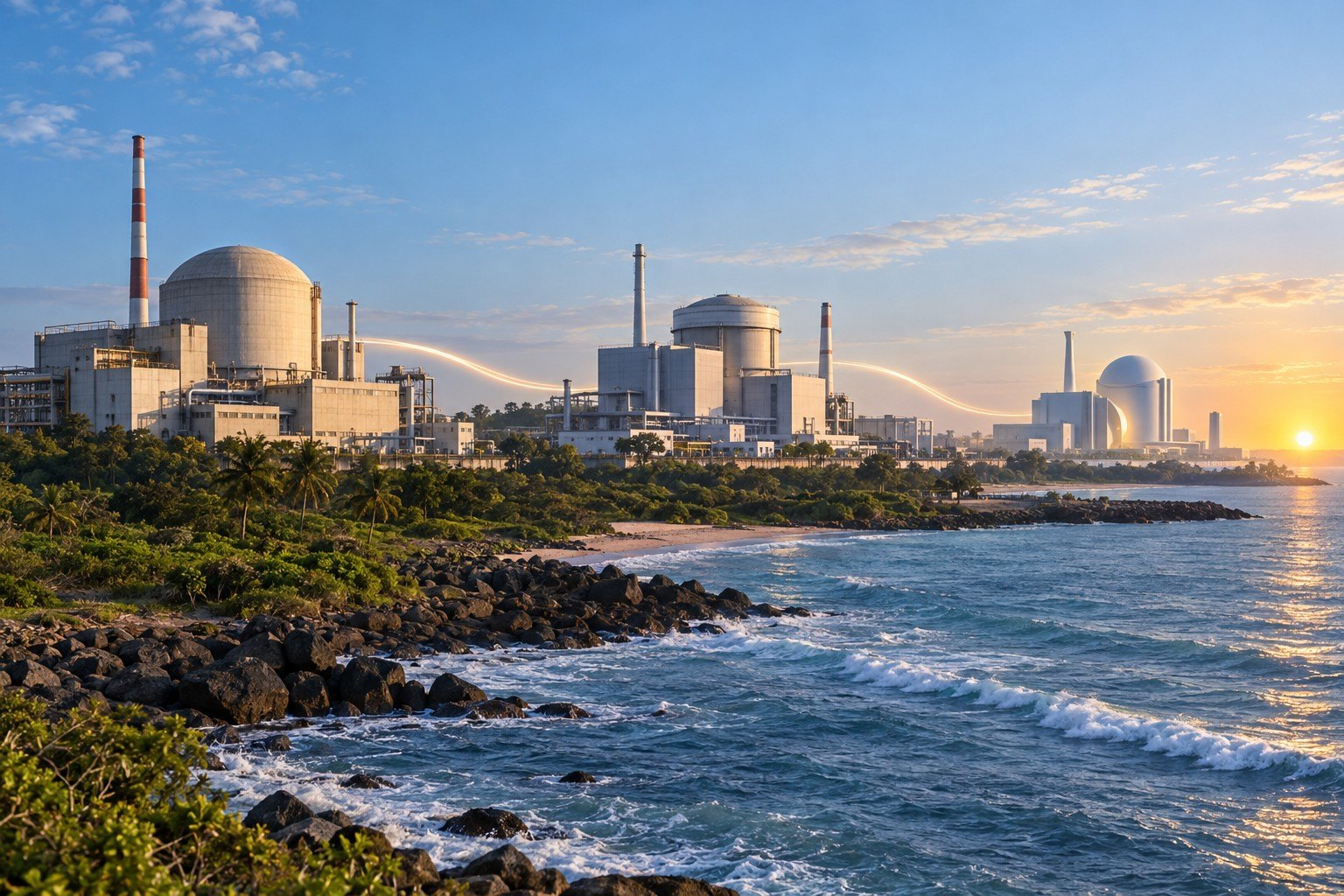
India's three-stage nuclear power programme moves from natural-uranium heavy water reactors to plutonium-fuelled fast breeders and finally to thorium reactors, because India has little uranium but vast thorium. The Kalpakkam fast breeder reached first criticality on 6 April 2026. A US firm now says its thorium fuel outperformed uranium oxide in laboratory tests.
Syllabus: Prelims · Science & Technology; GS3 · Infrastructure; GS3 · Science & Technology
Why this matters for UPSC
GS3 energy and science and technology: Prelims asks how PHWRs, fast breeders and the AHWR work and why thorium is fertile, not fissile; Mains asks whether thorium can secure India's energy future.
In short
India's three-stage nuclear power programme, conceived by Homi Bhabha, uses a closed fuel cycle to stretch scarce uranium into plutonium and then unlock the country's large thorium reserves.
With the PFBR critical, India must now prove breeding at scale and keep thorium reprocessing on schedule, so its thorium reserves become power, not promise.
Why it matters
Electricity in India still comes mostly from coal, and nuclear plants supply power round the clock with low lifecycle carbon emissions. A household or a factory gains if more of that steady power can come from fuel India digs up itself rather than imports. Thorium offers that: the DAE calls it a practically inexhaustible source, sitting in beach sands of the south and east, but only breeder reactors can make the fissile fuel that unlocks it. Every delay in the breeders delays thorium. The larger question is energy security: whether India can meet rising demand and its net zero goal for 2070 without depending on imported uranium.
Prelims pointers
- Bharat Small Reactors are 220 MW pressurised heavy water reactors adapted as captive power plants near industries such as steel and aluminium; NPCIL handles their design and operation.
- Once fully operational, the PFBR will make India only the second country after Russia to operate a commercial fast breeder reactor.
- Thorium is three to four times more abundant than uranium in nature, per the IAEA; thorium-232 absorbs thermal neutrons about three times more than uranium-238.
- Advanced Heavy Water Reactor: 300 MWe, vertical pressure tubes, cooled by boiling light water and moderated by heavy water; fuel is thorium-based MOX.
- Atomic Minerals Directorate for Exploration and Research, a DAE unit, explores monazite; monazite is a prescribed substance because it carries thorium and uranium.
- KAMINI, a 30 kWt research reactor, runs on uranium-233 recovered from thorium irradiated in research reactors of BARC.
Practise a UPSC-style question
With reference to the Prototype Fast Breeder Reactor (PFBR) at Kalpakkam, consider the following statements:
1. A blanket of uranium-233 surrounds its core and breeds plutonium-239.
2. Its uranium-plutonium mixed oxide fuel uses plutonium recovered from the spent fuel of pressurised heavy water reactors.
Which of the statements given above is/are correct?
- (a) 1 only
- (b) 2 only
- (c) Both 1 and 2
- (d) Neither 1 nor 2
Show the answer
Answer: (b) 2 only
Answer: (b) 2 only. The PFBR's blanket is uranium-238, not uranium-233; its MOX fuel recycles PHWR plutonium.
Statement 1: incorrect. The PFBR core is surrounded by a blanket of uranium-238, which fast neutrons convert into fissile plutonium-239 (DAE, April 2026).
Statement 2: correct. The PFBR burns uranium-plutonium mixed oxide fuel whose plutonium comes from reprocessed spent fuel of stage-one PHWRs.
Eliminate: Statement 1 is wrong because uranium-233 is a fissile fuel, not the fertile blanket material. Out: (a), (c).
Eliminate: Statement 2 is right, as stage two runs on stage one's plutonium. Out: (d).
Trap: Look-alike names. Uranium-233 and uranium-238 differ by a digit; one is a fuel bred from thorium, the other the fertile blanket.
Remember: PFBR = MOX fuel from PHWR plutonium + uranium-238 blanket; thorium blanket comes later.
More Explainers
- State Legislative Councils: Articles 168-172 and the graduates' and teachers' seats Polity
- Whales and dolphins in Indian waters: legal protection, IUCN status and strandings Environment
- The Aligarh Movement, AMU and the Article 30 minority test Polity
- Environmental clearance by States: SEIAA, SEAC and the EIA Notification, 2006 Environment
- Software vulnerabilities: CVE, CVSS, coordinated disclosure and CERT-In's role Sci-Tech
- Drug trafficking law in India: NDPS Act, PIT-NDPS, NCB and NCORD National
- Choosing the UN Secretary-General: Article 97, UNSC veto and straw polls World & IR
- UN Convention against Torture, and why India has not ratified it Polity
- NavIC: why India's navigation constellation cannot give a standalone position Sci-Tech
- International Energy Agency: membership, 90-day oil stocks and India's status World & IR
- PM Surya Ghar: Muft Bijli Yojana and the rooftop solar subsidy Economy
- HFSS foods: FSSAI's draft limits and front-of-pack warning labels National