
Teesta river and India-Bangladesh water sharing
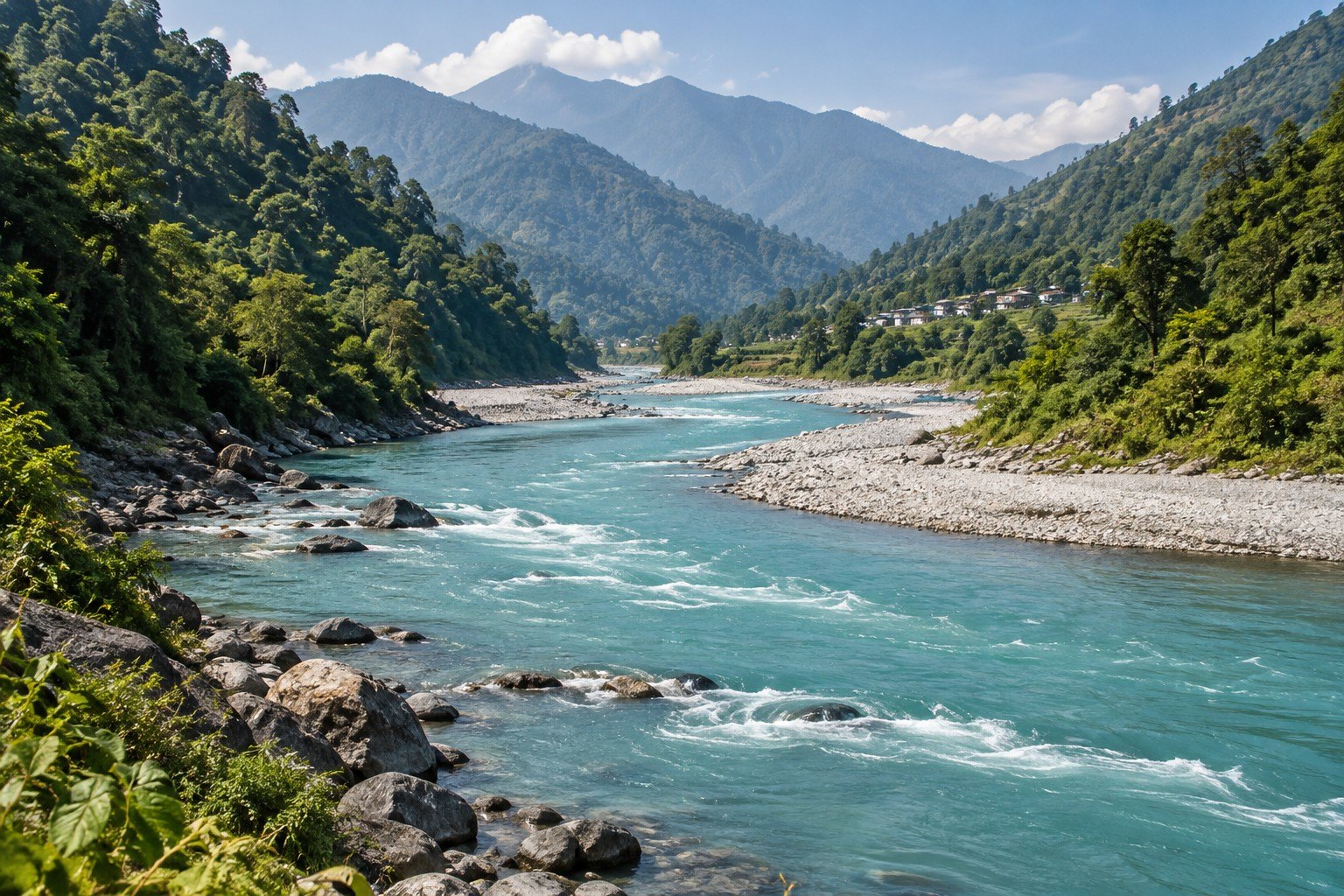
The Teesta rises in north Sikkim, crosses West Bengal and joins the Brahmaputra in Bangladesh. India and Bangladesh agreed a draft interim deal on sharing its lean-season water in January 2011, but it remains unsigned. Bangladesh's May 2026 request for China's support in restoring the river, near the Siliguri Corridor, keeps the issue live.
Syllabus: Prelims · Geography; GS3 · Disaster Management; GS2 · India & its Neighbourhood
Why this matters for UPSC
GS1 geography and GS2 India-Bangladesh relations: Prelims can ask the Teesta's course and tributaries, the Joint Rivers Commission and Entry 17; Mains, about federalism in river treaties and China near the Siliguri Corridor.
In short
The Teesta, a Brahmaputra tributary rising in north Sikkim, crosses West Bengal into Bangladesh; an interim deal to share its lean-season water, drafted in 2011, remains unsigned.
A signed Teesta deal backed by West Bengal, and basin-wide glacier and flood monitoring, would serve farmers on both banks and India's security.
Why it matters
Farming families along the Teesta in northern Bangladesh depend on its water in the dry months, when the river runs thin and fields go unwatered; in the monsoon the same river floods them and eats away their banks. Without a signed deal they have no assured share, and that grievance shapes how Dhaka sees New Delhi. If Bangladesh turns to China to rebuild the river, Chinese engineers and money arrive close to the narrow strip of land that links India to its north-eastern States. Upstream, in Sikkim, glacial lake outburst floods have become a real danger to towns, roads and dams on the same river.
Prelims pointers
- Entry 56 of the Union List lets Parliament bring inter-State rivers and river valleys under Union control to the extent it declares by law to be in the public interest.
- Entry 14 of the Union List covers entering into treaties and agreements with foreign countries and implementing them.
- India's Mahakali Treaty of 1996 with Nepal runs for 75 years; the 1996 Ganga treaty with Bangladesh runs for 30, with a review after five.
- The Teesta's major right-bank tributaries are Zemu Chhu, Rangyong Chhu and the Rangit; its left-bank ones are Lachung Chhu, Chakung Chhu, Dik Chhu, Rani Khola and Rangpo Chhu.
- India and Bangladesh signed a 2019 MoU for India to withdraw 1.82 cusec from the Feni River for drinking water in Sabroom town, Tripura.
- The Central Water Commission, with NRSC Hyderabad, prepared an inventory of Himalayan glacial lakes and water bodies larger than 10 hectares in June 2011.
Practise a UPSC-style question
With reference to the Teesta river, consider the following statements:
1. It rises from glacial sources in north Sikkim.
2. It is a tributary of the Ganga, which it joins near Farakka.
3. It leaves the hills and enters the plains of West Bengal at Sevoke near Siliguri.
Which of the statements given above is/are correct?
- (a) 1 and 2 only
- (b) 2 and 3 only
- (c) 1 and 3 only
- (d) 1, 2 and 3
Show the answer
Answer: (c) 1 and 3 only
Answer: (c) 1 and 3 only. The Teesta is a Brahmaputra tributary, not a Ganga one.
Statement 1: correct. Sikkim's State of Environment report traces the Teesta to Khangchung Chho, a glacial lake below Pauhunri in north-eastern Sikkim.
Statement 2: incorrect. The Teesta flows through Bangladesh to join the Brahmaputra, called the Jamuna there; the Central Water Commission lists it among the Brahmaputra's major tributaries.
Statement 3: correct. After about 40 km of hills below Melli, the river enters the West Bengal plain at Sevoke near Siliguri.
Eliminate: statement 2 pins the Teesta on the wrong main river. Out: (a), (b), (d).
Trap: Swapped attribution. Farakka and the Ganga treaty sit beside the Teesta in every India-Bangladesh water story, so the question hands the Teesta to the wrong main river.
Remember: Teesta: Sikkim glacier, Sevoke plains, Brahmaputra (Jamuna) in Bangladesh.
In the news
More Explainers
- State Legislative Councils: Articles 168-172 and the graduates' and teachers' seats Polity
- Whales and dolphins in Indian waters: legal protection, IUCN status and strandings Environment
- The Aligarh Movement, AMU and the Article 30 minority test Polity
- Environmental clearance by States: SEIAA, SEAC and the EIA Notification, 2006 Environment
- Software vulnerabilities: CVE, CVSS, coordinated disclosure and CERT-In's role Sci-Tech
- Drug trafficking law in India: NDPS Act, PIT-NDPS, NCB and NCORD National
- Choosing the UN Secretary-General: Article 97, UNSC veto and straw polls World & IR
- UN Convention against Torture, and why India has not ratified it Polity
- NavIC: why India's navigation constellation cannot give a standalone position Sci-Tech
- International Energy Agency: membership, 90-day oil stocks and India's status World & IR
- PM Surya Ghar: Muft Bijli Yojana and the rooftop solar subsidy Economy
- HFSS foods: FSSAI's draft limits and front-of-pack warning labels National