
Sustainable Aviation Fuel and ICAO's CORSIA: India's preparation for 2027
Why in news: CORSIA's mandatory phase begins on 1 January 2027, the year of India's indicative 1% SAF blending target for international flights.
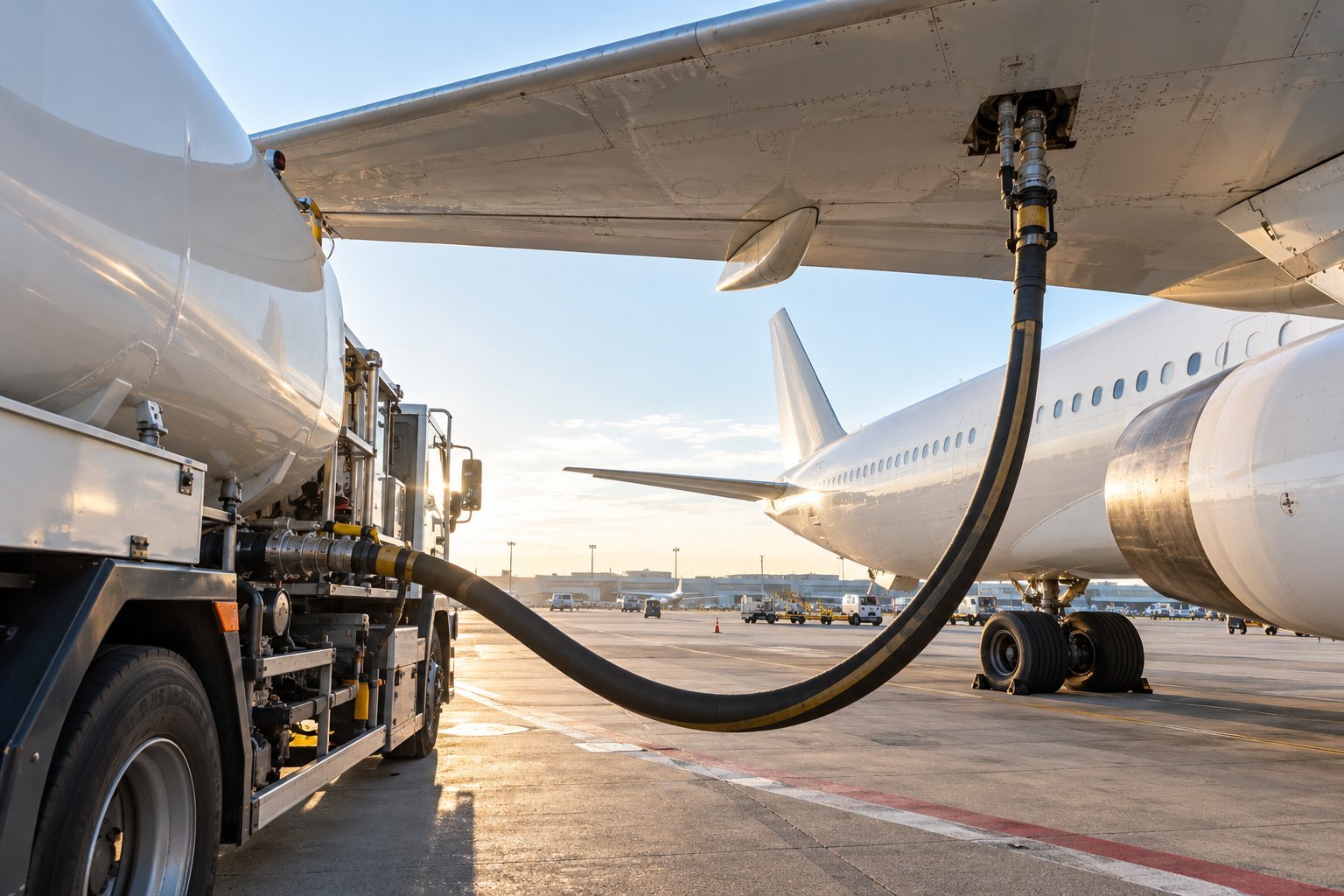
Sustainable Aviation Fuel (SAF) is a renewable jet fuel made from crops, biogenic residues and wastes that blends with Aviation Turbine Fuel (ATF) and cuts greenhouse gas emissions. Under CORSIA, airlines on international routes offset emissions above a baseline, and using eligible SAF lowers that bill. CORSIA's mandatory phase begins on 1 January 2027.
Syllabus: Prelims · Environment & Ecology; GS3 · Infrastructure; GS3 · Environment & Conservation
Why this matters for UPSC
GS3 environment and energy: Prelims can ask SAF pathways, feedstocks and blend limits under ASTM D7566, or CORSIA's phases and baseline; Mains, how India meets ICAO's CORSIA while protecting farm incomes and fares.
In short
Sustainable Aviation Fuel (SAF) is renewable jet fuel from crops, residues and wastes; under ICAO's CORSIA, airlines can use it to shrink the emissions they must offset.
A modest 1% start suits India; notifying the policy, tracing every litre and keeping domestic SAF affordable will decide whether CORSIA becomes cost or opportunity.
Why it matters
A passenger flying abroad from India from 2027 rides on an airline that must pay for emissions above a fixed line, either by buying credits or by burning cleaner fuel. If India makes enough SAF at home, that money stays in the country and flows to farmers selling molasses and crop residue, instead of to carbon-credit sellers abroad. If it does not, airlines face a recurring offset bill that can show up in ticket prices. The larger question is how a fast-growing aviation market cuts its emissions without making flying a luxury again.
Prelims pointers
- ASTM D7566: the standard for aviation turbine fuel containing synthesized hydrocarbons; it lists approved SAF pathways with blend limits from 10% to 50%.
- HEFA-SPK (ASTM D7566 Annex A2, 2011): hydroprocesses plant oils, animal fats and waste greases; 50% blend limit.
- Fischer-Tropsch SPK (Annex A1, 2009): gasifies municipal solid waste, farm and forest waste into syngas, then synthesises jet fuel; 50% blend limit.
- HFS-SIP (Annex A3, 2014): microbes convert sugars into hydrocarbons; blends are capped at 10%.
- ASTM D1655 allows fats, oils and greases, or Fischer-Tropsch biocrude, to be co-processed with petroleum in a refinery up to 5%.
- IS 1571 is the Indian specification ATF must meet; IS 17081 is the one SAF must meet before blending.
- 41st ICAO Assembly: CORSIA's Individual Growth Factor cut to 0% (from 20%) for 2030-32 and to 15% (from 70%) for 2033-35.
- The National Biofuels Coordination Committee, chaired by the Union Petroleum Minister, also set India's Compressed Bio-Gas Blending Obligation.
Practise a UPSC-style question
With reference to ICAO's Carbon Offsetting and Reduction Scheme for International Aviation (CORSIA), consider the following statements:
1. India took part in the voluntary pilot phase of CORSIA from 2021 to 2023.
2. Its pilot and first phases were voluntary, while its phase from 2027 to 2035 is mandatory.
3. Its baseline was revised by the ICAO Assembly to 85% of 2019 emissions.
Which of the statements given above is/are correct?
- (a) 1 and 2 only
- (b) 2 and 3 only
- (c) 1 and 3 only
- (d) 1, 2 and 3
Show the answer
Answer: (b) 2 and 3 only
Answer: (b) 2 and 3 only. India stayed out of both voluntary phases; the other two statements hold.
Statement 1: incorrect. The Government of India decided not to join CORSIA's voluntary phases, so offsetting for Indian carriers starts in 2027.
Statement 2: correct. The pilot (2021-23) and first phase (2024-26) are voluntary; the second phase, 2027-35, is mandatory.
Statement 3: correct. The 41st ICAO Assembly revised CORSIA's baseline to 85% of 2019 emissions.
Eliminate: Statement 1 is wrong, since India skipped the voluntary phases. Out: (a), (c), (d).
Trap: Wrong scope. The question counts on a student assuming every large aviation market joined CORSIA from its first year.
Remember: CORSIA voluntary till 2026, mandatory 2027-35; India joins at the mandatory phase.
More Explainers
- State Legislative Councils: Articles 168-172 and the graduates' and teachers' seats Polity
- Whales and dolphins in Indian waters: legal protection, IUCN status and strandings Environment
- The Aligarh Movement, AMU and the Article 30 minority test Polity
- Environmental clearance by States: SEIAA, SEAC and the EIA Notification, 2006 Environment
- Software vulnerabilities: CVE, CVSS, coordinated disclosure and CERT-In's role Sci-Tech
- Drug trafficking law in India: NDPS Act, PIT-NDPS, NCB and NCORD National
- Choosing the UN Secretary-General: Article 97, UNSC veto and straw polls World & IR
- UN Convention against Torture, and why India has not ratified it Polity
- NavIC: why India's navigation constellation cannot give a standalone position Sci-Tech
- International Energy Agency: membership, 90-day oil stocks and India's status World & IR
- PM Surya Ghar: Muft Bijli Yojana and the rooftop solar subsidy Economy
- HFSS foods: FSSAI's draft limits and front-of-pack warning labels National