
Subterranean fishes of India: from Kerala's aquifers to Assam's wells
Why in news: A 19 October 2026 report profiled two blind fishes described this year from wells in Assam's Goalpara district: Gitchak nakana and Rakthamichthys anchi.
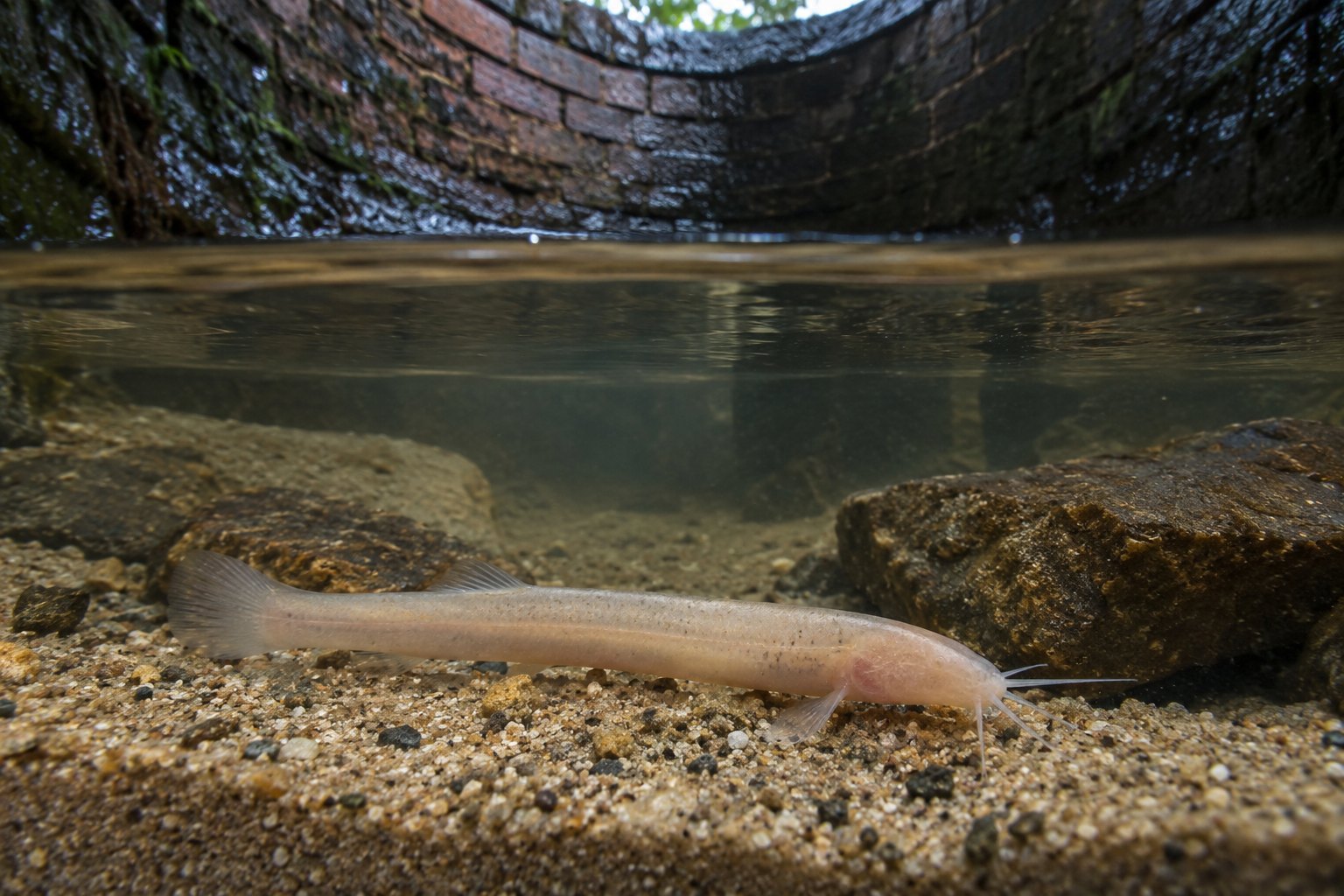
Subterranean fishes live in permanent darkness in caves or groundwater aquifers, often eyeless and without pigment. India has 21 known species, mainly in Kerala's lateritic aquifers and Meghalaya's limestone caves, a 2026 study counts. Two blind species from wells in Assam's Goalpara district, a loach and a swamp eel, now show alluvial aquifers host them too.
Syllabus: Prelims · Current Affairs & IR
Why this matters for UPSC
GS III biodiversity and GS I groundwater resources: Prelims can ask what phreatobitic and stygobitic mean and where India's subterranean fishes live; Mains, how over-extraction and pollution threaten aquifers as living ecosystems.
In short
Subterranean fishes are species adapted to permanent darkness in water-filled caves or groundwater aquifers; aquifer dwellers, called phreatobitic fishes, are the rarest and hardest to find.
India's subterranean fishes make aquifers living ecosystems; groundwater governance must protect their water quality and habitat, not merely ration the water drawn.
Why it matters
Households in Kerala and Assam draw drinking and household water from the very wells these fishes surface in, so fish and family share one supply. A blind fish turning up in a well signals clean water, researchers say, yet many residents panic, kill it or pour chlorine into the well. When groundwater is over-pumped or polluted by sewage and farm chemicals, these species can vanish before anyone names them, because each lives in so small an area. Protecting them means treating aquifers as habitats, which also protects drinking water.
Prelims pointers
- Neolissochilus pnar, described in 2023 from caves of Meghalaya, is the world's largest known subterranean fish.
- Horaglanis catfishes are endemic to Kerala south of the Palghat Gap, a biogeographic barrier in the Western Ghats.
- Pangio bhujia, a Kerala eel loach described in 2019, lacks a dorsal fin, unique among the more than 4,600 Cypriniformes species.
- Gangaichthys indonepalicus, from borewells in Bihar's Pashchim Champaran district, is the first subterranean member of the earthworm eel family Chaudhuriidae.
- China and Brazil together hold almost half of the world's subterranean fish species.
- The Central Ground Water Board, set up in 1970, works under the Ministry of Jal Shakti's Department of Water Resources.
- The Zoological Survey of India grew out of the Zoological Section of the Indian Museum, Calcutta, founded in 1875.
Practise a UPSC-style question
With reference to subterranean fishes in India, consider the following statements:
1. Subterranean fishes of Meghalaya live mainly in basalt lava tubes on the Shillong Plateau.
2. Subterranean fishes of Kerala live mainly in lateritic aquifers reached through dug-out homestead wells.
3. Neolissochilus pnar, described from caves of Meghalaya, is the world's largest known subterranean fish.
Which of the statements given above is/are correct?
- (a) 1 and 2 only
- (b) 2 and 3 only
- (c) 1 and 3 only
- (d) 1, 2 and 3
Show the answer
Answer: (b) 2 and 3 only
Answer: (b) 2 and 3 only. Meghalaya's subterranean fishes live in limestone caves, which rules out statement 1.
Statement 1: incorrect. Limestone caves are the main habitat of Meghalaya's six subterranean fish species, per the 2026 Scientific Reports study.
Statement 2: correct. Kerala's 13 subterranean species are confined to lateritic aquifers, a habitat globally unusual for fishes, met in homestead wells.
Statement 3: correct. Neolissochilus pnar, described in 2023 from Meghalaya's caves, is the world's largest known subterranean fish.
Eliminate: Judge statement 1 first: Meghalaya's fishes live in limestone caves, so statement 1 is incorrect. Out: (a), (c), (d).
Trap: Swapped attribution. The right region is paired with a rock type it is not known for, while the other two statements stay exact.
Remember: Kerala, lateritic aquifers; Meghalaya, limestone caves; Assam, alluvial aquifers.
More Explainers
- State Legislative Councils: Articles 168-172 and the graduates' and teachers' seats Polity
- Whales and dolphins in Indian waters: legal protection, IUCN status and strandings Environment
- The Aligarh Movement, AMU and the Article 30 minority test Polity
- Environmental clearance by States: SEIAA, SEAC and the EIA Notification, 2006 Environment
- Software vulnerabilities: CVE, CVSS, coordinated disclosure and CERT-In's role Sci-Tech
- Drug trafficking law in India: NDPS Act, PIT-NDPS, NCB and NCORD National
- Choosing the UN Secretary-General: Article 97, UNSC veto and straw polls World & IR
- UN Convention against Torture, and why India has not ratified it Polity
- NavIC: why India's navigation constellation cannot give a standalone position Sci-Tech
- International Energy Agency: membership, 90-day oil stocks and India's status World & IR
- PM Surya Ghar: Muft Bijli Yojana and the rooftop solar subsidy Economy
- HFSS foods: FSSAI's draft limits and front-of-pack warning labels National