
State of the World's Forests: FAO's flagship report on restoration
Why in news: FAO launched The State of the World's Forests 2026, on forest and landscape restoration, on 28 September 2026 at COFO 28 in Rome.
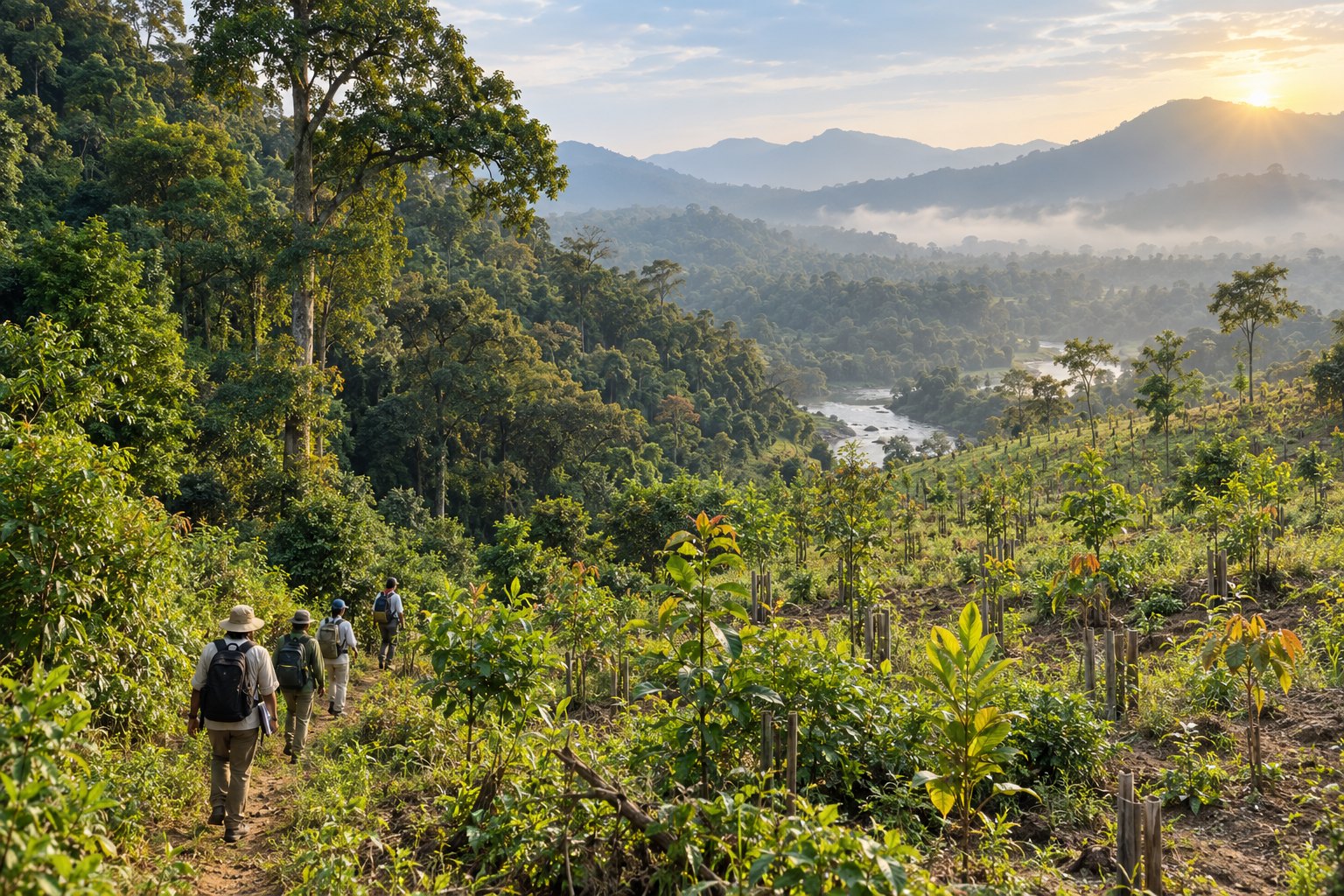
The State of the World's Forests (SOFO) is the Food and Agriculture Organization's flagship forest report, issued every two years with one theme per edition. Its 2026 edition, launched in Rome on 28 September at the Committee on Forestry, counts 1.56 billion hectares of degraded land and sets out four pathways to scale up forest and landscape restoration.
Syllabus: Prelims · Environment & Ecology; GS3 · Environment & Conservation; GS2 · International Institutions
Why this matters for UPSC
GS3 environment and conservation, and GS2 international institutions: Prelims can ask who publishes SOFO, how often, its theme and FAO's forest definition; Mains, on restoration finance, land degradation and community rights.
In short
The State of the World's Forests (SOFO) is the Food and Agriculture Organization's flagship biennial report; each edition takes one theme, and the 2026 edition examines forest and landscape restoration.
Restoration pays only if pledges become hectares on the ground; rights, steady finance and coherent law must move together before 2030.
Why it matters
A farmer in a dry district, a family that gathers fruit and fuelwood, a town that drinks from a forested watershed: all depend on land that is slowly wearing out. When forests are cut or degraded, soils erode, springs dry up, pollinators vanish and crops fail more often. Restoring that land brings back water, soil and income, and creates rural jobs. SOFO matters because it sets out what degradation costs and what restoration returns. Its message is that restoration is not charity for nature but an investment that protects harvests and incomes. Its warning is that pledges on paper are not trees in the ground, and that badly designed restoration can deepen inequality instead of easing it.
Prelims pointers
- COFO reports to the FAO Council on programme and budget matters and to the FAO Conference on policy and regulatory matters.
- FAO forest definition: land over 0.5 hectares with trees taller than 5 metres and canopy cover above 10 percent, or trees able to reach these in situ.
- Land predominantly under agricultural or urban use is not forest in FAO's definition, even with tree cover; agroforestry counts as other land with tree cover.
- Other wooded land (FAO): trees over 5 metres with 5-10 percent canopy cover, or shrubs, bushes and trees together above 10 percent.
- COFO: set up by the FAO Conference in 1971 as a committee of the FAO Council; open to all FAO Member Nations; usually meets every two years.
- Global Forest Resources Assessment 2025: 54 percent of forest area lies in five countries, Russia, Brazil, Canada, the United States and China.
- Agroforestry, per FRA 2025: India and Indonesia hold about 70 percent of the 55.4 million hectares reported worldwide.
- UN Decade on Ecosystem Restoration: proclaimed by the UN General Assembly in a 2019 resolution; led by UNEP and FAO.
Practise a UPSC-style question
With reference to forest reports of the Food and Agriculture Organization (FAO), consider the following statements:
1. The State of the World's Forests is published every two years, and each edition takes a single theme.
2. The Global Forest Resources Assessment is produced every five years from data reported by countries.
Which of the statements given above is/are correct?
- (a) 1 only
- (b) 2 only
- (c) Both 1 and 2
- (d) Neither 1 nor 2
Show the answer
Answer: (c) Both 1 and 2
Answer: (c) Both 1 and 2. FAO runs two forest series: a biennial thematic report and a five-yearly data assessment.
Statement 1: correct. FAO calls SOFO its biennial flagship forest report; the 2024 edition took forest-sector innovation and the 2026 edition forest and landscape restoration.
Statement 2: correct. The Global Forest Resources Assessment comes out every five years and is built on data that countries collect and report under standard definitions.
Eliminate: Statement 1 is correct, as SOFO's every-two-years cycle is its best-known feature. Out: (b), (d).
Eliminate: Statement 2 is correct, the assessment being five-yearly. Out: (a).
Trap: Look-alike names. Two FAO forest publications with different cycles are easy to mix up; a student who swaps the two-year and five-year cycles rejects a true statement.
Remember: SOFO every two years with a theme; FRA every five years with the data.
More Explainers
- State Legislative Councils: Articles 168-172 and the graduates' and teachers' seats Polity
- Whales and dolphins in Indian waters: legal protection, IUCN status and strandings Environment
- The Aligarh Movement, AMU and the Article 30 minority test Polity
- Environmental clearance by States: SEIAA, SEAC and the EIA Notification, 2006 Environment
- Software vulnerabilities: CVE, CVSS, coordinated disclosure and CERT-In's role Sci-Tech
- Drug trafficking law in India: NDPS Act, PIT-NDPS, NCB and NCORD National
- Choosing the UN Secretary-General: Article 97, UNSC veto and straw polls World & IR
- UN Convention against Torture, and why India has not ratified it Polity
- NavIC: why India's navigation constellation cannot give a standalone position Sci-Tech
- International Energy Agency: membership, 90-day oil stocks and India's status World & IR
- PM Surya Ghar: Muft Bijli Yojana and the rooftop solar subsidy Economy
- HFSS foods: FSSAI's draft limits and front-of-pack warning labels National