
Solar cell technologies and India's solar manufacturing chain
Why in news: On 16 October 2026 China proposed adding 12 solar-manufacturing technologies to its export-control catalogue; public consultation runs until 15 November.
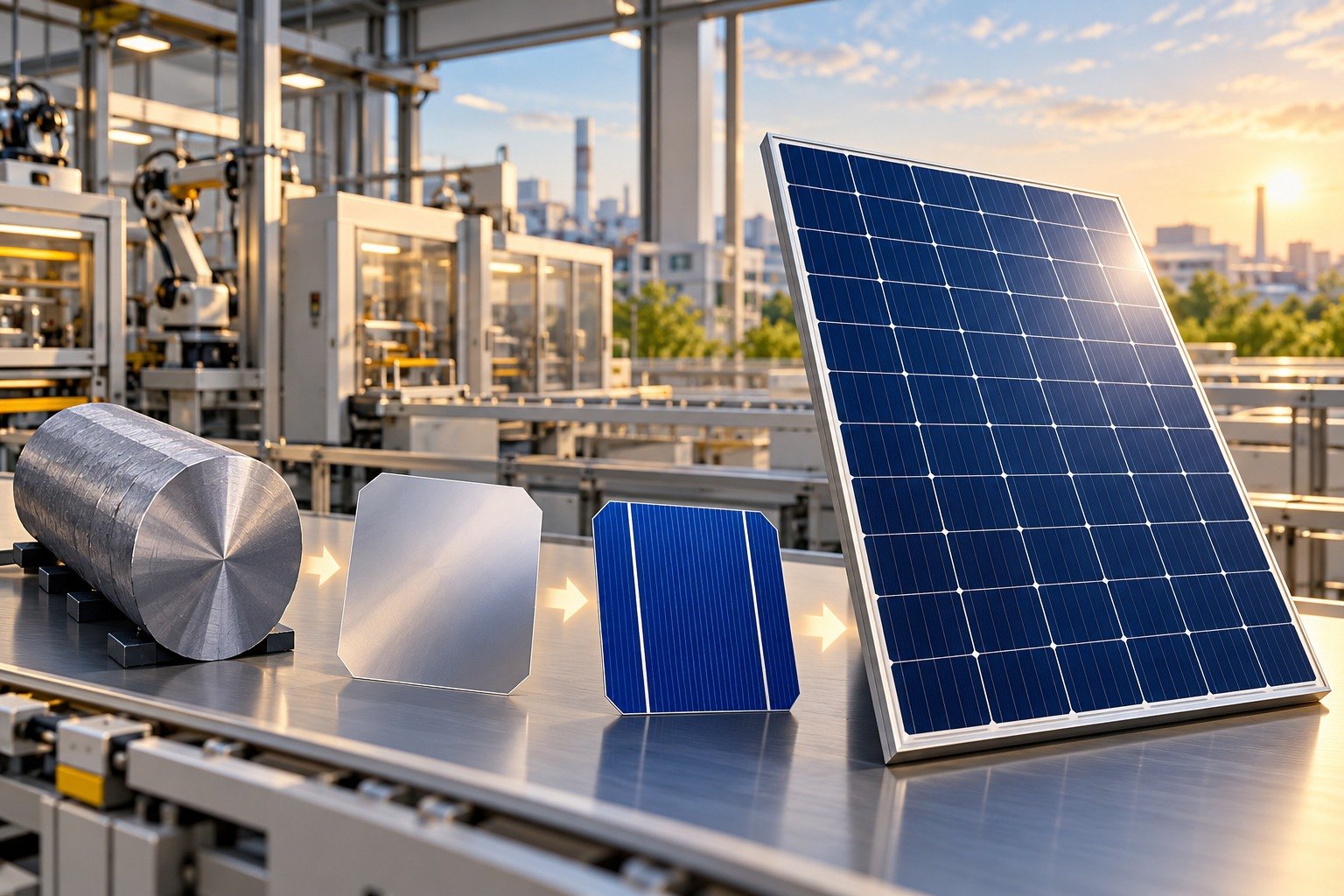
Solar photovoltaic manufacturing runs in four stages: polysilicon is refined, grown into ingots and sliced into wafers, made into cells and assembled into modules. The Ministry of New and Renewable Energy lists approved modules in ALMM List-I and cells in List-II. China's 16 October 2026 draft would curb exports of key cell and polysilicon technologies.
Syllabus: GS3 · Liberalisation & Industry; GS3 · Infrastructure; GS3 · Indian Achievements in S&T
Why this matters for UPSC
GS3 infrastructure (energy) and indigenisation of technology: Prelims can ask what PERC, TOPCon, heterojunction and tandem cells are, and what ALMM List-I and List-II cover; Mains, about self-reliance in the solar chain and the PLI Scheme.
In short
Solar photovoltaic manufacturing turns refined silicon into power-generating modules through four linked stages; India now assembles modules at scale but still depends on imports for cells and upstream inputs.
India's module boom becomes self-reliance only when cells, wafers and polysilicon follow; the cell mandate needs matching upstream investment and home-grown cell technology.
Why it matters
Every subsidised rooftop panel and every solar project that sells power to a government buyer must use listed modules, and from June 2026 listed cells too. That protects buyers of an asset meant to last 25 years and pulls factories and jobs into India. But the country makes far more modules than cells, so, as Mercom's chief executive put it, compliant panels have become scarcer and dearer and some projects are slowing. Below the cell, wafers and polysilicon come largely from China, which leads every stage worldwide. If Beijing withholds the know-how to build those factories, India's push to make the whole chain at home gets slower and costlier, and that touches energy security and the 500 GW non-fossil target for 2030.
Prelims pointers
- MNRE issued the ALMM Order on 2 January 2019; the first List-I (modules) came on 10 March 2021 and the first List-II (cells) on 31 July 2025.
- ALMM List-I modules are compulsory in projects selling power to Government under section 63 of the Electricity Act, 2003.
- PLI Tranche-I: Cabinet approval 7 April 2021, Rs 4,500 crore, implemented by IREDA; Tranche-II: Cabinet approval 21 September 2022, Rs 19,500 crore, implemented by SECI.
- The solar PLI Scheme is technology agnostic but rewards better module performance and promotes integrated plants and local sourcing of material.
- Crystalline silicon modules made up over 95% of global production and cadmium telluride thin film the rest, per the IEA's 2022 report.
- Cadmium telluride (CdTe) thin-film modules use no polysilicon: thin layers are deposited on a substrate, usually glass.
- NCPRE, the National Centre for Photovoltaic Research and Education, was launched at IIT Bombay in 2010 with MNRE funding.
Practise a UPSC-style question
With reference to the Approved List of Models and Manufacturers (ALMM) for solar photovoltaics in India, consider the following statements:
1. ALMM List-I specifies models and manufacturers of solar PV modules, and List-II those of solar PV cells.
2. The ALMM Order, 2019 was issued by the Ministry of Power under the Electricity Act, 2003.
Which of the statements given above is/are correct?
- (a) 1 only
- (b) 2 only
- (c) Both 1 and 2
- (d) Neither 1 nor 2
Show the answer
Answer: (a) 1 only
Answer: (a) 1 only. The two lists are described correctly, but the order came from a different ministry.
Statement 1: correct. MNRE's ALMM page says the list has List-I for solar PV modules and List-II for solar PV cells.
Statement 2: incorrect. The Ministry of New and Renewable Energy (MNRE) issued the ALMM Order on 2 January 2019, not the Ministry of Power.
Eliminate: Statement 2 names the wrong ministry, so every option that keeps 2 goes. Out: (b), (c).
Eliminate: Statement 1 matches MNRE's own description of the two lists. Out: (d).
Trap: Swapped attribution. The Ministry of Power runs the electricity sector, so it sounds right as the issuer, but the ALMM is MNRE's instrument.
Remember: ALMM is MNRE's; List-I modules, List-II cells.
In the news
More Explainers
- State Legislative Councils: Articles 168-172 and the graduates' and teachers' seats Polity
- Whales and dolphins in Indian waters: legal protection, IUCN status and strandings Environment
- The Aligarh Movement, AMU and the Article 30 minority test Polity
- Environmental clearance by States: SEIAA, SEAC and the EIA Notification, 2006 Environment
- Software vulnerabilities: CVE, CVSS, coordinated disclosure and CERT-In's role Sci-Tech
- Drug trafficking law in India: NDPS Act, PIT-NDPS, NCB and NCORD National
- Choosing the UN Secretary-General: Article 97, UNSC veto and straw polls World & IR
- UN Convention against Torture, and why India has not ratified it Polity
- NavIC: why India's navigation constellation cannot give a standalone position Sci-Tech
- International Energy Agency: membership, 90-day oil stocks and India's status World & IR
- PM Surya Ghar: Muft Bijli Yojana and the rooftop solar subsidy Economy
- HFSS foods: FSSAI's draft limits and front-of-pack warning labels National