
Sloth bear: the ant-eating bear of the Indian subcontinent
Why in news: An October 2026 species note reports sloth bears in Telangana's Amrabad Tiger Reserve eating shield-tailed snakes this monsoon, possibly a first record.
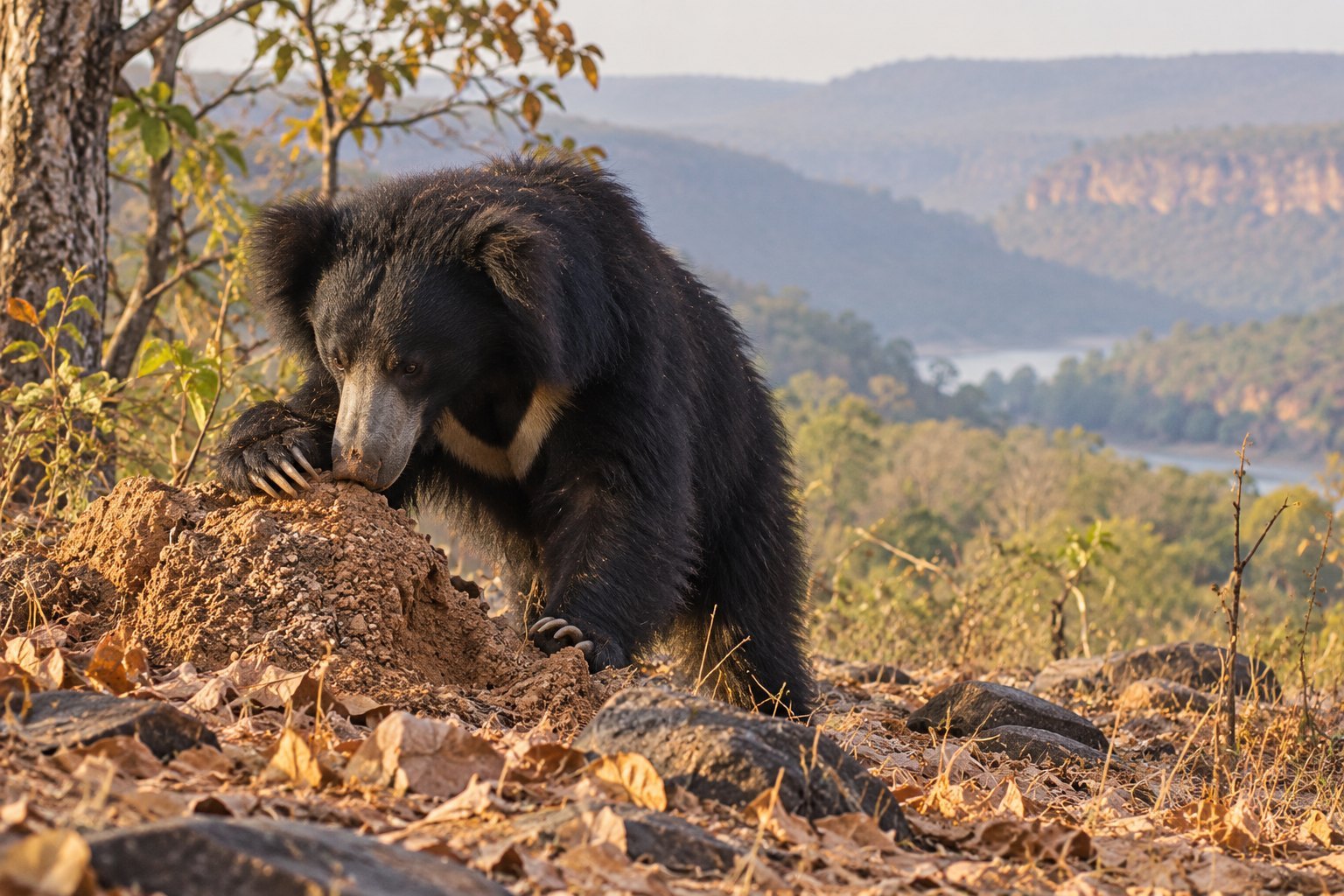
The sloth bear (Melursus ursinus) is a shaggy, mostly nocturnal bear found only on the Indian subcontinent, living chiefly on termites, ants and fruit. It is Vulnerable on the IUCN Red List and in Schedule I of the Wild Life (Protection) Act, 1972. Scat studies in Telangana's Amrabad Tiger Reserve this monsoon found shield-tailed snakes in its diet.
Syllabus: Prelims · Environment & Ecology; GS3 · Environment & Conservation
Why this matters for UPSC
GS3 conservation and Prelims biodiversity: Prelims asks a species' IUCN status, its Wild Life (Protection) Act schedule, CITES Appendix, range and protected areas such as Daroji; Mains asks about human-wildlife conflict and Project Sloth Bear.
In short
The sloth bear (Melursus ursinus) is a shaggy bear found only on the Indian subcontinent, built to feed on termites and ants, and protected at the highest legal level.
The sloth bear's survival rests less on Schedule I than on rocky scrub outside reserves; protecting that habitat and easing conflict must come first.
Why it matters
A sloth bear does a quiet but useful job: it eats huge numbers of termites and ants and spreads the seeds of the fruit it eats, which helps dry forests grow back. Yet it shares its land with farmers and forest workers. When its scrub and rocky hills are cleared for fields, roads or mines, hungry bears enter farms and villages, and surprise encounters end in injuries to people and revenge killings of bears. Because about half of India's sloth bears live outside reserves, their survival depends on how ordinary land outside forests is used. The bear is a test of whether India can protect wildlife where people also live, not only inside fenced parks.
Prelims pointers
- The sloth bear is the only bear with long hair on its ears and the only one with 40 adult teeth; nursing cubs have 42.
- Schedule I, Part A of the amended Wild Life (Protection) Act also lists the Asiatic black bear, brown bear and sun bear.
- Under CITES, listing an animal species in Appendix I or II covers the whole animal, live or dead, and all its parts and derivatives.
- Import of an Appendix I specimen into India needs a prior import permit and is refused if the use is primarily commercial (section 49J).
- Sloth bears mate in May to July and usually bear two cubs in protected dens; cubs stay with the mother for 1.5 to 2 years.
- Daroji Bear Sanctuary lies about 15 km from Hampi, on the rocky hillocks between Daroji in Sandur taluk and Ramasagar in Hospet taluk, Karnataka.
- Project Sloth Bear came with four other national projects, including Project Gharial, Project Dolphin (Phase II) and a Centre of Excellence for Human-Wildlife Conflict Management at SACON.
Practise a UPSC-style question
With reference to the sloth bear (Melursus ursinus), consider the following statements:
1. It lacks the two upper middle incisors, leaving a gap through which it sucks up insects.
2. It can close its nostrils at will, which keeps out dust while it feeds at termite mounds.
3. It has 42 adult teeth, more than any other bear species.
Which of the statements given above is/are correct?
- (a) 1 and 2 only
- (b) 2 and 3 only
- (c) 1 and 3 only
- (d) 1, 2 and 3
Show the answer
Answer: (a) 1 and 2 only
Answer: (a) 1 and 2 only. The gap in the teeth and closable nostrils are real adaptations; the tooth count is wrong.
Statement 1: correct. Sloth bears have no upper two middle incisors, and the gap forms a channel for sucking in termites and ants.
Statement 2: correct. They can close their nostrils voluntarily, so the dust they blow off a termite mound is not breathed in.
Statement 3: incorrect. The sloth bear has only 40 adult teeth, unique among bears; 42 is the count in nursing cubs.
Eliminate: Judge statement 3 first: adults have 40 teeth, not 42, so it is incorrect. Out: (b), (c), (d).
Trap: Near-miss figure. The cubs' tooth count of 42 is passed off as the adult count, and the extra teeth sound plausible for a bear.
Remember: Sloth bear: no upper middle incisors, closable nostrils, 40 adult teeth.
More Explainers
- State Legislative Councils: Articles 168-172 and the graduates' and teachers' seats Polity
- Whales and dolphins in Indian waters: legal protection, IUCN status and strandings Environment
- The Aligarh Movement, AMU and the Article 30 minority test Polity
- Environmental clearance by States: SEIAA, SEAC and the EIA Notification, 2006 Environment
- Software vulnerabilities: CVE, CVSS, coordinated disclosure and CERT-In's role Sci-Tech
- Drug trafficking law in India: NDPS Act, PIT-NDPS, NCB and NCORD National
- Choosing the UN Secretary-General: Article 97, UNSC veto and straw polls World & IR
- UN Convention against Torture, and why India has not ratified it Polity
- NavIC: why India's navigation constellation cannot give a standalone position Sci-Tech
- International Energy Agency: membership, 90-day oil stocks and India's status World & IR
- PM Surya Ghar: Muft Bijli Yojana and the rooftop solar subsidy Economy
- HFSS foods: FSSAI's draft limits and front-of-pack warning labels National