
Sewage treatment under Namami Gange: technologies, Hybrid Annuity Model, septage
Why in news: PIB's backgrounder "Transforming Wastewater Treatment" of 21 October 2026 reviews the sewage technologies and contract models used under Namami Gange.
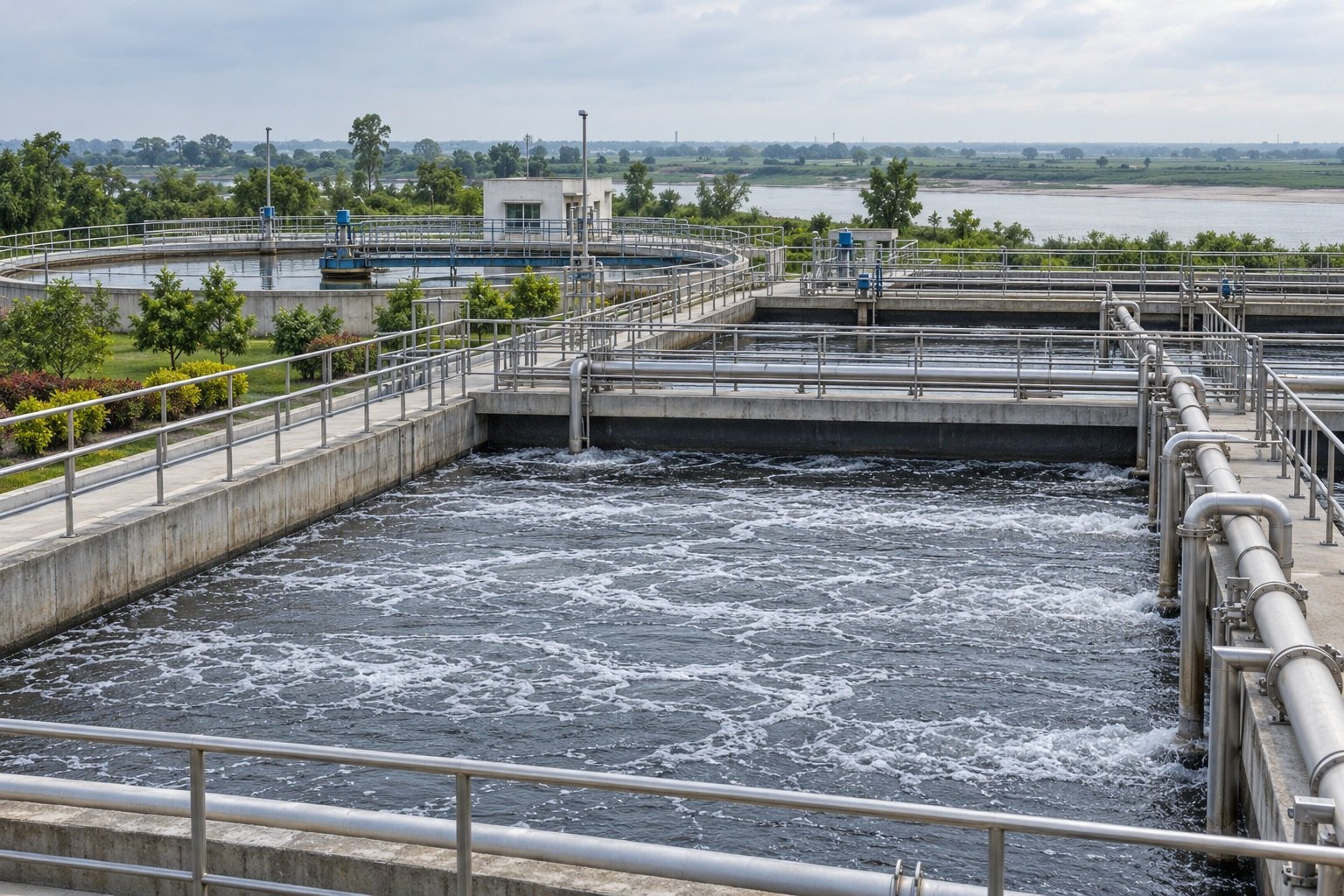
The Namami Gange Programme, run by the National Mission for Clean Ganga, treats Ganga basin sewage in large centralised plants, small decentralised units and septage plants, picking each technology to suit the site. Private operators are paid partly on construction and partly on performance over 15 years under the Hybrid Annuity Model. PIB reviewed these methods on 21 October 2026.
Syllabus: Prelims · Environment & Ecology; GS2 · Government Policies; GS3 · Investment Models
Why this matters for UPSC
GS3 conservation, environmental pollution and investment models: Prelims can ask how a Sequential Batch Reactor, NEREDA or a constructed wetland treats sewage and how the Hybrid Annuity Model pays; GS3 Mains, how to keep sewage treatment plants working after they are built.
In short
Sewage treatment under the Namami Gange Programme is a site-specific mix of centralised plants, decentralised units and septage treatment, built and run by private operators paid for performance.
Plants are only as good as their operation: performance-linked contracts, septage chains and one honest dataset must keep pace with new capacity.
Why it matters
A family in a small riverside town with no sewer line flushes into a septic tank. When that tank is emptied into a drain, the waste reaches the river where pilgrims bathe and towns downstream draw water. Treatment that fits the place, a wetland on a drain, a packaged unit on a hillside or a sludge plant for tanker loads, lets such towns treat waste they could never afford to pipe to a big plant. Paying an operator only when the plant meets its standards means a plant that is built but badly run earns less, so residents get cleaner water for years, not only at the opening. The wider question is whether India can treat sanitation as a lasting public service.
Prelims pointers
- Five-tier Ganga structure under the 2016 Order: National Ganga Council (Prime Minister), Empowered Task Force (Union Minister of Jal Shakti), NMCG, State and District Ganga Committees.
- NMCG was registered on 12 August 2011 under the Societies Registration Act, 1860; the National Ganga River Basin Authority was dissolved on 7 October 2016.
- Pillars of the Namami Gange Programme include sewerage infrastructure, river-front development, river-surface cleaning, biodiversity, afforestation, public awareness, industrial effluent monitoring and Ganga Gram.
- Namami Gange was approved as a 'Flagship Programme' by the Union Government in June 2014 with a budget outlay of Rs 20,000 crore (NMCG).
- CPCB ranks polluted river stretches in five priority classes by BOD: Priority I above 30 mg/l, down to Priority V at 3 to 6 mg/l.
- Ganga Action Plan I began in 1985 on the main stem; GAP-II (1993) was merged with the National River Conservation Plan in 1996.
Practise a UPSC-style question
With reference to sewage treatment technologies used under the Namami Gange Programme, consider the following statements:
1. Electrocoagulation is a biological process in which bacteria grow on plant roots to break down pollutants.
2. NEREDA uses aerobic granular sludge, whose compact granules settle faster than conventional activated sludge.
3. A Food Chain Reactor improves on the activated sludge process by adding fixed artificial media and plant roots.
Which of the statements given above is/are correct?
- (a) 1 and 2 only
- (b) 2 and 3 only
- (c) 1 and 3 only
- (d) 1, 2 and 3
Show the answer
Answer: (b) 2 and 3 only
Answer: (b) 2 and 3 only. NEREDA and the Food Chain Reactor are described correctly; electrocoagulation is not biological.
Statement 1: incorrect. Electrocoagulation is non-biological: an electric current and a metal anode destabilise suspended and emulsified pollutants. Plant roots belong to the Food Chain Reactor.
Statement 2: correct. NEREDA uses the same bacteria as activated sludge but forms compact aerobic granules with good settling properties.
Statement 3: correct. The Food Chain Reactor adds fixed artificial media and plant roots to the activated sludge idea, for a smaller footprint and lower power use.
Eliminate: statement 1 is wrong, so every option containing 1 goes. Out: (a), (c), (d).
Trap: Swapped attribution. The plant-root feature of the Food Chain Reactor is pinned on electrocoagulation, which uses electricity, not microbes.
Remember: Electrocoagulation is electric and non-biological; NEREDA uses granules; FCR uses roots and media.
More Explainers
- State Legislative Councils: Articles 168-172 and the graduates' and teachers' seats Polity
- Whales and dolphins in Indian waters: legal protection, IUCN status and strandings Environment
- The Aligarh Movement, AMU and the Article 30 minority test Polity
- Environmental clearance by States: SEIAA, SEAC and the EIA Notification, 2006 Environment
- Software vulnerabilities: CVE, CVSS, coordinated disclosure and CERT-In's role Sci-Tech
- Drug trafficking law in India: NDPS Act, PIT-NDPS, NCB and NCORD National
- Choosing the UN Secretary-General: Article 97, UNSC veto and straw polls World & IR
- UN Convention against Torture, and why India has not ratified it Polity
- NavIC: why India's navigation constellation cannot give a standalone position Sci-Tech
- International Energy Agency: membership, 90-day oil stocks and India's status World & IR
- PM Surya Ghar: Muft Bijli Yojana and the rooftop solar subsidy Economy
- HFSS foods: FSSAI's draft limits and front-of-pack warning labels National