
Satellite mega-constellations, unintended radiation and radio astronomy
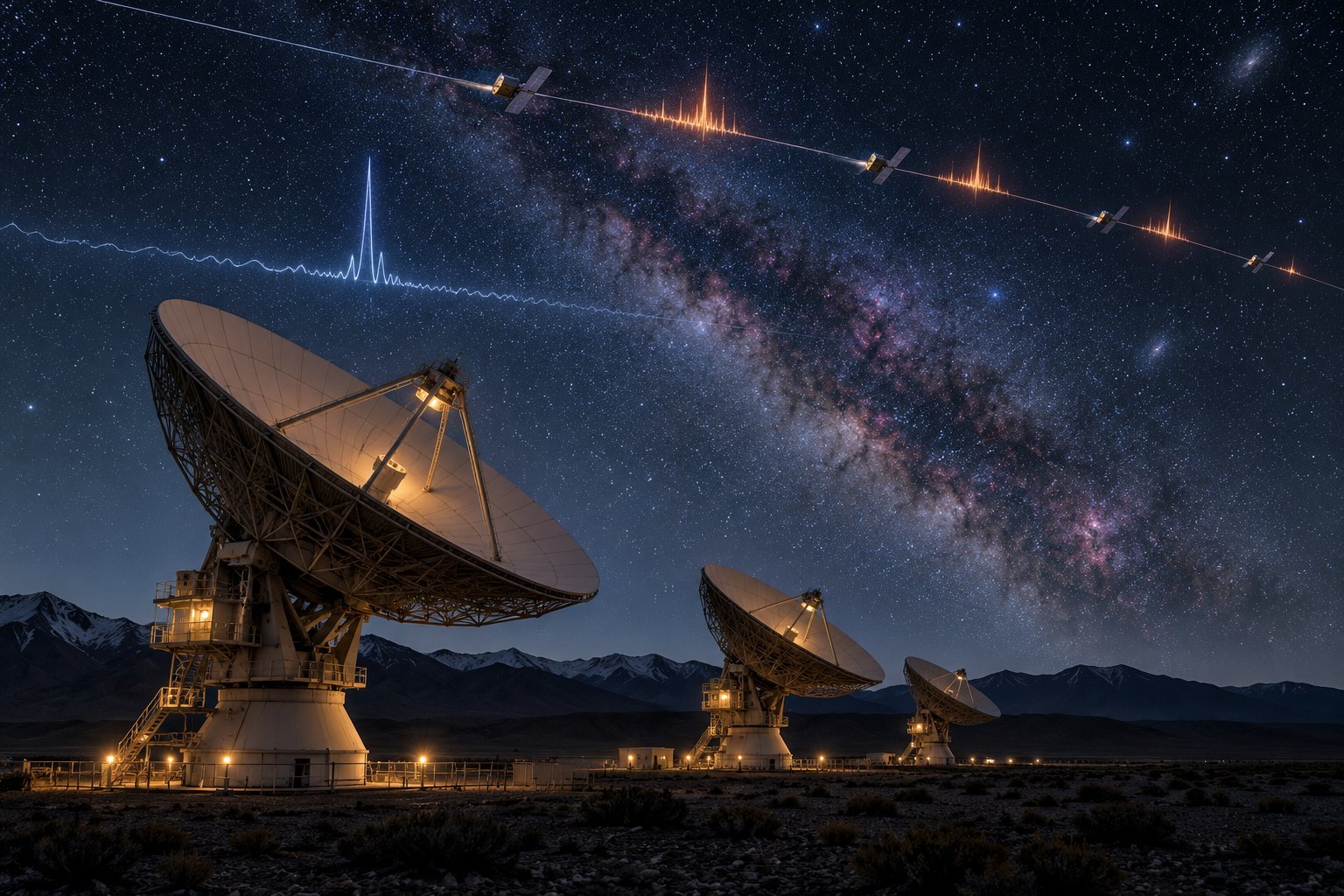
Radio telescopes record cosmic signals so faint that human-made radio signals can outshine them, and low-Earth-orbit constellations now disturb them in three ways: intended emission, unwanted emission and unintended radiation from on-board electronics. A CSIRO study, SNIFFLES-I, published in June 2026, logged 2,345 such detections from three constellations, some inside bands protected for radio astronomy.
Syllabus: Prelims · Current Affairs & IR; GS3 · Science & Technology; GS3 · IT, Space, Biotech & IPR
Why this matters for UPSC
GS3 science and technology (space) and GS2 international institutions: Prelims can ask what unintended radiation is, what ITU Resolution 681 covers, where the SKA Observatory's telescopes stand and what the Giant Metrewave Radio Telescope observes; Mains, about sharing spectrum.
In short
Unintended radiation is electromagnetic leakage from a satellite's on-board electronics, separate from its transmissions; with intended and unwanted emissions, it threatens radio telescopes that detect extremely faint cosmic signals.
Satellite broadband and radio astronomy both serve the public; WRC-27 should bring platform radiation under clear limits before constellations grow further.
Why it matters
An astronomer searching for the faint signals of the early Universe can lose a whole observation when one satellite passes through the telescope's view, because the satellite outshines natural sources many times over and swamps the receiver. Astronomers cannot move to a quieter frequency, since nature fixes where cosmic signals sit. The same satellites carry broadband and phone links to people in remote places, so neither use can simply be switched off. The question is how two public goods share one spectrum. India has a direct stake: it is a member of the SKA Observatory, whose sites in South Africa and Australia depend on clean skies, and it runs its own Giant Metrewave Radio Telescope near Pune.
Prelims pointers
- International Telecommunication Union (ITU): a UN specialised agency; its Radiocommunication Sector (ITU-R) takes satellite orbit filings, after which a first satellite must be in orbit within 7 years.
- Radio Regulations No. 5.340: in about 20 bands allocated to passive services all emissions are prohibited; they cover only 1-2% of spectrum below 86 GHz.
- Resolution 681 (WRC-23, Dubai) names the SKA Observatory in South Africa and ALMA in Chile as radio astronomy sites whose quiet zones may be recognised.
- Report ITU-R RA.2259 lists more than fifteen national radio quiet zones; Recommendation ITU-R RA.769 sets interference thresholds for radio astronomy.
- SKA Observatory: SKA-Low (50-350 MHz) in Western Australia's Murchison; SKA-Mid (350 MHz-15.4 GHz, includes MeerKAT) in South Africa's Karoo; headquarters in the UK.
- India in SKAO: joined in July 2024 by signing and ratifying the Convention Establishing the SKAO; ₹1250 crore from DAE and DST up to 2031.
- GMRT site: about 80 km north of Pune near Narayangaon; 30 fully steerable 45 m dishes spread up to 25 km apart.
- "Dark and Quiet Skies" is discussed in the UN Committee on the Peaceful Uses of Outer Space (COPUOS); the IAU CPS is co-hosted by NSF NOIRLab and SKAO.
Practise a UPSC-style question
With reference to interference from satellites with radio astronomy, consider the following statements:
1. Spurious emissions, which include harmonics, are a category of unwanted emission under the ITU Radio Regulations.
2. Radiation leaking from a satellite's on-board power electronics is classed as out-of-band emission in the Radio Regulations.
Which of the statements given above is/are correct?
- (a) 1 only
- (b) 2 only
- (c) Both 1 and 2
- (d) Neither 1 nor 2
Show the answer
Answer: (a) 1 only
Answer: (a) 1 only. Harmonics are spurious emissions, but platform leakage is not an emission at all.
Statement 1: correct. RR 1.146 divides unwanted emission into out-of-band emission and spurious emission; RR 1.145 counts harmonics as spurious.
Statement 2: incorrect. Out-of-band emission comes from the modulation of a transmitted signal; leakage from power electronics has no carrier and is called unintended radiation.
Eliminate: Judge statement 2 first: electronics leakage is not produced by any transmitter's modulation, so it cannot be out-of-band emission. Out: (b), (c).
Eliminate: Statement 1 is correct, since harmonics are listed among spurious emissions. Out: (d).
Trap: Look-alike names. Out-of-band emission, spurious emission and unintended radiation sound alike, and the question swaps one category for another.
Remember: Unwanted emission = out-of-band + spurious (harmonics); electronics leakage = unintended radiation.
More Explainers
- State Legislative Councils: Articles 168-172 and the graduates' and teachers' seats Polity
- Whales and dolphins in Indian waters: legal protection, IUCN status and strandings Environment
- The Aligarh Movement, AMU and the Article 30 minority test Polity
- Environmental clearance by States: SEIAA, SEAC and the EIA Notification, 2006 Environment
- Software vulnerabilities: CVE, CVSS, coordinated disclosure and CERT-In's role Sci-Tech
- Drug trafficking law in India: NDPS Act, PIT-NDPS, NCB and NCORD National
- Choosing the UN Secretary-General: Article 97, UNSC veto and straw polls World & IR
- UN Convention against Torture, and why India has not ratified it Polity
- NavIC: why India's navigation constellation cannot give a standalone position Sci-Tech
- International Energy Agency: membership, 90-day oil stocks and India's status World & IR
- PM Surya Ghar: Muft Bijli Yojana and the rooftop solar subsidy Economy
- HFSS foods: FSSAI's draft limits and front-of-pack warning labels National