
Sand mining in India: minor-mineral law, guidelines and the NGT
Why in news: An NGT-appointed joint committee's report on the Sindh river, reported on 19 October 2026, found Madhya Pradesh's sand-mining task force ineffective.
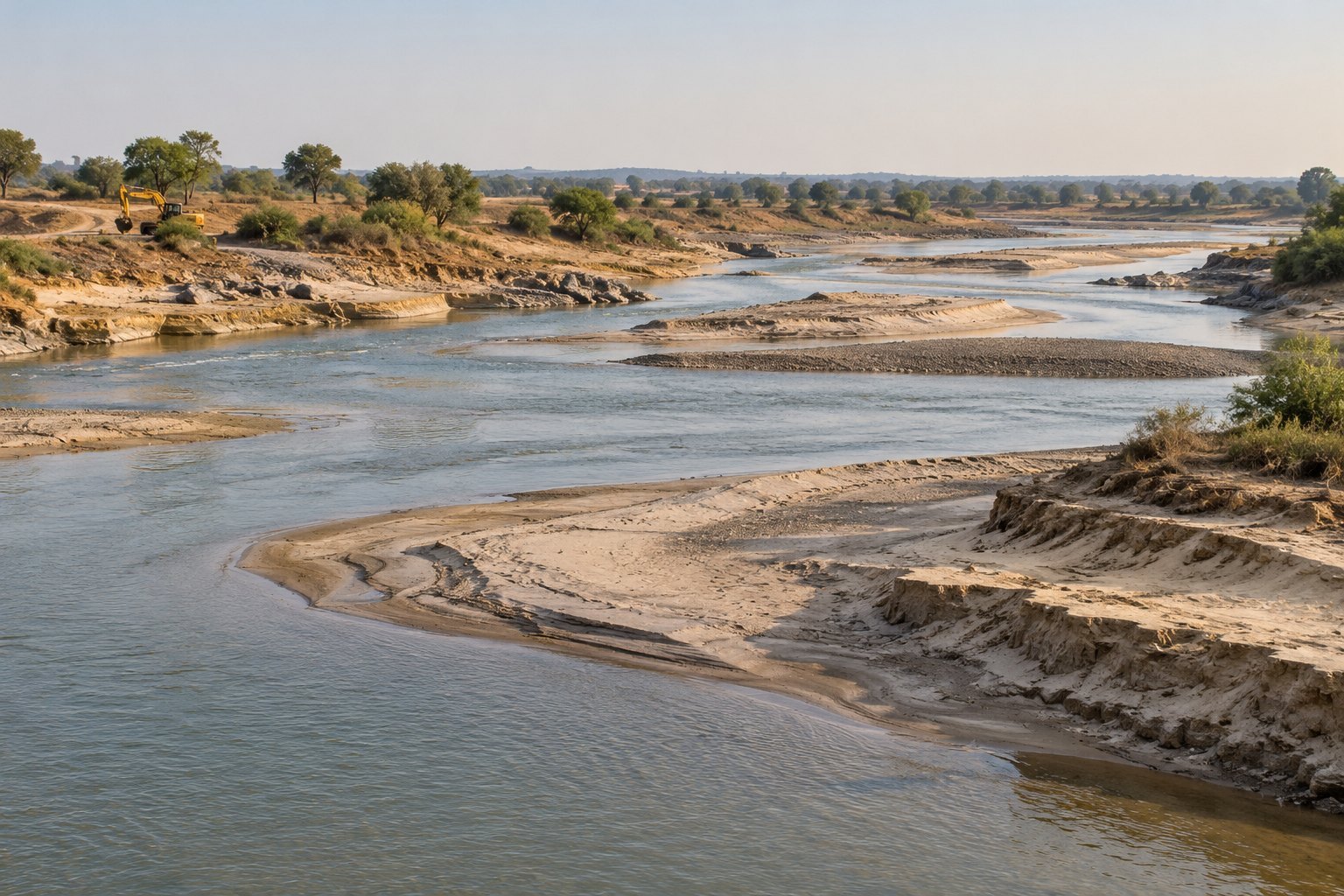
Ordinary sand is a minor mineral under the Mines and Minerals (Development and Regulation) Act, 1957, so each State makes its own rules for leasing it and curbing illegal mining. Environmental clearance and Environment Ministry guidelines of 2016 and 2020 limit where and how much is dug. An NGT-appointed committee has now faulted Madhya Pradesh's enforcement on the Sindh river.
Syllabus: GS4 · Ethics in Public Administration; Prelims · Environment & Ecology; GS2 · Statutory & Regulatory Bodies
Why this matters for UPSC
Sand mining sits in GS3 conservation and environmental degradation. Prelims can ask what a minor mineral is under the MMDR Act, 1957, who makes rules under section 15 and section 23C, and what the NGT applies; Mains, why enforcement fails.
In short
Sand mining is extraction of sand from river beds, floodplains and coasts. Ordinary sand is a minor mineral under the MMDR Act, 1957: States lease it; environmental law caps it.
India's sand law is sound on paper; the gap is enforcement, so tracked transport, independent monitoring and named accountability must outweigh State revenue interests.
Why it matters
A farmer drawing water from a riverside well, a family crossing an old bridge and a town that takes its supply from a river all depend on sand staying where the river left it. When more is dug than the river brings back each monsoon, the bed sinks, banks cave in, wells run dry and bridge piers are left exposed. Because builders keep buying sand even when it costs more, illegal digging pays well, and the gangs behind it have killed officials who tried to stop them. Gharials and turtles lose the sandbanks they need. The larger question is whether a State that earns from leasing sand can also police it honestly.
Prelims pointers
- MMDR Act, section 15: State Governments make the rules for quarry leases, mining leases and other concessions for minor minerals, and fix their royalty.
- MMDR Act, section 23C (added in 1999): States make rules to prevent illegal mining, transport and storage of minerals; the Centre cannot revise orders passed under them.
- MMDR Act, section 21: breaching section 4 is punishable with up to five years' jail and a fine up to Rs 5 lakh per hectare; the offence is cognizable.
- Deepak Kumar v State of Haryana (2012): the Supreme Court extended prior environmental clearance to minor-mineral leases below 5 hectares.
- 2020 Guidelines: no sand extraction within 1 km of major bridges and highways, and no river-bed mining during the monsoon.
- District Level Task Force (2020 Guidelines): chaired by the Collector or District Magistrate, with the Superintendent of Police, forest, transport, pollution-board and mining officers.
- NGT Act, 2010, section 20: the Tribunal applies sustainable development, the precautionary principle and the polluter pays principle in every order.
- Sustainable Sand Mining Management Guidelines, 2016: mining depth capped at 3 metres; issued by the Ministry of Environment, Forest and Climate Change.
Practise a UPSC-style question
With reference to the Mines and Minerals (Development and Regulation) Act, 1957, consider the following statements:
1. Ordinary sand, other than sand used for prescribed purposes, is classed as a minor mineral under the Act.
2. Rules for granting mining leases of minor minerals are made by the Central Government under section 15 of the Act.
3. State Governments may make rules providing check-posts and weigh-bridges to prevent illegal transport of minerals.
Which of the statements given above is/are correct?
- (a) 1 and 2 only
- (b) 2 and 3 only
- (c) 1 and 3 only
- (d) 1, 2 and 3
Show the answer
Answer: (c) 1 and 3 only
Answer: (c) 1 and 3 only. Minor-mineral leasing rules are the States', not the Centre's, so statement 2 fails.
Statement 1: correct. Section 3(e) of the MMDR Act, 1957 lists ordinary sand, other than sand for prescribed purposes, among minor minerals.
Statement 2: incorrect. Section 15 empowers State Governments, not the Centre, to make rules for leases and concessions of minor minerals.
Statement 3: correct. Section 23C lets State Governments make rules against illegal mining, transport and storage, including check-posts and weigh-bridges.
Eliminate: Judge statement 2 first: minor minerals are a State subject under section 15, so statement 2 is incorrect. Out: (a), (b), (d).
Trap: Swapped attribution. The power under section 15 is pinned on the Central Government instead of the State Governments.
Remember: Sand is a minor mineral (s.3(e)); States make its leasing rules (s.15) and anti-illegal-mining rules (s.23C).
More Explainers
- State Legislative Councils: Articles 168-172 and the graduates' and teachers' seats Polity
- Whales and dolphins in Indian waters: legal protection, IUCN status and strandings Environment
- The Aligarh Movement, AMU and the Article 30 minority test Polity
- Environmental clearance by States: SEIAA, SEAC and the EIA Notification, 2006 Environment
- Software vulnerabilities: CVE, CVSS, coordinated disclosure and CERT-In's role Sci-Tech
- Drug trafficking law in India: NDPS Act, PIT-NDPS, NCB and NCORD National
- Choosing the UN Secretary-General: Article 97, UNSC veto and straw polls World & IR
- UN Convention against Torture, and why India has not ratified it Polity
- NavIC: why India's navigation constellation cannot give a standalone position Sci-Tech
- International Energy Agency: membership, 90-day oil stocks and India's status World & IR
- PM Surya Ghar: Muft Bijli Yojana and the rooftop solar subsidy Economy
- HFSS foods: FSSAI's draft limits and front-of-pack warning labels National