
Rock art in India: petroglyphs, rock paintings and their protection
Why in news: On 15 October 2026 the Prime Minister inaugurated India's first Petroglyph Conservation Park in Leh, one of five Ladakh projects, PIB said.
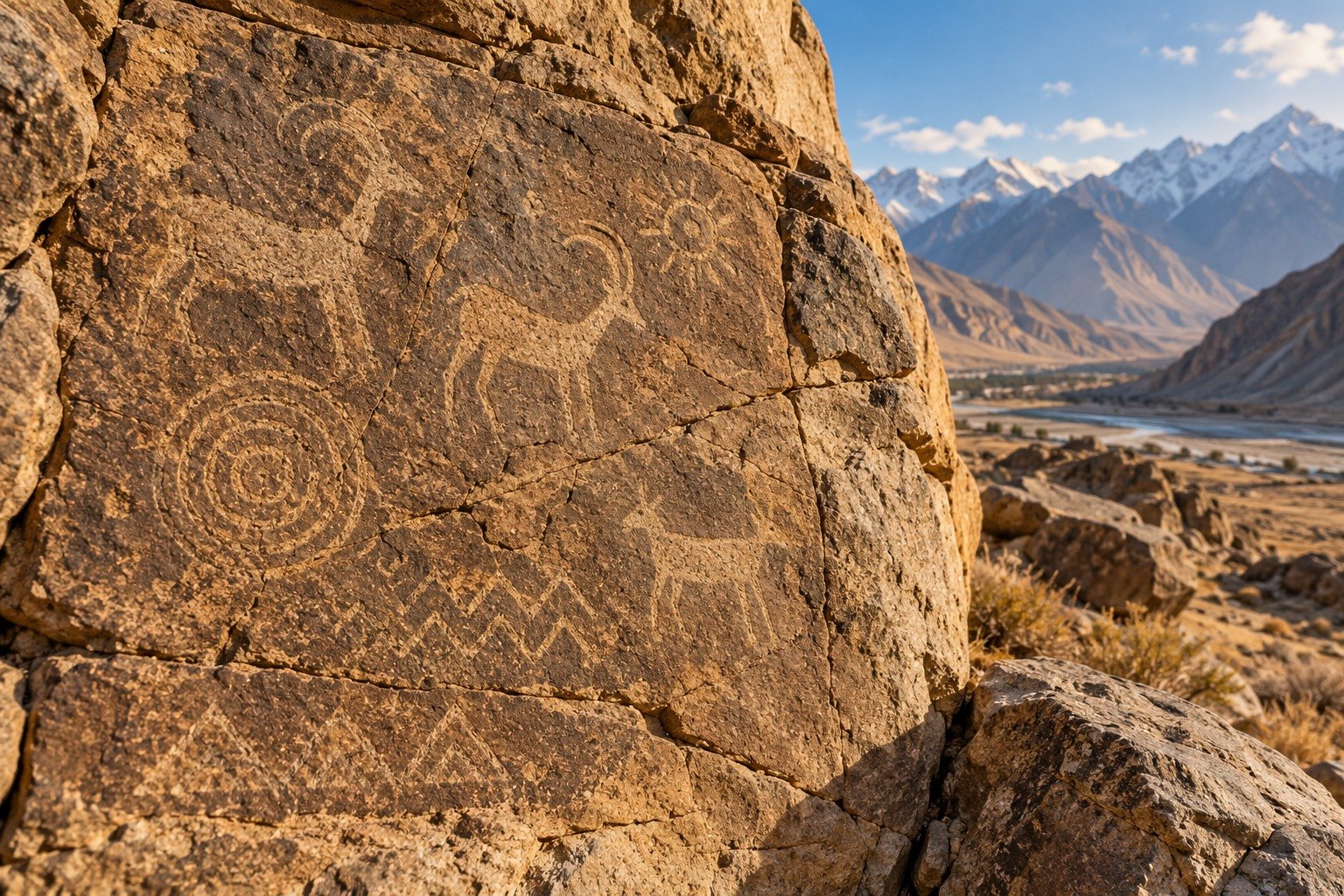
Rock art is imagery made on natural rock, chiefly painted onto it (pictographs) or carved, pecked or engraved into it (petroglyphs). NCERT dates India's earliest rock paintings to the Upper Palaeolithic; Bhimbetka in Madhya Pradesh is a World Heritage Site. On 15 October 2026 the Prime Minister inaugurated what the Government calls India's first Petroglyph Conservation Park, in Leh.
Syllabus: GS1 · Art & Culture; Prelims · Current Affairs & IR; Prelims · History & Culture
Why this matters for UPSC
Rock art is GS1 Indian culture: Prelims asks sites and their States, periods, pigments and UNESCO status, such as Bhimbetka and the Konkan geoglyphs; GS1 Mains asks what prehistoric art reveals and how the AMASR Act protects heritage.
In short
Rock art is imagery made on natural rock: pictographs add pigment, petroglyphs remove rock by carving or engraving. India's paintings run, per NCERT, from the Upper Palaeolithic to historic times.
Rock art is an irreplaceable archive: map every site, keep carvings in place where possible, and make development answer to heritage.
Why it matters
A carved boulder in a Ladakhi pasture or on a Konkan plateau can sit right where a road is to be widened or a plot built on. Once a blast or a bulldozer breaks it, a picture that outlasted thousands of years is lost for good, and no replica restores the place where it stood. For some regions these images are the only record of how early people lived, hunted and believed, and of animals that no longer roam there. Protecting them touches villagers and private landowners who hold the sites, builders who will need clearances, and tourists and students who come to see them. The larger question is how a country building fast keeps its oldest record without stopping development.
Prelims pointers
- Bhimbetka (Madhya Pradesh): about 45 km south of Bhopal (NCERT); NCERT counts about 800 shelters, about 500 painted; ASI counts over 700, over 400 painted.
- Bhimbetka's seven periods (NCERT): Period I Upper Palaeolithic, Period II Mesolithic, Period III Chalcolithic, then four later ones.
- Lakhudiyar (Kumaon hills, Uttarakhand), on the Suyal river: the name means one lakh caves; paintings show stick-like humans and hand-linked dancers.
- Kupgallu, Piklihal and Tekkalkota: painted granite-rock sites of Karnataka and Andhra Pradesh; NCERT dates their paintings Neolithic, early historical and late historical.
- Geoglyphs of Konkan Region: submitted to UNESCO's Tentative List on 17 February 2022 under criteria (i), (iii) and (iv); Pansaymol is the Goa site.
- AMASR Act, 1958 after 2010: a 200 m regulated area lies beyond the 100 m prohibited area; building there needs a competent authority's permission.
- National Monuments Authority (section 20F, 2010): its whole-time Chairperson is appointed by the President; the Cabinet Secretary chairs the committee that selects members.
- Section 30, AMASR Act: damaging a protected monument draws up to two years' jail, up to Rs 1 lakh fine, or both; before 2010, three months or Rs 5,000.
Practise a UPSC-style question
With reference to the prehistoric rock paintings of Bhimbetka, consider the following statements:
1. The artists obtained red pigment from chalcedony, known in India as geru.
2. Among the many colours the artists used, white and red were their favourites.
3. The largest number of paintings at the site belong to the Mesolithic period.
Which of the statements given above is/are correct?
- (a) 1 and 2 only
- (b) 2 and 3 only
- (c) 1 and 3 only
- (d) 1, 2 and 3
Show the answer
Answer: (b) 2 and 3 only
Answer: (b) 2 and 3 only. Red came from haematite, not chalcedony, which gave the green.
Statement 1: incorrect. NCERT says red came from haematite, called geru in India; a green variety of chalcedony gave green.
Statement 2: correct. Bhimbetka's painters used white, yellow, orange, red ochre, purple, brown, green and black, but favoured white and red.
Statement 3: correct. Period II, the Mesolithic, holds the largest number of Bhimbetka's paintings: smaller figures, mostly hunting scenes.
Eliminate: Judge statement 1 first: geru is haematite, so statement 1 is incorrect. Out: (a), (c), (d).
Trap: Swapped attribution. The statement keeps the true name geru but pins it on chalcedony, the stone behind the green colour.
Remember: Red = haematite (geru); green = chalcedony; white possibly limestone.
In the news
More Explainers
- State Legislative Councils: Articles 168-172 and the graduates' and teachers' seats Polity
- Whales and dolphins in Indian waters: legal protection, IUCN status and strandings Environment
- The Aligarh Movement, AMU and the Article 30 minority test Polity
- Environmental clearance by States: SEIAA, SEAC and the EIA Notification, 2006 Environment
- Software vulnerabilities: CVE, CVSS, coordinated disclosure and CERT-In's role Sci-Tech
- Drug trafficking law in India: NDPS Act, PIT-NDPS, NCB and NCORD National
- Choosing the UN Secretary-General: Article 97, UNSC veto and straw polls World & IR
- UN Convention against Torture, and why India has not ratified it Polity
- NavIC: why India's navigation constellation cannot give a standalone position Sci-Tech
- International Energy Agency: membership, 90-day oil stocks and India's status World & IR
- PM Surya Ghar: Muft Bijli Yojana and the rooftop solar subsidy Economy
- HFSS foods: FSSAI's draft limits and front-of-pack warning labels National