
PM inaugurates India's first Petroglyph Conservation Park at Leh's Sindhu Ghat
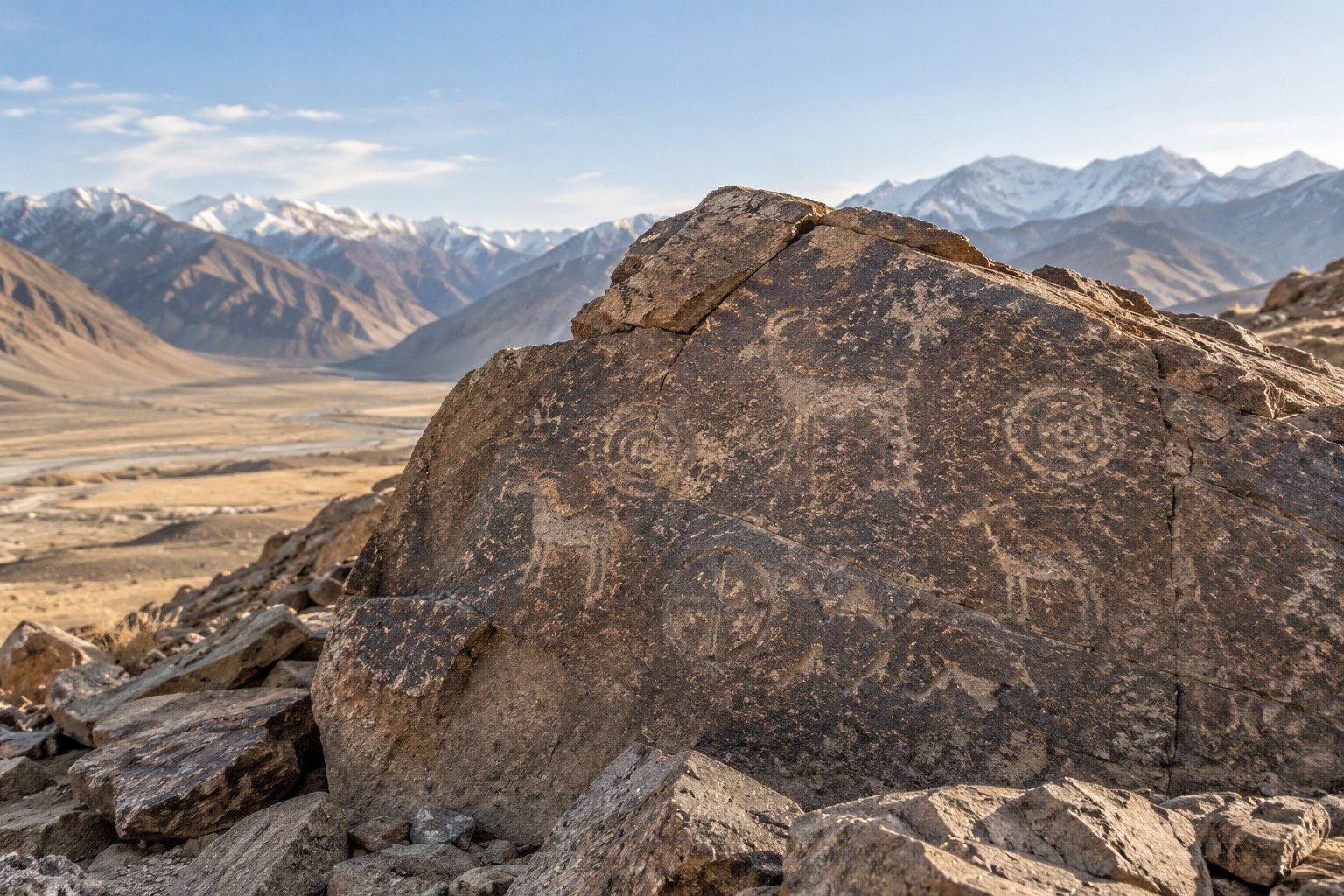
The Prime Minister on 15 October 2026 inaugurated, by video conference, what the Prime Minister's Office calls India's first Petroglyph Conservation Park, at Sindhu Ghat in Leh, to shelter Ladakh's prehistoric rock carvings. He also dedicated the 298-km Nimmu-Padum-Darcha road over Shinkun La and opened a geothermal-heated terminal at Leh airport, among five projects worth about Rs 3,350 crore.
Syllabus: GS1 · Art & Culture; Prelims · Geography; GS3 · Infrastructure
Why this matters for UPSC
GS1 heritage: Prelims can ask what separates a petroglyph from a pictograph and where Bhimbetka lies, and about Shinkun La, the Border Roads Organisation and geothermal energy; GS3 Mains, about border roads and conservation in fragile regions.
Why it matters
A family in Zanskar that once faced a long day on the road to reach a hospital, college or market now has a shorter route out, and the Armed Forces gain another supply line to a border region. The carvings matter in a different way: a single blast for a road or a careless visitor can erase an image that has survived thousands of years, and with it part of the only record of how early herders and hunters lived in the high Himalaya. Gathering the most exposed carvings in a guarded park saves them, though it takes them out of the landscape that gave them meaning. The larger question is how a fragile mountain region builds roads, airports and power lines without losing its heritage and water.
Prelims pointers
- Rock Shelters of Bhimbetka (Madhya Pradesh): five clusters of shelters in the Vindhyan foothills, with paintings from the Mesolithic to the historical period; World Heritage Site since 2003.
- Shinkun La Tunnel: a 4.1 km twin-tube tunnel being built at about 15,800 feet on the Nimmu-Padum-Darcha road; the Government says it will be the world's highest.
- Atal Tunnel: an 8.8 km tunnel under the Rohtang Pass, built by the BRO, that shortens the Manali-Leh distance by 46 km.
- Sela Tunnel: on the Balipara-Charduar-Tawang road in Arunachal Pradesh, it bypasses the Sela Pass climb and gives Tawang all-weather access.
- Puga Valley, Ladakh: India's first two geothermal wells, commissioned by ONGC Energy Centre; the National Policy on Geothermal Energy (2025) names MNRE as nodal ministry.
- Mission Amrit Sarovar: launched on 24 April 2022 to build or revive at least 75 Amrit Sarovars in every district; Ministry of Rural Development is the nodal ministry.
- Vibrant Villages Programme (approved 2023): a Centrally Sponsored Scheme for villages in 46 northern border blocks of Arunachal Pradesh, Himachal Pradesh, Sikkim, Uttarakhand and Ladakh.
- Ladakh: a Union Territory without a legislature since 2019, under the Jammu and Kashmir Reorganisation Act, 2019.
Practise a UPSC-style question
With reference to rock art in India, consider the following statements:
1. Petroglyphs are made by carving, pecking or engraving a rock surface, whereas pictographs are made by painting on it.
2. The Rock Shelters of Bhimbetka lie in the foothills of the Aravalli Range on the north-western edge of the Indian plateau.
3. The rock paintings at Bhimbetka appear to span from the Mesolithic period to the historical period.
Which of the statements given above is/are correct?
- (a) 1 and 2 only
- (b) 2 and 3 only
- (c) 1 and 3 only
- (d) 1, 2 and 3
Show the answer
Answer: (c) 1 and 3 only
Answer: (c) 1 and 3 only. Statement 2 misplaces Bhimbetka's range.
Statement 1: correct. A petroglyph is cut into the rock; a pictograph is pigment applied on top of it.
Statement 2: incorrect. Bhimbetka lies in the foothills of the Vindhyan Mountains, on the southern edge of the central Indian plateau, in Madhya Pradesh.
Statement 3: correct. UNESCO describes paintings there from the Mesolithic period through to the historical period; the site was inscribed in 2003.
Eliminate: Statement 2 is the surest call, since Bhimbetka is a Vindhyan site in Madhya Pradesh. Out: (a), (b), (d).
Trap: Look-alike names. The Aravalli and the Vindhyan ranges are both old central and western Indian hills, and swapping one for the other catches a student who knows the site but not its setting.
Remember: Petroglyph = carved (Ladakh); pictograph = painted (Bhimbetka, Vindhyan foothills, Madhya Pradesh).
Explainers on this topic
More from the 16 October 2026 edition
- Black Sea and the Turkish Straits: drone strikes hit merchant shipping World & IR
- India approves rollover of ₹30 billion currency swap for the Maldives World & IR
- Census Rules, 1990 amended to spell out who can be enumerators Polity
- Sports Ministry issues norms for revised National Sports Federations assistance scheme National
- Section 163 BNSS order and park closure curb Connaught Place assembly Polity
- India presses terrorism, connectivity norms at CICA's Baku summit World & IR
- ISRO: Aditya-L1 and Proba-3 coronagraphs jointly study coronal mass ejections Sci-Tech
- Centre cancels paraquat herbicide's registration; Madhya Pradesh orders stocks destroyed Environment
- UN DESA's World Social Report 2026 scores 168 countries on inclusive transformation World & IR
- AT-1 bonds: Supreme Court upholds quashing of Yes Bank write-down Economy
- CERT-In issues critical advisory on AI agents reaching Indian systems Sci-Tech
- UN report urges limits on neurotechnology and neural data in justice Sci-Tech