
Right to water under Article 21: the courts and the Constitution
Why in news: The NHRC held a national conference, 'Water as the Elixir of Life', on the right to water on its 33rd Foundation Day, 12 October 2026.
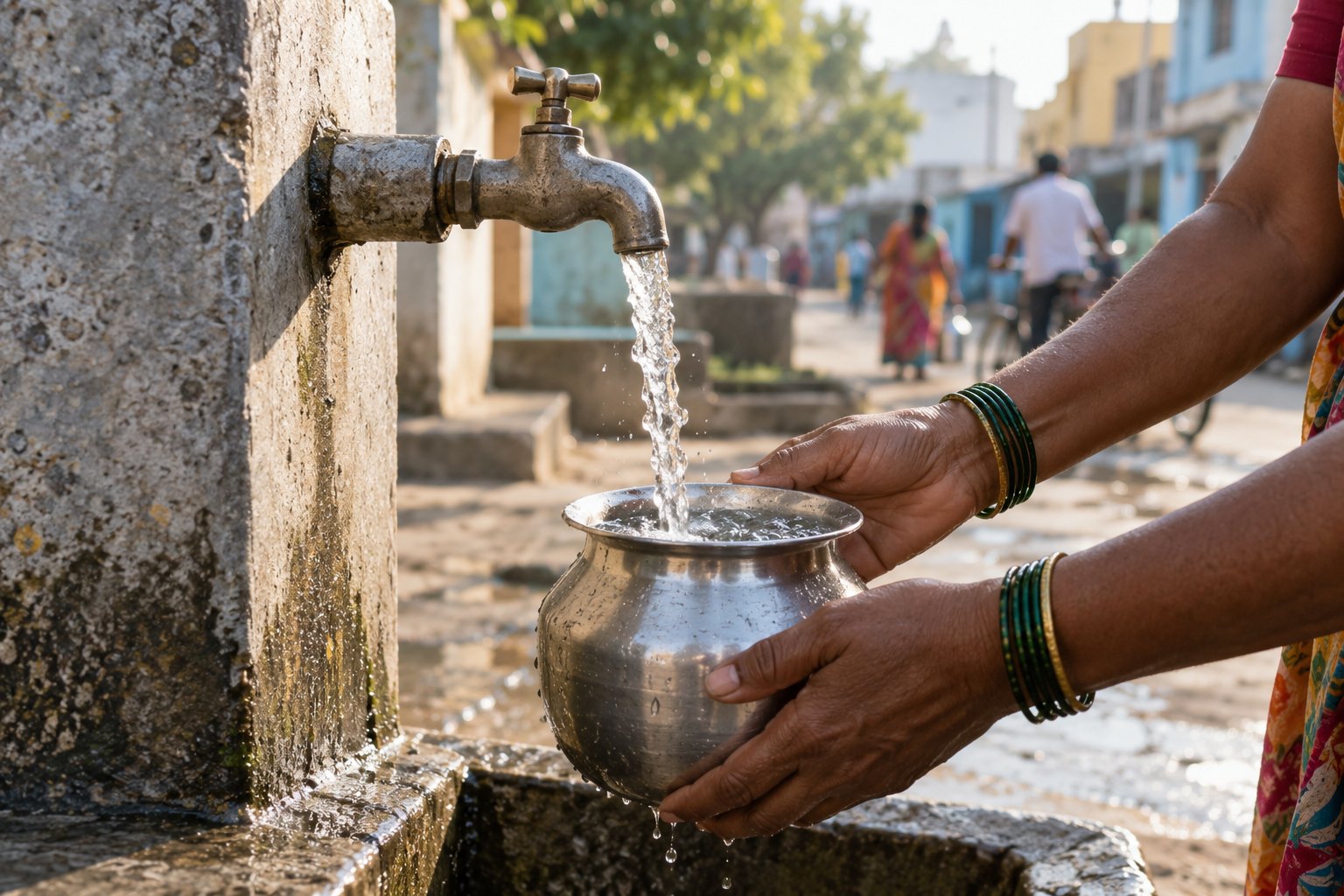
No Article names a right to water; the Supreme Court read it into the right to life under Article 21. Subhash Kumar (1991) covered pollution-free water, and A.P. Pollution Control Board II (2000) a State duty to supply clean drinking water. The NHRC's 33rd Foundation Day conference on 12 October 2026 took up the right to water.
Syllabus: GS2 · Constitution; GS2 · Federalism & Local Government; Prelims · Polity & Governance
Why this matters for UPSC
GS2 fundamental rights and Centre-State relations, GS3 water resources. Prelims can ask which case read water into Article 21, State List Entry 17, Article 262 and the Eleventh Schedule; Mains, whether water should be an express right.
In short
The right to water is judge-made: the Supreme Court read it into Article 21's right to life, while constitutional text leaves water mostly to States.
Courts have secured water as a right; making it real needs sustainable sources, village water budgets and Panchayats able to deliver, not taps alone.
Why it matters
Take a family whose only well or tap gives polluted water. Because the courts treat clean water as part of the right to life, that family's problem is not just a poor service but a possible breach of a fundamental right, and a court can order the State to act, as it ordered Haryana to keep Delhi's reservoirs full. The same reading lets courts stop polluters near drinking-water sources, as in Hyderabad. Behind it lies scarcity: a NITI Aayog official told the NHRC conference on 12 October 2026 that India has about 4% of the world's freshwater for nearly 18% of its people, with per capita availability of about 1,300 to 1,400 cubic metres a year, below the 1,700 cubic-metre stress line.
Prelims pointers
- Entry 17, State List: water supplies, irrigation and canals, drainage and embankments, water storage and water power, subject to Entry 56 of the Union List.
- Entry 56, Union List: regulation and development of inter-State rivers and river valleys, to the extent Parliament declares by law to be expedient.
- Article 262: Parliament may by law provide for adjudicating inter-State river water disputes and bar the Supreme Court and other courts from them.
- Article 47 (Directive Principles): raising nutrition and the standard of living and improving public health are among the State's primary duties.
- Article 48A (Directive Principles) asks the State to protect the environment; Article 51A(g) makes protecting lakes and rivers a citizen's fundamental duty.
- Eleventh Schedule (Article 243G, 73rd Amendment, 1992): item 11 drinking water; item 3 minor irrigation, water management and watershed development.
- Twelfth Schedule (Article 243W, 74th Amendment, 1992): item 5 water supply for domestic, industrial and commercial purposes; item 6 public health and sanitation.
- Article 39(b): the State directs policy so that ownership and control of the community's material resources best serve the common good.
Practise a UPSC-style question
With reference to the Seventh Schedule of the Constitution of India, consider the following statements:
1. Water, including water supplies, irrigation and canals, is an entry in the Union List.
2. Regulation and development of inter-State rivers, to the extent Parliament declares expedient by law, is a Union List entry.
Which of the statements given above is/are correct?
- (a) 1 only
- (b) 2 only
- (c) Both 1 and 2
- (d) Neither 1 nor 2
Show the answer
Answer: (b) 2 only
1 is incorrect: water, including water supplies, irrigation and canals, is Entry 17 of the State List, not the Union List. 2 is correct: Entry 56 of the Union List covers inter-State rivers and river valleys to the extent Parliament declares Union control expedient by law.
More Explainers
- State Legislative Councils: Articles 168-172 and the graduates' and teachers' seats Polity
- Whales and dolphins in Indian waters: legal protection, IUCN status and strandings Environment
- The Aligarh Movement, AMU and the Article 30 minority test Polity
- Environmental clearance by States: SEIAA, SEAC and the EIA Notification, 2006 Environment
- Software vulnerabilities: CVE, CVSS, coordinated disclosure and CERT-In's role Sci-Tech
- Drug trafficking law in India: NDPS Act, PIT-NDPS, NCB and NCORD National
- Choosing the UN Secretary-General: Article 97, UNSC veto and straw polls World & IR
- UN Convention against Torture, and why India has not ratified it Polity
- NavIC: why India's navigation constellation cannot give a standalone position Sci-Tech
- International Energy Agency: membership, 90-day oil stocks and India's status World & IR
- PM Surya Ghar: Muft Bijli Yojana and the rooftop solar subsidy Economy
- HFSS foods: FSSAI's draft limits and front-of-pack warning labels National