
Public Accounts Committee, Parliament's financial committees and the CAG
Why in news: The PAC took evidence on 15 October 2026 on a CAG audit of Scheduled Caste scholarships and sought privilege action against six absent chief secretaries.
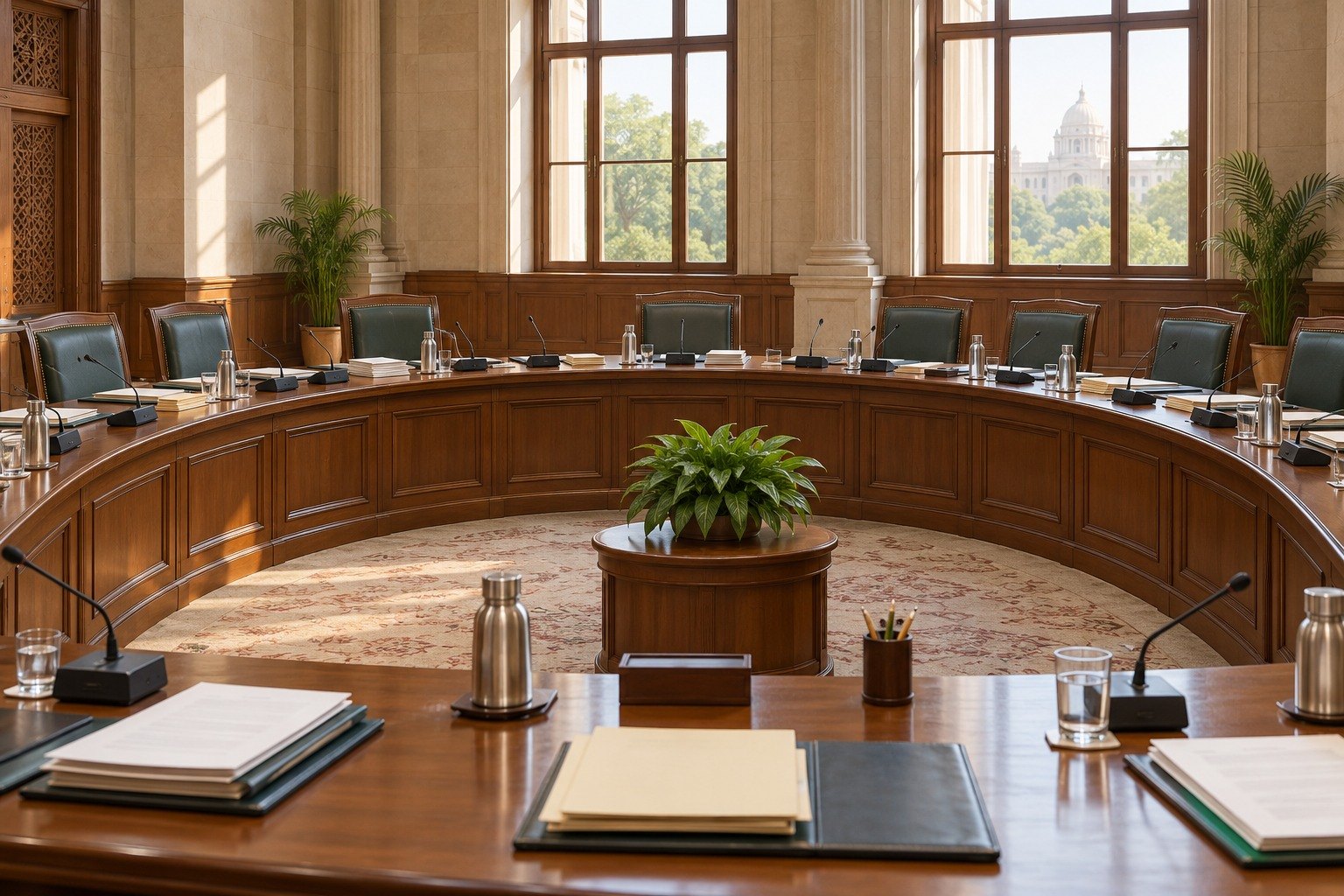
Parliament scrutinises spending through three financial committees: the Public Accounts Committee (PAC), the Estimates Committee and the Committee on Public Undertakings. The Comptroller and Auditor General (CAG) audits the accounts the PAC examines. On 15 October 2026 the PAC sought privilege action against six chief secretaries who skipped its hearing on a CAG audit of Scheduled Caste scholarships.
Syllabus: GS3 · Government Budgeting; GS2 · Parliament & State Legislatures; GS2 · Constitutional Bodies
Why this matters for UPSC
GS2 Parliament and constitutional bodies: Prelims asks each financial committee's size, Houses and chair, and the CAG's appointment, tenure and removal under Articles 148-151; Mains asks how far the PAC and CAG hold the executive accountable.
In short
Parliament's financial committees, the Public Accounts Committee, Estimates Committee and Committee on Public Undertakings, check how granted money is spent, aided by the Comptroller and Auditor General (Articles 148-151).
Audit gives Parliament the facts, but control of public money is real only when officials appear, reports are debated and action follows on time.
Why it matters
A Scheduled Caste student waiting for a scholarship depends on money Parliament voted reaching her bank account on time. Between the vote and the student stand ministries, State departments, banks and colleges, and an audit is the outside check on what happened along the way. An audit finding changes nothing by itself. It matters when MPs call officials to explain, and when the government acts on what the MPs recommend. If officials stay away or replies lie pending, the same lapses carry into the next scheme and the next batch of students. The strength of these committees decides whether taxpayers' money is spent the way Parliament intended.
Prelims pointers
- PAC and COPU: 15 Lok Sabha members elected every year by proportional representation through the single transferable vote; up to 7 Rajya Sabha members associated.
- Estimates Committee: 30 members, all of the Lok Sabha, the largest financial committee; Demands for Grants may be voted even if it has not reported (Rule 312).
- No Minister may be elected to the PAC, the Estimates Committee or COPU; a member who becomes a Minister ceases to be a member from that date.
- Article 148: the CAG's salary, leave, pension and retirement age cannot be varied to the CAG's disadvantage after appointment; oath in the Third Schedule's form.
- Article 149: the CAG's duties and powers are as Parliament prescribes by law; Article 150: accounts kept in the form the President prescribes on the CAG's advice.
- Article 151: CAG reports on a State's accounts go to the Governor, who has them laid before the State Legislature.
- Departmentally Related Standing Committees: 24, each of 31 members (21 Lok Sabha, 10 Rajya Sabha); barred from day-to-day administration of their ministries.
Practise a UPSC-style question
With reference to the financial committees of Parliament, consider the following statements:
1. The Estimates Committee has thirty members, elected by the Lok Sabha from among its members.
2. The Committee on Public Undertakings has no members from the Rajya Sabha.
3. The Committee on Public Undertakings examines the reports of the Comptroller and Auditor-General on public undertakings.
Which of the statements given above is/are correct?
- (a) 1 and 2 only
- (b) 2 and 3 only
- (c) 1 and 3 only
- (d) 1, 2 and 3
Show the answer
Answer: (c) 1 and 3 only
Answer: (c) 1 and 3 only. COPU takes up to seven Rajya Sabha members; the all-Lok Sabha committee is the Estimates Committee.
Statement 1: correct. Rule 311 provides for up to thirty Estimates Committee members, elected every year by the Lok Sabha from its own members.
Statement 2: incorrect. Rule 312B gives COPU 15 Lok Sabha members and not more than 7 Rajya Sabha members associated with it.
Statement 3: correct. Rule 312A lets COPU examine the CAG's reports, if any, on the public undertakings in the Fourth Schedule.
Eliminate: Judge statement 2 first: COPU, like the PAC, has 22 members including up to 7 from the Rajya Sabha, so statement 2 is incorrect. Out: (a), (b), (d).
Trap: Swapped attribution. The Estimates Committee's all-Lok Sabha make-up is pinned on COPU, which shares the PAC's mixed membership.
Remember: Estimates 30, all Lok Sabha; PAC and COPU 22 each, 15 Lok Sabha plus up to 7 Rajya Sabha.
More Explainers
- State Legislative Councils: Articles 168-172 and the graduates' and teachers' seats Polity
- Whales and dolphins in Indian waters: legal protection, IUCN status and strandings Environment
- The Aligarh Movement, AMU and the Article 30 minority test Polity
- Environmental clearance by States: SEIAA, SEAC and the EIA Notification, 2006 Environment
- Software vulnerabilities: CVE, CVSS, coordinated disclosure and CERT-In's role Sci-Tech
- Drug trafficking law in India: NDPS Act, PIT-NDPS, NCB and NCORD National
- Choosing the UN Secretary-General: Article 97, UNSC veto and straw polls World & IR
- UN Convention against Torture, and why India has not ratified it Polity
- NavIC: why India's navigation constellation cannot give a standalone position Sci-Tech
- International Energy Agency: membership, 90-day oil stocks and India's status World & IR
- PM Surya Ghar: Muft Bijli Yojana and the rooftop solar subsidy Economy
- HFSS foods: FSSAI's draft limits and front-of-pack warning labels National