
Project Elephant: Elephant Reserves, corridors and the DNA-based census
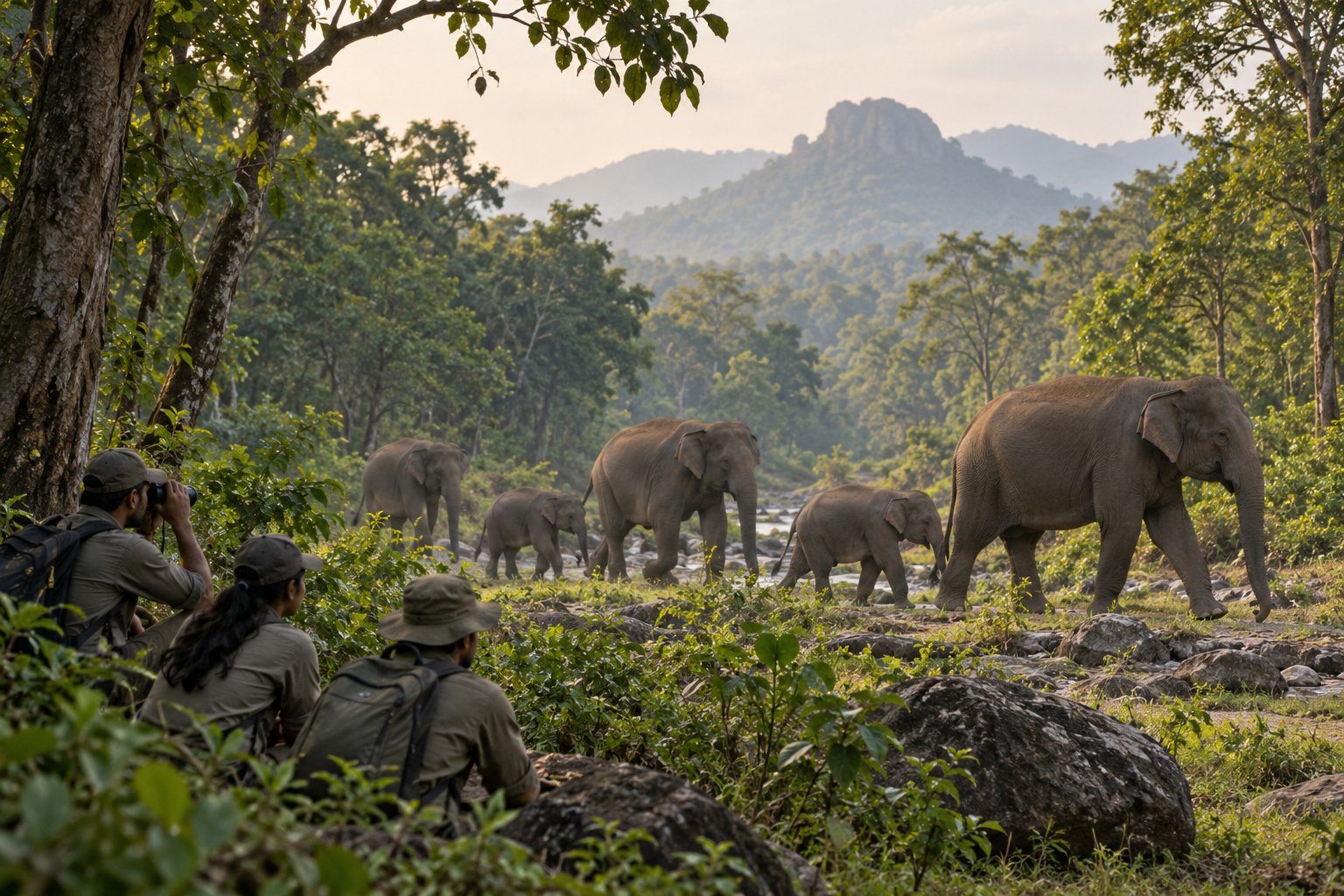
Project Elephant, run by the Union Environment Ministry since 1992, funds and advises States to protect elephants, their habitats and corridors, reduce human-elephant conflict and look after captive elephants. India has 33 Elephant Reserves and 150 identified corridors. A government note for World Elephant Day, 12 August 2026, put the wild population at 22,446 from the first DNA-based count.
Syllabus: Prelims · Environment & Ecology; GS3 · Environment & Conservation
In short
Project Elephant, run by the Union Environment Ministry since 1992, funds and guides States to protect elephants, their habitats and corridors on land herds share with people.
Project Elephant has expanded reserves and sharpened counting; its real test is keeping corridors open, so coexistence rests on connected land, not compensation.
Why it matters
A farmer on the edge of a forest can lose a season's paddy to a herd in one night, and sometimes a family member. Elephants range widely, with home ranges of 100 to 3,000 sq km, so when roads, railway lines and farms cut their routes, herds stray into fields and onto tracks. Project Elephant tries to keep those routes open through reserves and corridors, pays ex-gratia relief (₹10 lakh for a death, under the government's norms) and uses sensors to warn train drivers. The larger issue is coexistence: protecting a long-ranging, Endangered animal in a crowded country where people and elephants share the same land.
Prelims pointers
- Project Elephant (1992): a centrally sponsored scheme of the Union Environment Ministry for elephants, their habitats and corridors.
- Asian elephant (Elephas maximus): Endangered on the IUCN Red List; listed in Appendix I of CITES; in Schedule I of the Wildlife (Protection) Act, 1972.
- The elephant has been India's National Heritage Animal since 2010.
- Elephant Reserves: notified by State governments; not a protected-area category under the 1972 Act, whose categories are national parks, sanctuaries, conservation reserves and community reserves.
- Management Effectiveness Evaluation pilot reserves (2023): Shivalik (Uttarakhand), Kaziranga–Karbi Anglong (Assam), Mayurbhanj (Odisha) and Nilgiri.
- The Wildlife (Protection) Amendment Act, 2022 lets a holder of a valid ownership certificate transfer a captive elephant on conditions the Centre sets; the 2024 Rules set them.
- Ex-gratia for human-wildlife conflict is paid under the centrally sponsored schemes Project Tiger and Elephant, and Development of Wildlife Habitats.
- Keystone species: one whose effect on its ecosystem far exceeds its numbers; elephants disperse seeds, open paths and create water holes.
Practise a UPSC-style question
With reference to Project Elephant, consider the following statements:
1. It was launched in 1992 by the then Ministry of Environment and Forests as a centrally sponsored scheme.
2. Elephant Reserves under it are a category of protected area defined in the Wildlife (Protection) Act, 1972.
3. Under it, the Centre gives States financial and technical support to reduce human-elephant conflict.
Which of the statements given above is/are correct?
- (a) 1 and 2 only
- (b) 2 and 3 only
- (c) 1 and 3 only
- (d) 1, 2 and 3
Show the answer
Answer: (c) 1 and 3 only
1 is correct: Project Elephant began in 1992 as a centrally sponsored scheme of the then Ministry of Environment and Forests. 2 is incorrect: Elephant Reserves are notified by State governments as management landscapes; the Act's protected-area categories are national parks, sanctuaries, conservation reserves and community reserves. 3 is correct: the programme funds and advises States on habitat protection, captive elephants and human-elephant conflict.
In the news
More Explainers
- State Legislative Councils: Articles 168-172 and the graduates' and teachers' seats Polity
- Whales and dolphins in Indian waters: legal protection, IUCN status and strandings Environment
- The Aligarh Movement, AMU and the Article 30 minority test Polity
- Environmental clearance by States: SEIAA, SEAC and the EIA Notification, 2006 Environment
- Software vulnerabilities: CVE, CVSS, coordinated disclosure and CERT-In's role Sci-Tech
- Drug trafficking law in India: NDPS Act, PIT-NDPS, NCB and NCORD National
- Choosing the UN Secretary-General: Article 97, UNSC veto and straw polls World & IR
- UN Convention against Torture, and why India has not ratified it Polity
- NavIC: why India's navigation constellation cannot give a standalone position Sci-Tech
- International Energy Agency: membership, 90-day oil stocks and India's status World & IR
- PM Surya Ghar: Muft Bijli Yojana and the rooftop solar subsidy Economy
- HFSS foods: FSSAI's draft limits and front-of-pack warning labels National