
PRAGATI: how the Prime Minister's ICT platform reviews projects, schemes and grievances
Why in news: All India Radio reported on 19 October 2026 that the Prime Minister has chaired 53 PRAGATI meetings so far.
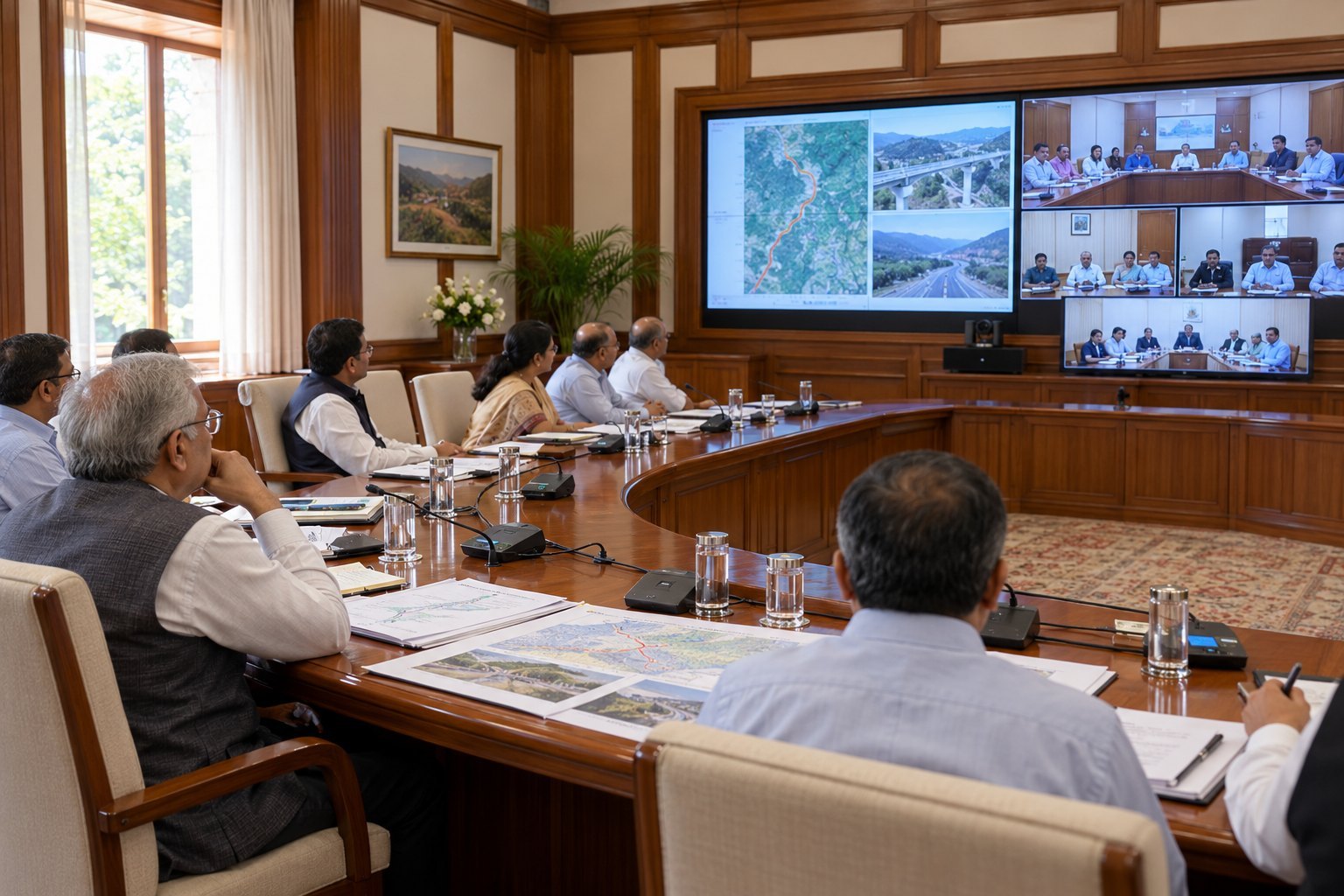
PRAGATI (Pro-Active Governance and Timely Implementation) is an ICT-enabled platform, launched on 25 March 2015, on which the Prime Minister reviews delayed projects, government schemes and public grievances with Union Secretaries and State Chief Secretaries over video-conference. All India Radio reported on 19 October 2026 that it has sped up stalled infrastructure projects.
Syllabus: GS2 · Federalism & Local Government; GS2 · Executive & Judiciary; GS3 · Infrastructure
Why this matters for UPSC
GS2 governance and e-governance: Prelims can ask PRAGATI's three tiers, technologies and the databases it uses, such as CPGRAMS; GS2 Mains, about project monitoring, cooperative federalism and time and cost overruns.
In short
PRAGATI (Pro-Active Governance and Timely Implementation), launched by the Prime Minister's Office in March 2015, is an ICT platform on which the Prime Minister personally reviews projects, schemes and grievances.
PRAGATI shows that top-level, data-backed review can unlock stalled projects; its gains will last only if States adopt it and outcomes are published consistently.
Why it matters
A bridge, power plant or hospital that stays unfinished costs more every year, and the people it was meant to serve wait longer. At AIIMS Bibinagar in Telangana, its Executive Director said, PRAGATI helped sort out water and power supply problems. When a central ministry, a State government and a land or forest authority each hold one piece of a project, nobody owns the delay; PRAGATI puts them in one meeting before the Prime Minister. The larger question is whether such speed can come from a system that works without the Prime Minister's personal attention, and whether States will build their own versions for schools, health and grievances.
Prelims pointers
- Linked platforms: PRAGATI integrates PM GatiShakti, PARIVESH and the PM Ref Portal, per the PIB backgrounder of 2026.
- Structure: three-tier (PMO, Union Government Secretaries, Chief Secretaries of States); designed in-house by the PMO team with the National Informatics Centre (NIC).
- Technologies bundled: digital data management, video-conferencing and geo-spatial technology.
- Objectives at launch: grievance redressal, programme implementation and project monitoring.
- Databases used: CPGRAMS for grievances, the Project Monitoring Group (PMG) for projects, and the Ministry of Statistics and Programme Implementation (MoSPI).
- Follow-up: the Cabinet Secretariat monitors projects; schemes and grievances are reviewed at ministry level under PMO oversight.
- SWAGAT (State Wide Attention on Grievances by Application of Technology), Gujarat, April 2003: online complaints, tracking, video-conference with officials and monthly public hearings.
- MoSPI monitors central sector infrastructure projects costing Rs 150 crore and above for time and cost overruns (as stated in 2015).
Practise a UPSC-style question
With reference to PRAGATI (Pro-Active Governance and Timely Implementation), consider the following statements:
1. It was designed in-house by the PMO team with the help of the National Informatics Centre.
2. It is a two-tier system linking the Prime Minister's Office directly with the Chief Secretaries of States.
3. It combines digital data management, video-conferencing and geo-spatial technology on one platform.
Which of the statements given above is/are correct?
- (a) 1 and 2 only
- (b) 2 and 3 only
- (c) 1 and 3 only
- (d) 1, 2 and 3
Show the answer
Answer: (c) 1 and 3 only
Answer: (c) 1 and 3 only. PRAGATI has three tiers, not two, which rules out every option with statement 2.
Statement 1: correct. The 2015 launch release says the PMO team designed the system in-house with the National Informatics Centre.
Statement 2: incorrect. PRAGATI is three-tier: the PMO, Union Government Secretaries and Chief Secretaries of States.
Statement 3: correct. It bundles digital data management, video-conferencing and geo-spatial technology.
Eliminate: Judge statement 2 first: Union Secretaries form a third tier, so statement 2 is incorrect. Out: (a), (b), (d).
Trap: Near-miss figure. The count of tiers is cut from three to two by dropping the Union Secretaries, a detail easy to overlook.
Remember: PRAGATI = 3 tiers (PMO, Union Secretaries, State Chief Secretaries) + 3 technologies, built by PMO with NIC.
More Explainers
- State Legislative Councils: Articles 168-172 and the graduates' and teachers' seats Polity
- Whales and dolphins in Indian waters: legal protection, IUCN status and strandings Environment
- The Aligarh Movement, AMU and the Article 30 minority test Polity
- Environmental clearance by States: SEIAA, SEAC and the EIA Notification, 2006 Environment
- Software vulnerabilities: CVE, CVSS, coordinated disclosure and CERT-In's role Sci-Tech
- Drug trafficking law in India: NDPS Act, PIT-NDPS, NCB and NCORD National
- Choosing the UN Secretary-General: Article 97, UNSC veto and straw polls World & IR
- UN Convention against Torture, and why India has not ratified it Polity
- NavIC: why India's navigation constellation cannot give a standalone position Sci-Tech
- International Energy Agency: membership, 90-day oil stocks and India's status World & IR
- PM Surya Ghar: Muft Bijli Yojana and the rooftop solar subsidy Economy
- HFSS foods: FSSAI's draft limits and front-of-pack warning labels National