
Phage therapy: bacteriophages against drug-resistant bacteria
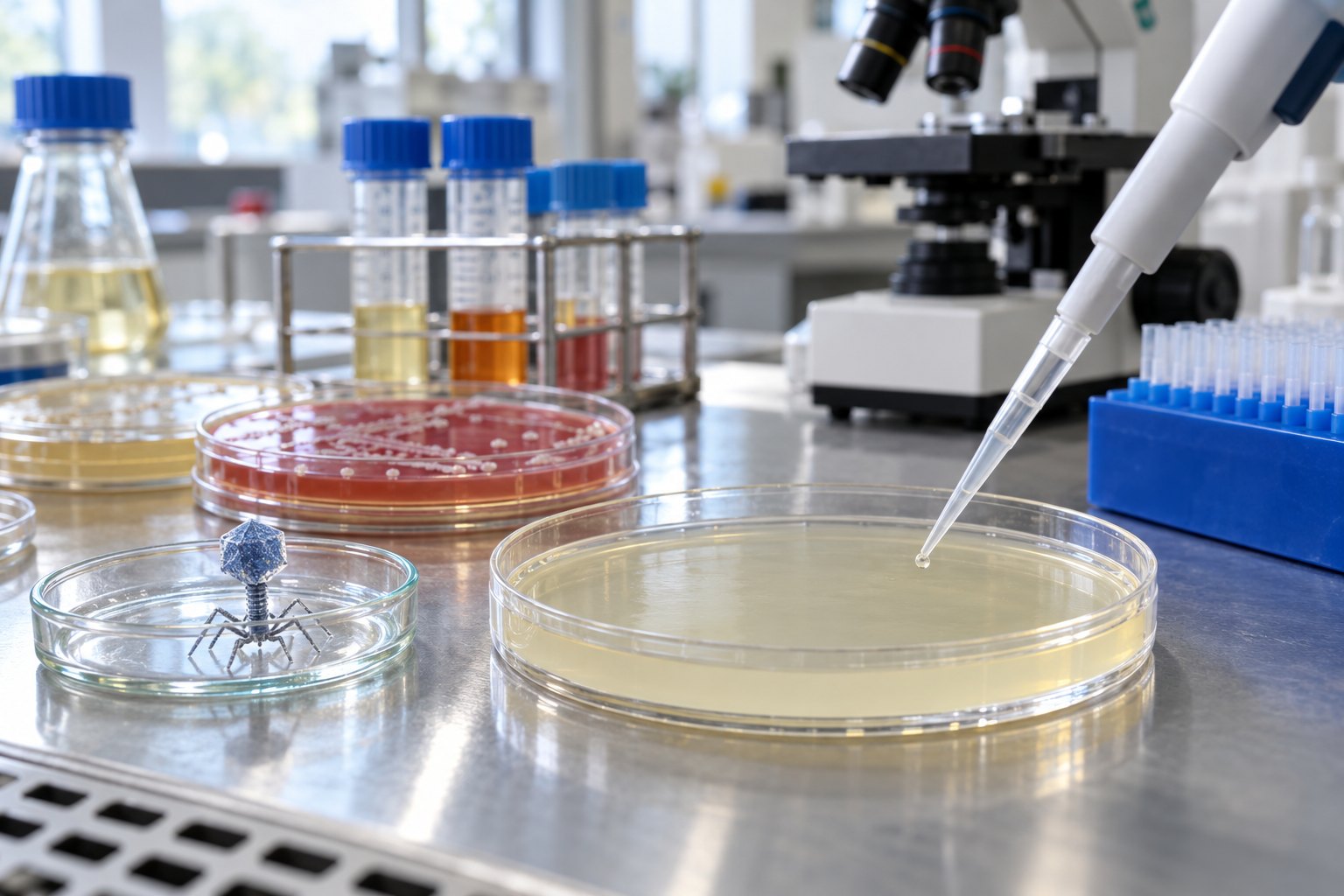
Phage therapy treats bacterial infections with bacteriophages, viruses that infect bacteria alone and burst them from inside. Because each phage recognises only matching surface receptors, cocktails of several phages are used against drug-resistant strains. A bioRxiv preprint reports that the genome models Evo 1 and Evo 2 designed 16 viable phages killing Escherichia coli.
Syllabus: GS3 · Science & Technology; GS2 · Health, Education & Human Resources; GS3 · IT, Space, Biotech & IPR
Why this matters for UPSC
GS3 science and technology, and GS2 health governance. Prelims can ask what a bacteriophage is, how lytic and lysogenic phages differ, and who publishes the Bacterial Priority Pathogens List; Mains, antimicrobial resistance and One Health.
In short
Phage therapy uses bacteriophages, viruses that infect bacteria alone, as living antibacterials: a century-old idea revived by antimicrobial resistance and now aided by generative genome design.
Phage therapy needs rigorous trials and a clinical pathway in India; generative design must advance with biosecurity screening inside the tools themselves.
Why it matters
For a patient whose infection no antibiotic clears, a burn wound, a venous leg ulcer or an implant that keeps getting infected, a phage multiplies where the bacteria are and fades once they are gone. Cost can favour it too: in one Polish series, phage treatment of resistant staphylococcal infections came to about 524 euros, below a ten-day course of some reserve antibiotics. The larger issue is that resistant infections make routine surgery, transplants and cancer chemotherapy riskier while few new antibiotics reach patients. If software can design phages in weeks, a hospital may one day match a phage to the strain growing in one person's wound.
Prelims pointers
- Antimicrobial resistance: it develops naturally through genetic changes, while misuse and overuse of antimicrobials in humans, animals and plants accelerates it; WHO calls it a top ten global health threat.
- WHO Bacterial Priority Pathogens List, 2024: covers 24 antibiotic-resistant pathogens across 15 bacterial families and guides research, development and investment; it updates the 2017 edition.
- ESKAPE pathogens: Enterococcus faecium, Staphylococcus aureus, Klebsiella pneumoniae, Acinetobacter baumannii, Pseudomonas aeruginosa and Enterobacter species, behind difficult-to-treat hospital infections.
- National Action Plan on Antimicrobial Resistance: released in 2017 under the Ministry of Health and Family Welfare; NAP-AMR 2.0 runs 2025-2029 with budgeted ministry plans.
- Global Action Plan on Antimicrobial Resistance: published by WHO after the World Health Assembly's May 2015 resolution asked member states to align national plans by May 2017.
- ΦX174: a lytic Microviridae phage of about 5.4 kilobases with 11 genes that infects Escherichia coli; the first complete DNA genome to be sequenced.
- Global Burden of Disease study, 2021: evaluated 84 pathogen-drug combinations and estimated 1.14 million deaths attributable to bacterial resistance, 4.71 million associated with it.
- National Centre for Disease Control and Indian Council of Medical Research: run India's antimicrobial resistance surveillance networks and publish annual resistance reports.
Practise a UPSC-style question
With reference to bacteriophages, consider the following statements:
1. They infect bacteria as well as human cells, which restricts their therapeutic use.
2. A lytic phage multiplies inside the bacterium and breaks open its cell wall to release new phages.
3. The range of bacteria a phage can infect is decided by the surface receptors it is able to bind.
Which of the statements given above is/are correct?
- (a) 1 and 2 only
- (b) 2 and 3 only
- (c) 1 and 3 only
- (d) 1, 2 and 3
Show the answer
Answer: (b) 2 and 3 only
Answer: (b) 2 and 3 only. Phages infect bacteria alone, while lysis and receptor binding are correctly described.
Statement 1: incorrect. Bacteriophages infect only bacteria, because human cells lack the surface receptors phages bind; they do not infect mammalian cells.
Statement 2: correct. A lytic phage takes over the host's replication machinery, builds progeny to a burst size and lyses the cell wall to release them.
Statement 3: correct. A phage adsorbs only where a complementary receptor exists on the bacterial surface, and that fixes its host range.
Eliminate: Statement 1 is the surest: phages cannot infect human cells, so every option carrying 1 falls. Out: (a), (c), (d).
Trap: Sounds right. Calling a phage a danger to human cells borrows the fear attached to viruses in general.
Remember: Phage specificity comes from receptors, which is why phages spare human cells and gut flora.
More Explainers
- State Legislative Councils: Articles 168-172 and the graduates' and teachers' seats Polity
- Whales and dolphins in Indian waters: legal protection, IUCN status and strandings Environment
- The Aligarh Movement, AMU and the Article 30 minority test Polity
- Environmental clearance by States: SEIAA, SEAC and the EIA Notification, 2006 Environment
- Software vulnerabilities: CVE, CVSS, coordinated disclosure and CERT-In's role Sci-Tech
- Drug trafficking law in India: NDPS Act, PIT-NDPS, NCB and NCORD National
- Choosing the UN Secretary-General: Article 97, UNSC veto and straw polls World & IR
- UN Convention against Torture, and why India has not ratified it Polity
- NavIC: why India's navigation constellation cannot give a standalone position Sci-Tech
- International Energy Agency: membership, 90-day oil stocks and India's status World & IR
- PM Surya Ghar: Muft Bijli Yojana and the rooftop solar subsidy Economy
- HFSS foods: FSSAI's draft limits and front-of-pack warning labels National