
Noise Pollution Rules, 2000: India's ambient noise limits and who enforces them
Why in news: The NHRC sought an action taken report within two weeks from the Maharashtra Pollution Control Board on Pune's Ganeshotsav noise (reported 2 September 2026).
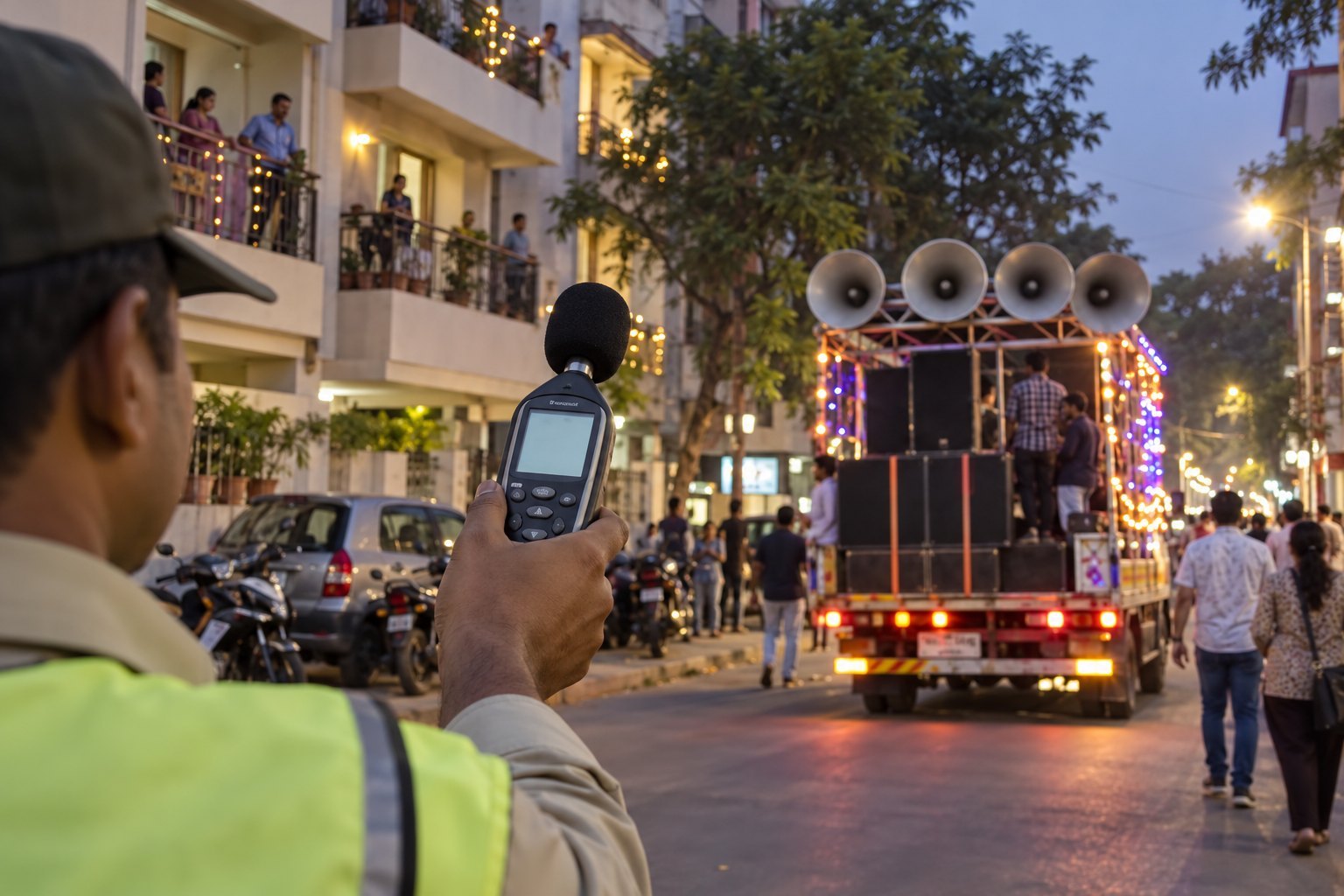
The Noise Pollution (Regulation and Control) Rules, 2000, made under the Environment (Protection) Act, 1986, set day and night noise limits for industrial, commercial and residential areas and silence zones, and bar loudspeakers outside closed premises from 10 pm to 6 am. Pune's festival noise revived them when the NHRC sought a State pollution board's report.
Syllabus: Prelims · Environment & Ecology; GS2 · Health, Education & Human Resources; GS3 · Environment & Conservation
Why this matters for UPSC
GS3 environmental pollution: Prelims can ask the zone-wise dB(A) limits, silence zones, the night rule and the Environment (Protection) Act, 1986 behind them; Mains, why noise limits go unenforced and how cities can grow quieter.
In short
Noise pollution is unwanted sound that harms health. India caps it through the Noise Pollution (Regulation and Control) Rules, 2000, which set zone-wise day and night limits.
India's noise limits are sound on paper; notified silence zones, denser monitoring and firm district action must make them real.
Why it matters
A student revising for an exam next to a pandal's speaker wall, a heart patient in a flat above a busy road, and a newborn in a hospital ward all pay for noise with lost sleep and raised stress. The Rules give each of them a lawful limit and a named officer to call, but only if the State has drawn the zones and the police act on complaints. Where enforcement slips, festival nights stretch past 10 pm and the quiet ring around hospitals and schools exists only on paper. The larger issue is that cities are growing louder while noise is still treated as a nuisance, though its harm to the heart and mind resembles that of dirty air.
Prelims pointers
- Parent law: the Rules were made under sections 3(2)(ii), 6 and 25 of the Environment (Protection) Act, 1986, read with rule 5 of the 1986 Rules.
- Schedule, dB(A) Leq day/night: industrial 75/70, commercial 65/55, residential 55/45, silence zone 50/40.
- Rule 3(5): an area of not less than 100 metres around hospitals, educational institutions and courts may be declared a silence zone by the State.
- Rule 5(3): States may permit loudspeakers between 10 pm and midnight on cultural, religious or festive occasions, for at most 15 days a calendar year.
- Rule 5A: no horns in silence zones or at night in residential areas; no sound-emitting crackers in silence zones or at night.
- Rule 4(3): State Pollution Control Boards, consulting the CPCB, collect and publish noise data and abatement measures.
- NANMN stations: 10 each in Bengaluru, Chennai, Delhi, Hyderabad, Kolkata, Lucknow and Mumbai.
Practise a UPSC-style question
With reference to the Noise Pollution (Regulation and Control) Rules, 2000, consider the following statements:
1. The Rules were made by the Central Government under the Environment (Protection) Act, 1986.
2. Under the Rules, night time runs from 11 pm to 6 am.
3. The State Government must classify areas into industrial, commercial, residential or silence zones.
Which of the statements given above is/are correct?
- (a) 1 and 2 only
- (b) 2 and 3 only
- (c) 1 and 3 only
- (d) 1, 2 and 3
Show the answer
Answer: (c) 1 and 3 only
Answer: (c) 1 and 3 only. Night time under the Rules starts at 10 pm, not 11 pm.
Statement 1: correct. The Centre made the Rules under sections 3, 6 and 25 of the Environment (Protection) Act, 1986.
Statement 2: incorrect. The Rules define night time as 10 pm to 6 am; day time is 6 am to 10 pm.
Statement 3: correct. Rule 3(2) says the State Government shall categorise areas into the four zones.
Eliminate: Judge statement 2 first: the night window opens at 10 pm, so statement 2 is incorrect. Out: (a), (b), (d).
Trap: Near-miss figure. The night window is shifted by one hour, close enough to feel familiar.
Remember: Noise Rules, 2000: night is 10 pm to 6 am; States draw the four zones.
More Explainers
- State Legislative Councils: Articles 168-172 and the graduates' and teachers' seats Polity
- Whales and dolphins in Indian waters: legal protection, IUCN status and strandings Environment
- The Aligarh Movement, AMU and the Article 30 minority test Polity
- Environmental clearance by States: SEIAA, SEAC and the EIA Notification, 2006 Environment
- Software vulnerabilities: CVE, CVSS, coordinated disclosure and CERT-In's role Sci-Tech
- Drug trafficking law in India: NDPS Act, PIT-NDPS, NCB and NCORD National
- Choosing the UN Secretary-General: Article 97, UNSC veto and straw polls World & IR
- UN Convention against Torture, and why India has not ratified it Polity
- NavIC: why India's navigation constellation cannot give a standalone position Sci-Tech
- International Energy Agency: membership, 90-day oil stocks and India's status World & IR
- PM Surya Ghar: Muft Bijli Yojana and the rooftop solar subsidy Economy
- HFSS foods: FSSAI's draft limits and front-of-pack warning labels National