
Neutron stars, pulsars and X-ray binaries
Why in news: On 21 October 2026, PIB announced a Raman Research Institute study indicating that the X-ray pulsar Centaurus X-3 feeds through an accretion disk.
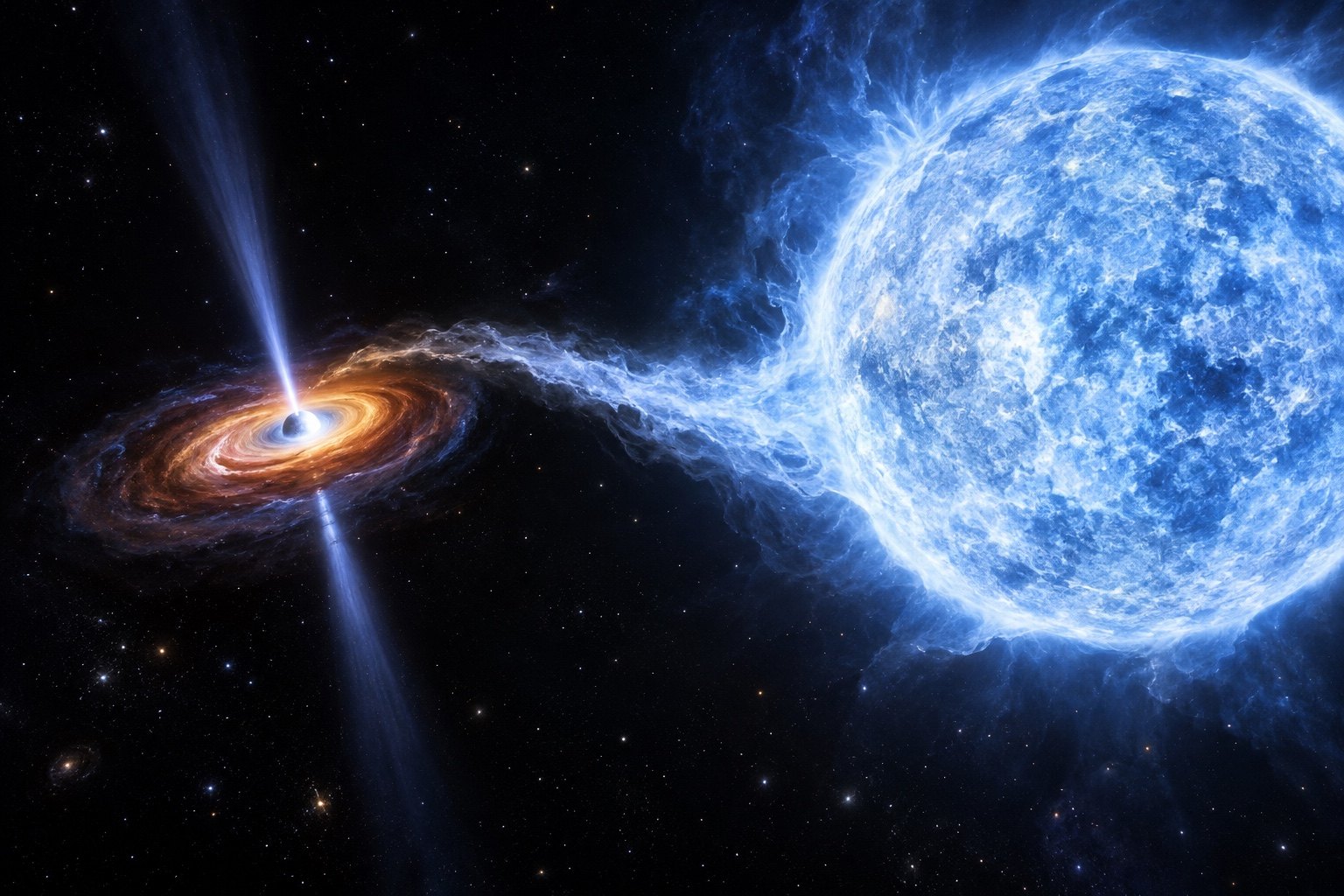
A neutron star is the collapsed core of a massive star, about 20 km across yet holding roughly the Sun's mass. Spinning with strong magnetic fields, it can beam radiation as a pulsar and, beside a companion star, power an X-ray binary. A Raman Research Institute study indicates that the pulsar Centaurus X-3 feeds through an accretion disk.
Syllabus: Prelims · Science & Technology; GS3 · Science & Technology; GS3 · Indian Achievements in S&T
Why this matters for UPSC
GS III Science and Technology and Prelims General Science: Prelims can ask how a neutron star forms, why a pulsar pulses and how X-ray binaries feed; Mains, about India's space astronomy through AstroSat and XPoSat.
In short
A neutron star is a massive star's ultra-dense collapsed core; spinning with strong magnetic fields it appears as a pulsar, and beside a companion it powers an X-ray binary.
Centaurus X-3 suggests accretion can break its textbook class; India should pair archival analysis with sustained observatories like AstroSat and XPoSat to test such models.
Why it matters
Neutron stars hold matter packed tighter than anything on Earth and magnetic fields no laboratory can make, so astronomers use them to test physics at its limits. Because they sit thousands of light years away and look like single points of light, scientists read their surroundings from how the light changes. Evidence of a disk where a wind was expected means emission models of this system must be revised, its lead researcher says. For India, the result shows that a home institute can win new science from archived data, while its own satellites, AstroSat and XPoSat, give its astronomers instruments of their own.
Prelims pointers
- A collapsing stellar core of about 1 to 3 solar masses stops as a neutron star; a heavier core goes on to form a stellar-mass black hole.
- Stars of 8 or more solar masses end in supernovae; lighter stars end as white dwarfs, which cannot exceed about 1.4 solar masses, the Chandrasekhar limit.
- A typical neutron star's magnetic field is trillions of times Earth's; a magnetar's field is about 1,000 times stronger still.
- Pulsar periods typically range from milliseconds to seconds; one pulse is seen per rotation when the beam crosses the line of sight.
- Earth's atmosphere blocks cosmic X-rays and ultraviolet light, so X-ray and ultraviolet telescopes must observe from space.
- AstroSat was launched on 28 September 2015 by PSLV-C30 from Sriharikota; its data are processed and archived at the Indian Space Science Data Centre, Bylalu.
- XPoSat was launched on 1 January 2024 by PSLV-C58; its POLIX payload (8-30 keV) was built by the Raman Research Institute, XSPECT by URSC.
- XMM-Newton was launched on 10 December 1999 on an Ariane 5; its three X-ray telescopes each nest 58 mirrors.
Practise a UPSC-style question
With reference to neutron stars, consider the following statements:
1. A collapsing stellar core heavier than about three solar masses ends as a white dwarf.
2. A neutron star forms when the core of a massive star collapses after its nuclear fuel runs out.
3. A typical neutron star is about 20 kilometres across yet holds roughly the mass of the Sun.
Which of the statements given above is/are correct?
- (a) 1 and 2 only
- (b) 2 and 3 only
- (c) 1 and 3 only
- (d) 1, 2 and 3
Show the answer
Answer: (b) 2 and 3 only
Answer: (b) 2 and 3 only. A collapsed core becomes a neutron star; heavier cores become black holes, not white dwarfs.
Statement 1: incorrect. Per NASA, a core above about 3 solar masses keeps collapsing into a stellar-mass black hole; white dwarfs come from stars below about 8 solar masses.
Statement 2: correct. When a massive star runs out of fuel its core collapses, crushing protons and electrons into neutrons.
Statement 3: correct. NASA gives neutron stars a diameter of about 20 km with the mass of a sun packed inside.
Eliminate: Statement 2 is the standard account of how a neutron star forms, so it is correct. Out: (c).
Eliminate: Statement 1 is wrong, since cores that heavy form black holes. Out: (a), (d).
Trap: Look-alike names. White dwarf, neutron star and black hole are all stellar remnants; the statement pins the heaviest core on the lightest remnant.
Remember: core of about 1-3 solar masses: neutron star; heavier: black hole.
More Explainers
- State Legislative Councils: Articles 168-172 and the graduates' and teachers' seats Polity
- Whales and dolphins in Indian waters: legal protection, IUCN status and strandings Environment
- The Aligarh Movement, AMU and the Article 30 minority test Polity
- Environmental clearance by States: SEIAA, SEAC and the EIA Notification, 2006 Environment
- Software vulnerabilities: CVE, CVSS, coordinated disclosure and CERT-In's role Sci-Tech
- Drug trafficking law in India: NDPS Act, PIT-NDPS, NCB and NCORD National
- Choosing the UN Secretary-General: Article 97, UNSC veto and straw polls World & IR
- UN Convention against Torture, and why India has not ratified it Polity
- NavIC: why India's navigation constellation cannot give a standalone position Sci-Tech
- International Energy Agency: membership, 90-day oil stocks and India's status World & IR
- PM Surya Ghar: Muft Bijli Yojana and the rooftop solar subsidy Economy
- HFSS foods: FSSAI's draft limits and front-of-pack warning labels National