
National Supercomputing Mission and India's PARAM supercomputers
Why in news: The National Supercomputing Mission had deployed 40 supercomputers with 68 petaflops of combined capacity by September 2026, the government said on 4 October 2026.
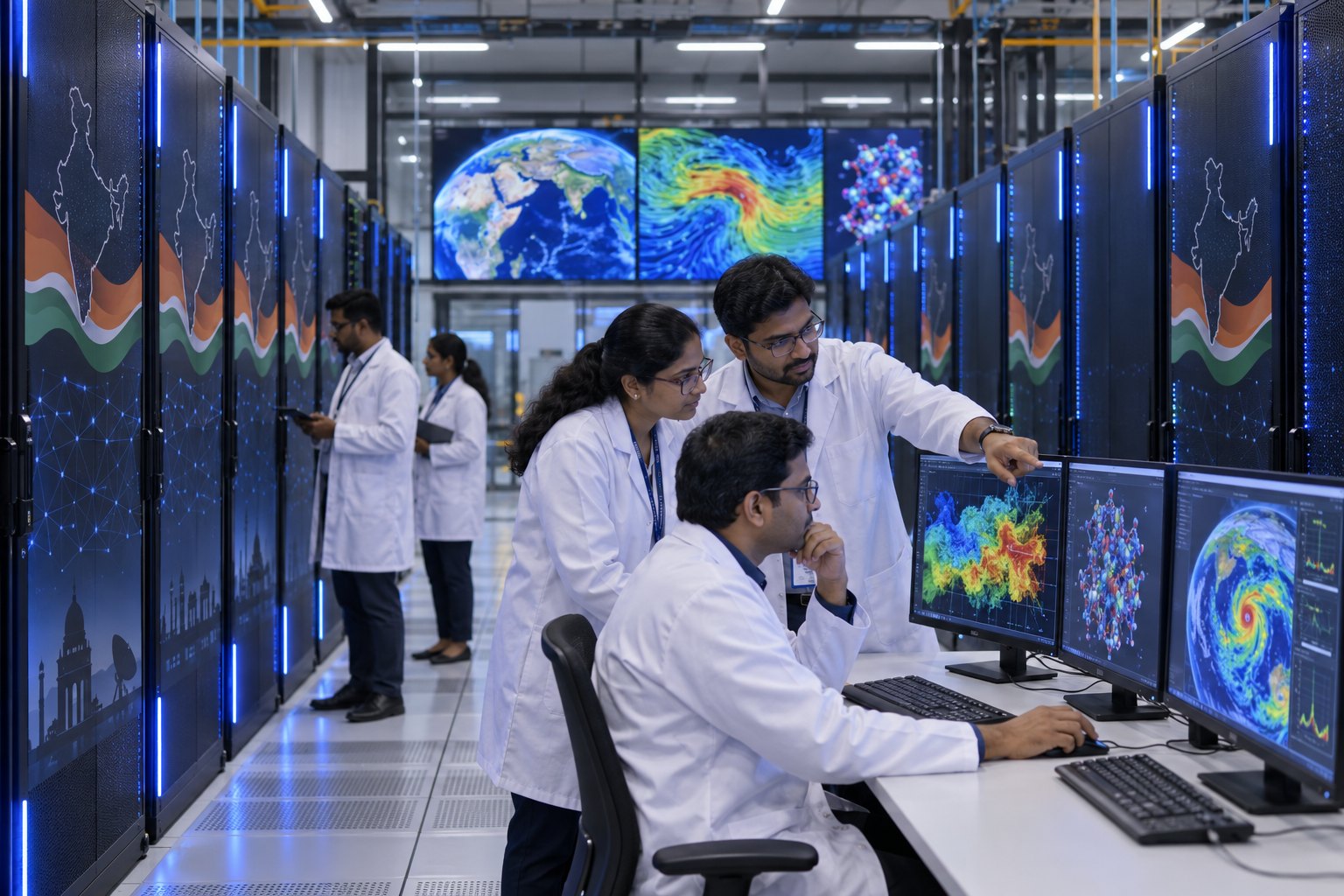
The National Supercomputing Mission (NSM), launched in 2015 and steered jointly by the Department of Science and Technology and the Ministry of Electronics and Information Technology, builds and networks supercomputers for research and develops Indian servers and software. C-DAC and IISc implement it. A government note of 4 October 2026 put its fleet at 40 supercomputers delivering 68 petaflops.
Syllabus: GS3 · Science & Technology; GS3 · Indian Achievements in S&T; GS3 · IT, Space, Biotech & IPR
In short
The National Supercomputing Mission, launched in April 2015, builds and networks Indian supercomputers, seeking self-reliance in a strategic technology that research and forecasting now depend on.
NSM has shown India can build supercomputers at home; its worth now lies in scaling capacity and turning computation into usable warnings and research.
Why it matters
A village in the Mahanadi basin can get a flood warning up to two days ahead because a supercomputer runs the river models; a drug researcher can screen existing medicines quickly, as was done during COVID-19. That work needs computing power no ordinary server can give. Building the machines and their parts at home reduces dependence on a few foreign suppliers and keeps sensitive weather, health and research data within the country's own systems. According to the government, NSM systems serve agencies such as the India Meteorological Department and the Central Water Commission and have supported over 16,000 researchers. The larger issue is self-reliance in a technology that is becoming strategic.
Prelims pointers
- FLOPS: floating-point operations per second; tera = 10^12, peta = 10^15, exa = 10^18. A petaflop is a thousand teraflops.
- NSM (2015): steered by DST and MeitY; implemented by C-DAC, Pune and IISc, Bengaluru.
- C-DAC: a research and development organisation of MeitY, set up in Pune in 1988; built PARAM 8000 (1991).
- Rudra: an indigenous high-performance server designed by C-DAC; PARAM Rudra supercomputers pair it with an Indian system software stack.
- PARAM Shavak: a supercomputer-in-a-box designed and made in India for students and researchers in colleges and universities.
- National Knowledge Network: the high-speed network linking academic and research institutions; it connects NSM's facilities and is implemented by the National Informatics Centre.
- Parallel processing: many processors work at the same time on one calculation; hence supercomputers are called parallel computers.
- SWAYAM: the Ministry of Education's online course platform; NPTEL, an initiative of the IITs and IISc, offers NSM's HPC course on it.
Practise a UPSC-style question
With reference to the National Supercomputing Mission (NSM), consider the following statements:
1. It is steered jointly by the Department of Science and Technology and the Ministry of Electronics and Information Technology.
2. It is implemented by the Indian Space Research Organisation and the Indian Institute of Science.
3. It aims to build self-reliance by developing supercomputer servers, software and cooling technology in India.
Which of the statements given above is/are correct?
- (a) 1 and 2 only
- (b) 2 and 3 only
- (c) 1 and 3 only
- (d) 1, 2 and 3
Show the answer
Answer: (c) 1 and 3 only
1 is correct: DST and MeitY jointly steer NSM, launched in 2015. 2 is incorrect: the implementing agencies are the Centre for Development of Advanced Computing (C-DAC), Pune and the Indian Institute of Science, Bengaluru; ISRO has no such role. 3 is correct: the mission has developed indigenous servers, system software, interconnects and cooling technology.
More Explainers
- State Legislative Councils: Articles 168-172 and the graduates' and teachers' seats Polity
- Whales and dolphins in Indian waters: legal protection, IUCN status and strandings Environment
- The Aligarh Movement, AMU and the Article 30 minority test Polity
- Environmental clearance by States: SEIAA, SEAC and the EIA Notification, 2006 Environment
- Software vulnerabilities: CVE, CVSS, coordinated disclosure and CERT-In's role Sci-Tech
- Drug trafficking law in India: NDPS Act, PIT-NDPS, NCB and NCORD National
- Choosing the UN Secretary-General: Article 97, UNSC veto and straw polls World & IR
- UN Convention against Torture, and why India has not ratified it Polity
- NavIC: why India's navigation constellation cannot give a standalone position Sci-Tech
- International Energy Agency: membership, 90-day oil stocks and India's status World & IR
- PM Surya Ghar: Muft Bijli Yojana and the rooftop solar subsidy Economy
- HFSS foods: FSSAI's draft limits and front-of-pack warning labels National