
National Policy on Biofuels: ethanol blending, 2G, CBG and SAF
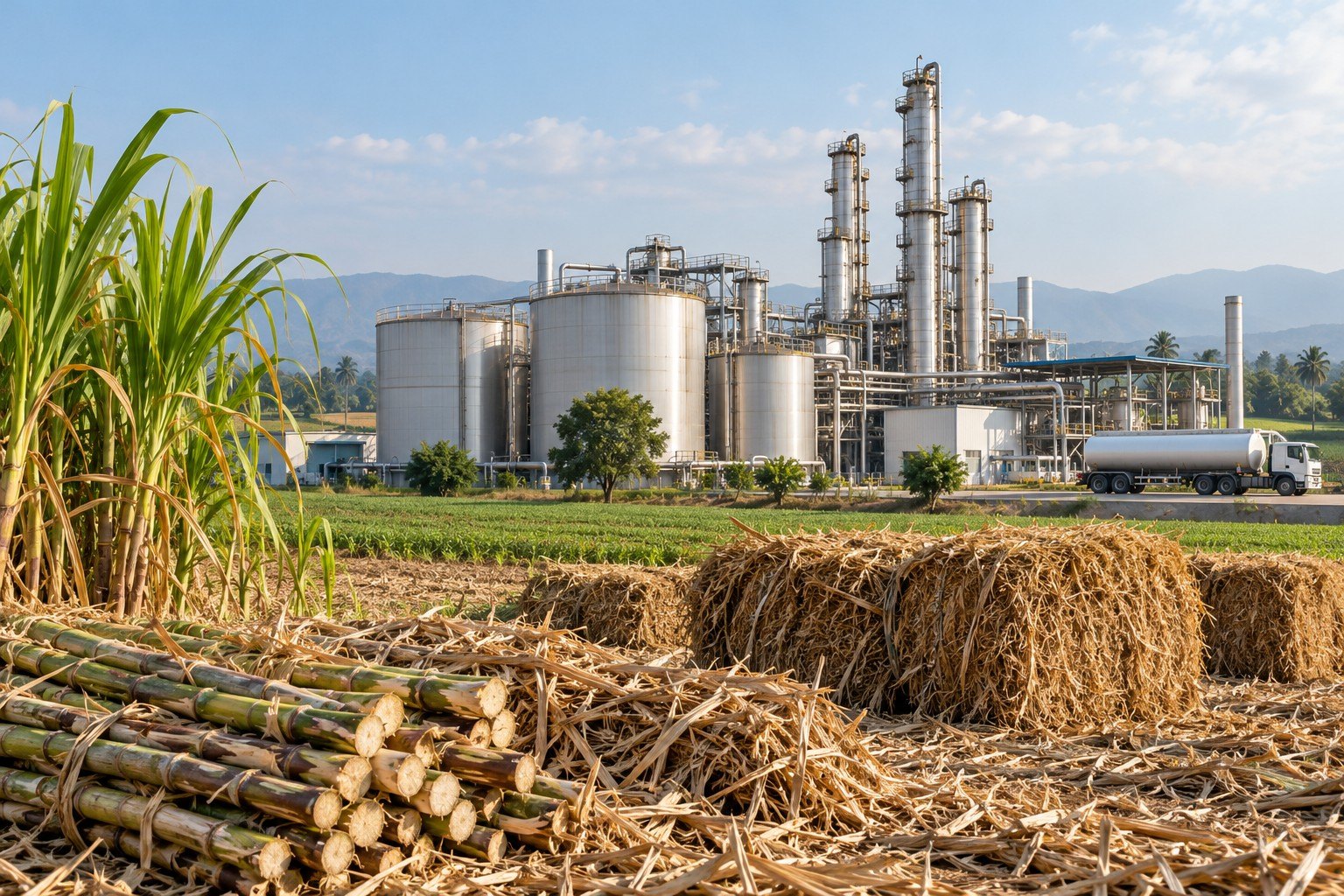
Biofuels are fuels made from biomass such as sugarcane, grain, crop residue and waste. India's National Policy on Biofuels, 2018, notified by the Ministry of Petroleum and Natural Gas and amended in 2022, advanced the 20% ethanol-in-petrol target to ESY 2025-26. The ministry's July 2026 Q&A answered concerns over E20 mileage and the lack of pure petrol at pumps.
Syllabus: Prelims · Environment & Ecology; GS3 · Infrastructure; GS3 · Environment & Conservation
Why this matters for UPSC
GS3 energy and environment: Prelims asks the National Policy on Biofuels, 2018's categories and feedstocks, PM JI-VAN Yojana, SATAT and the Global Biofuels Alliance; GS3 Mains asks about energy security and food versus fuel.
In short
Biofuels are liquid or gaseous fuels made from biomass and wastes. India steers them through the National Policy on Biofuels, 2018, balancing energy security, farm incomes and food supply.
Biofuels serve India best when blending targets follow feedstock reality, with residues and waste growing so that food and sugar supplies are not squeezed.
Why it matters
A farmer selling maize or crop stubble to a distillery, a motorist filling E20 and an airline buying jet fuel are all touched by the same policy. Each litre of ethanol blended means less crude bought abroad and more money paid at home, which steadies pump prices when oil markets swing. The cost falls elsewhere: grain and cane drawn into fuel are not available for food or sugar, and some older vehicles run slightly less far on a litre. How India chooses its feedstocks therefore decides whether biofuels ease import and climate pressures or add to strain on food and farms.
Prelims pointers
- The 2018 biofuel policy is the Petroleum Ministry's; it superseded the 2009 policy issued through the Ministry of New and Renewable Energy.
- The National Biofuel Coordination Committee is chaired by the Union Petroleum Minister and must approve surplus food grains for ethanol.
- PM JI-VAN 2G projects: Indian Oil at Panipat (Haryana), BPCL at Bargarh (Odisha), HPCL at Bathinda (Punjab), NRL at Numaligarh (Assam).
- SATAT buyers are IOCL, BPCL, HPCL, GAIL and IGL, which invited expressions of interest to procure CBG from entrepreneurs at an assured price.
- CBG blending obligation set by the committee in November 2023: 1%, 3% and 4% of CNG and PNG use for FY 2025-26 to 2027-28, then 5%.
- Blended jet fuel must meet BIS standard IS 1571, and SAF for blending IS 17081; ICAO runs CORSIA, mandatory from 2027.
- The Global Biofuels Alliance was launched by India with Singapore, Bangladesh, Italy, the USA, Brazil, Argentina, Mauritius and the UAE.
Practise a UPSC-style question
With reference to the National Policy on Biofuels, 2018, consider the following statements:
1. It was notified by the Ministry of New and Renewable Energy, replacing the biofuel policy of 2009.
2. It classifies second-generation ethanol and bio-CNG as advanced biofuels.
3. It allows surplus food grains to be used for ethanol with the approval of the National Biofuel Coordination Committee.
Which of the statements given above is/are correct?
- (a) 1 and 2 only
- (b) 2 and 3 only
- (c) 1 and 3 only
- (d) 1, 2 and 3
Show the answer
Answer: (b) 2 and 3 only
Answer: (b) 2 and 3 only. The policy is the Petroleum Ministry's; the classification and grain rule are as stated.
Statement 1: incorrect. The Ministry of Petroleum and Natural Gas notified it on 4 June 2018; the superseded 2009 policy came through the Ministry of New and Renewable Energy.
Statement 2: correct. The policy lists 2G ethanol, MSW to drop-in fuels, 3G biofuels and bio-CNG as advanced biofuels (PIB, 16 May 2018).
Statement 3: correct. Surplus food grains may be used for ethanol for blending only with the committee's approval.
Eliminate: Statement 1 is the surest call, since the 2018 policy is a Petroleum Ministry document. Out: (a), (c), (d).
Trap: Swapped attribution. The ministry of the older 2009 policy is pinned on the 2018 one.
Remember: 2009 policy, MNRE; 2018 policy, Petroleum Ministry.
More Explainers
- State Legislative Councils: Articles 168-172 and the graduates' and teachers' seats Polity
- Whales and dolphins in Indian waters: legal protection, IUCN status and strandings Environment
- The Aligarh Movement, AMU and the Article 30 minority test Polity
- Environmental clearance by States: SEIAA, SEAC and the EIA Notification, 2006 Environment
- Software vulnerabilities: CVE, CVSS, coordinated disclosure and CERT-In's role Sci-Tech
- Drug trafficking law in India: NDPS Act, PIT-NDPS, NCB and NCORD National
- Choosing the UN Secretary-General: Article 97, UNSC veto and straw polls World & IR
- UN Convention against Torture, and why India has not ratified it Polity
- NavIC: why India's navigation constellation cannot give a standalone position Sci-Tech
- International Energy Agency: membership, 90-day oil stocks and India's status World & IR
- PM Surya Ghar: Muft Bijli Yojana and the rooftop solar subsidy Economy
- HFSS foods: FSSAI's draft limits and front-of-pack warning labels National