
Musk deer in India: protection and conservation breeding
Why in news: A Central Zoo Authority inventory of September 2026, reported on 14 October 2026, lists only two captive musk deer, both male.
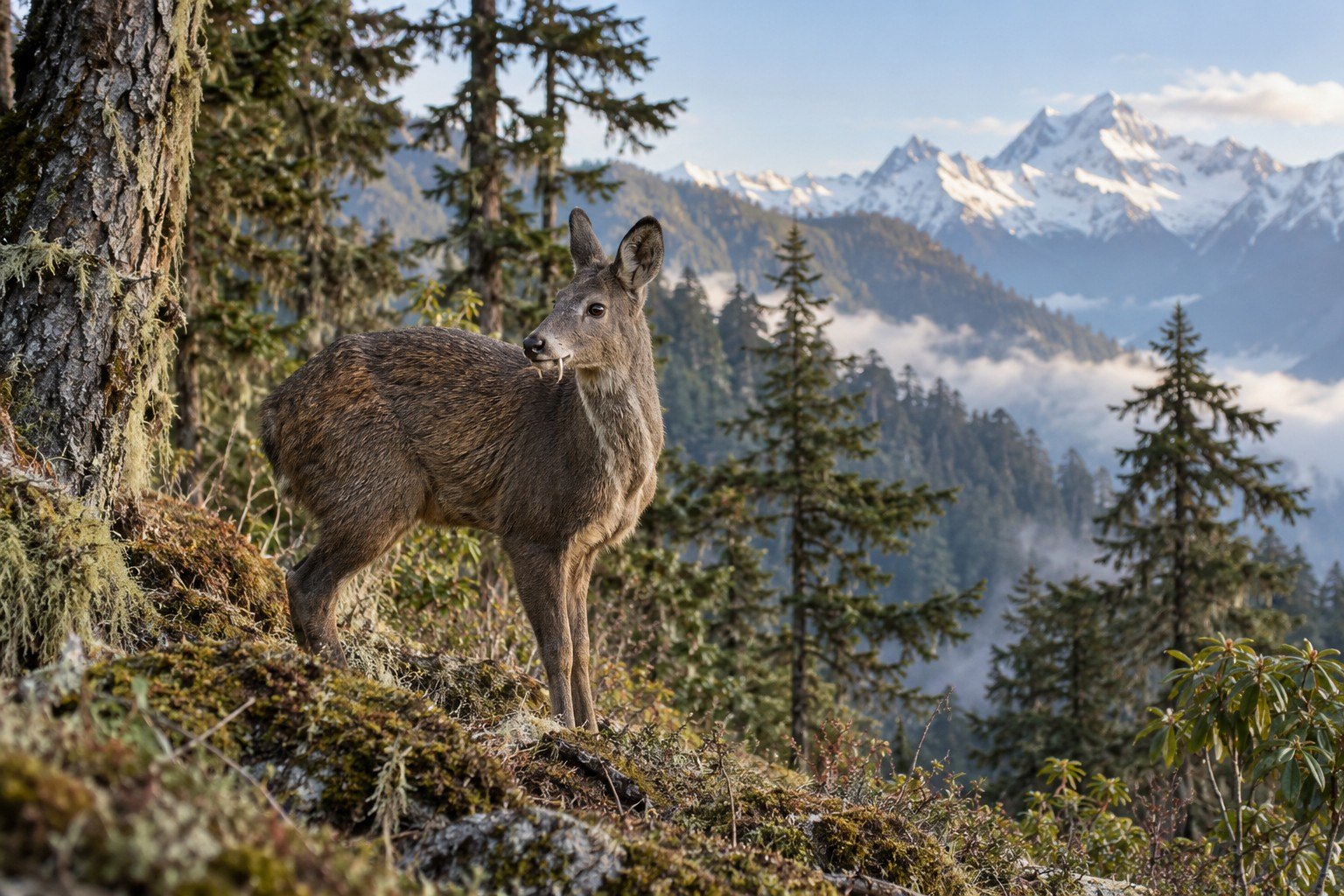
India has four musk deer species, all in Schedule I of the Wild Life (Protection) Act, 1972, and its musk deer populations are in CITES Appendix I; males are killed for their musk. The Central Zoo Authority's inventory as of September 2026, disclosed under RTI, lists only two captive musk deer in recognised zoos, both male.
Syllabus: Prelims · Environment & Ecology; GS2 · Statutory & Regulatory Bodies; GS3 · Environment & Conservation
Why this matters for UPSC
GS3 conservation and Prelims biodiversity: Prelims asks a species' Schedule, CITES Appendix, IUCN status and range, and the Central Zoo Authority's role; Mains asks why ex-situ conservation of threatened species fails.
In short
Musk deer are small Himalayan ungulates of the family Moschidae, poached for the musk pod of males; India protects its four species under Schedule I and CITES Appendix I.
Legal cover is strong on paper; survival now rests on correctly identified founder stock, regular census and policing the musk trade.
Why it matters
A species that cannot be bred in captivity has no fallback if wild numbers crash. Musk deer live in remote Himalayan slopes where poachers are hard to catch, and every adult male is a target because its musk pod is so valuable. Without females in zoos and without an up-to-date count in the wild, managers cannot tell whether the animal is recovering or vanishing. The case also shows a wider gap in India's conservation: strong laws on paper, but breeding plans that stall over poor records, wrongly identified animals and centres that fall between regulators.
Prelims pointers
- Schedule I, Part A of the amended Act lists Alpine (Moschus chrysogaster), Black (M. fuscus), Himalayan (M. leucogaster) and Kashmir (M. cupreus) musk deer.
- Section 9 of the Wild Life (Protection) Act bars hunting any animal in Schedules I and II, except under sections 11 and 12.
- CITES lists Moschus populations of Afghanistan, Bhutan, India, Myanmar, Nepal and Pakistan in Appendix I; all others, China's included, in Appendix II.
- IUCN assesses the Alpine, Himalayan and Black musk deer each as Endangered, citing over-exploitation.
- IUCN ranges: Black musk deer in Arunachal Pradesh, Himalayan in northern India including Sikkim, Alpine in north-eastern India.
- Section 38H: no zoo may operate in India without recognition by the Central Zoo Authority.
- Section 38A: the Authority has a chairperson, up to ten members and a Member-Secretary, appointed by the Central Government.
- The amended Act has four Schedules: I and II for animals, III for specified plants, IV for CITES-listed specimens.
Practise a UPSC-style question
With reference to the listing of musk deer (Moschus spp.) under CITES, consider the following statements:
1. The musk deer populations of China are included in Appendix I.
2. The musk deer populations of India are included in Appendix I.
Which of the statements given above is/are correct?
- (a) 1 only
- (b) 2 only
- (c) Both 1 and 2
- (d) Neither 1 nor 2
Show the answer
Answer: (b) 2 only
Answer: (b) 2 only. CITES splits the genus: Appendix I for six South Asian range States, Appendix II for every other population.
Statement 1: incorrect. China's musk deer populations fall under Appendix II, which covers all populations outside the six countries named in the Appendix I entry.
Statement 2: correct. The Moschus spp. entry places the populations of Afghanistan, Bhutan, India, Myanmar, Nepal and Pakistan in Appendix I.
Eliminate: Statement 2 is the surest, since India is one of the six Appendix I countries. Out: (a), (d).
Eliminate: Statement 1 fails because China sits in Appendix II. Out: (c).
Trap: Swapped attribution. China holds the bulk of the Alpine musk deer's range, so the strictest listing sounds natural for it; the split listing in fact leaves China in Appendix II.
Remember: Musk deer in CITES Appendix I: Afghanistan, Bhutan, India, Myanmar, Nepal, Pakistan; the rest, China included, Appendix II.
More Explainers
- State Legislative Councils: Articles 168-172 and the graduates' and teachers' seats Polity
- Whales and dolphins in Indian waters: legal protection, IUCN status and strandings Environment
- The Aligarh Movement, AMU and the Article 30 minority test Polity
- Environmental clearance by States: SEIAA, SEAC and the EIA Notification, 2006 Environment
- Software vulnerabilities: CVE, CVSS, coordinated disclosure and CERT-In's role Sci-Tech
- Drug trafficking law in India: NDPS Act, PIT-NDPS, NCB and NCORD National
- Choosing the UN Secretary-General: Article 97, UNSC veto and straw polls World & IR
- UN Convention against Torture, and why India has not ratified it Polity
- NavIC: why India's navigation constellation cannot give a standalone position Sci-Tech
- International Energy Agency: membership, 90-day oil stocks and India's status World & IR
- PM Surya Ghar: Muft Bijli Yojana and the rooftop solar subsidy Economy
- HFSS foods: FSSAI's draft limits and front-of-pack warning labels National