
Martian analogue sites and hydrous sulphates: reading Mars's watery past
Why in news: On 16 October 2026, the Ministry of Science & Technology reported University of Kerala finds of melanterite and gypsum in Tamil Nadu and Chile.
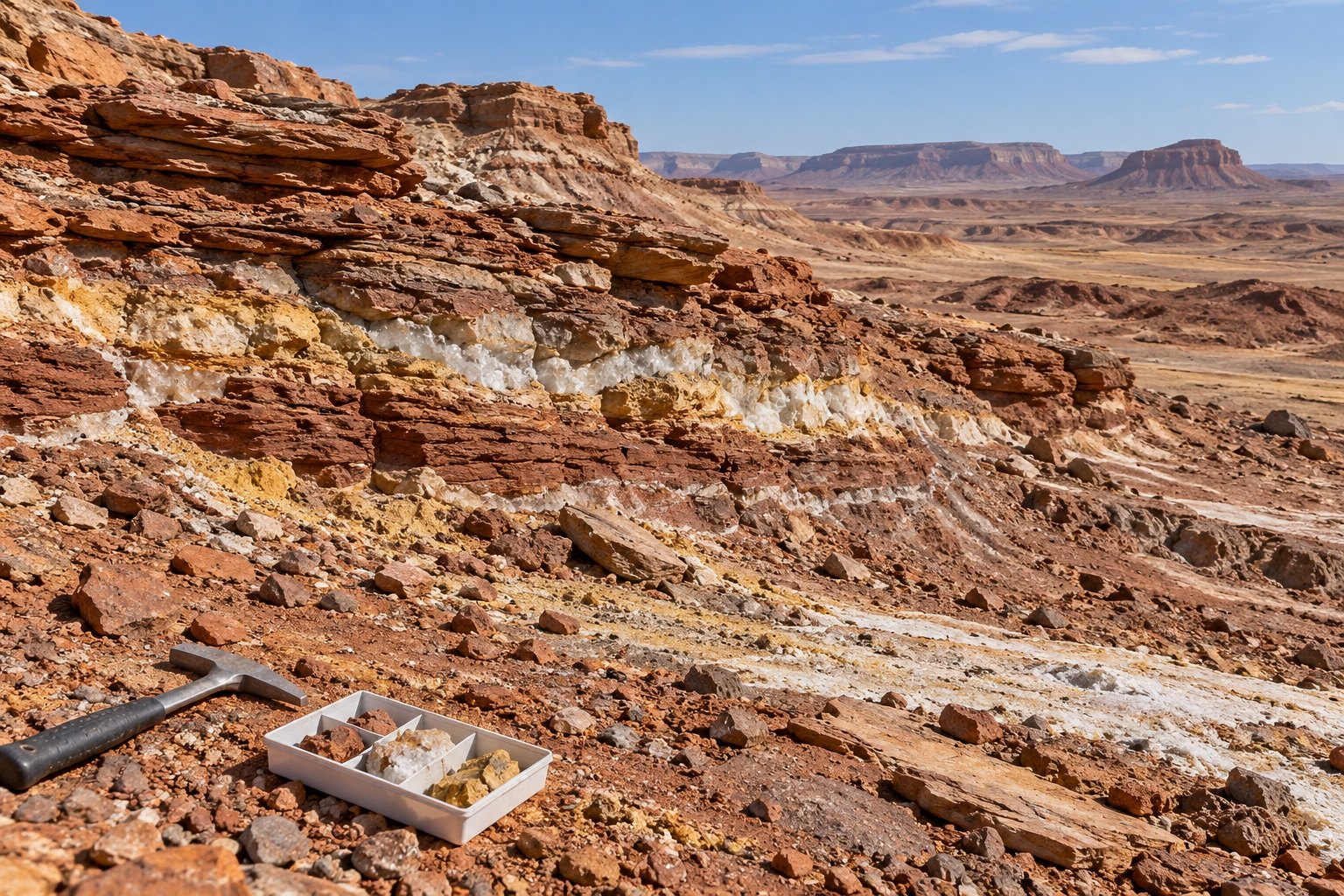
A Martian analogue site is a place on Earth whose rocks, chemistry and climate resemble Mars, so scientists can study there how Martian minerals formed. Hydrous sulphates such as gypsum and melanterite lock water into their crystals and record past water–rock contact. On 16 October 2026 the Ministry of Science & Technology reported such finds in Tamil Nadu and Chile.
Syllabus: Prelims · Science & Technology; GS3 · Indian Achievements in S&T; GS3 · IT, Space, Biotech & IPR
Why this matters for UPSC
GS3 space science and Prelims General Science: Prelims can ask what CRISM, Raman spectroscopy or a hydrous sulphate is; GS3 Mains, how orbital data is read and what Indian laboratories add to planetary science.
In short
Martian analogue sites are places on Earth that resemble Mars geologically, chemically and physically; their minerals let scientists test how water once shaped the Red Planet.
Analogue sites turn orbital guesses into tested geology; their value depends on reading minerals as evidence of past water, never as proof of life.
Why it matters
Every Mars mission is costly and can visit only a few places, so choosing where to land and drill decides what it can find. A rock sample on Earth can be cut, heated and examined; a mineral on Mars is usually just a pattern of light seen from orbit. Analogue sites close that gap. If gypsum from a hyperarid desert and gypsum from buried tropical mudstone look the same from space, a mission team that ignores geology could misjudge how long water lasted at a site. For Indian students and researchers, the finds also show that a well-equipped university laboratory can add to space science, not only agencies that build rockets.
Prelims pointers
- Mars Reconnaissance Orbiter (NASA): launched from Cape Canaveral on 12 August 2005; entered Mars orbit on 10 March 2006.
- OMEGA, an instrument on the European Space Agency's Mars Express orbiter, detected gypsum at several Martian locations in 2005.
- Curiosity rover found apparent gypsum veins at Yellowknife Bay in Gale Crater in 2013.
- SHERLOC sits on the robotic arm of NASA's Perseverance rover and uses an ultraviolet laser to classify organics and minerals.
- Vigyan Dhara: a Central Sector Scheme of DST whose components include FIST, PURSE, SAIF, SATHI and CURIE.
- Cuatro Ciénegas Basin in Mexico's Chihuahua Desert holds some of the world's purest gypsum dune fields, studied as a Mars analogue.
Practise a UPSC-style question
With reference to the Compact Reconnaissance Imaging Spectrometer for Mars (CRISM), consider the following statements:
1. It flies aboard NASA's Mars Reconnaissance Orbiter and searches for minerals that formed in the presence of water.
2. It detects minerals by reading the many colours in sunlight reflected from the Martian surface.
Which of the statements given above is/are correct?
- (a) 1 only
- (b) 2 only
- (c) Both 1 and 2
- (d) Neither 1 nor 2
Show the answer
Answer: (c) Both 1 and 2
Answer: (c) Both 1 and 2. CRISM is the orbiter's mineral-finding spectrometer and works on reflected sunlight.
Statement 1: correct. NASA lists CRISM among the Mars Reconnaissance Orbiter's instruments; its main job is to find the residue of minerals that form in water.
Statement 2: correct. CRISM reads hundreds of colours in reflected sunlight to detect patterns that mark particular minerals.
Eliminate: Judge statement 1 first: CRISM is on the Mars Reconnaissance Orbiter and hunts water-formed minerals. Out: (b), (d).
Eliminate: Statement 2 is also correct, since a spectrometer works on reflected light. Out: (a).
Trap: Swapped attribution. A student who links Mars instruments to rovers may doubt that CRISM is on an orbiter, and drop statement 1.
Remember: CRISM = spectrometer on NASA's Mars Reconnaissance Orbiter, looking for water-formed minerals from orbit.
More Explainers
- State Legislative Councils: Articles 168-172 and the graduates' and teachers' seats Polity
- Whales and dolphins in Indian waters: legal protection, IUCN status and strandings Environment
- The Aligarh Movement, AMU and the Article 30 minority test Polity
- Environmental clearance by States: SEIAA, SEAC and the EIA Notification, 2006 Environment
- Software vulnerabilities: CVE, CVSS, coordinated disclosure and CERT-In's role Sci-Tech
- Drug trafficking law in India: NDPS Act, PIT-NDPS, NCB and NCORD National
- Choosing the UN Secretary-General: Article 97, UNSC veto and straw polls World & IR
- UN Convention against Torture, and why India has not ratified it Polity
- NavIC: why India's navigation constellation cannot give a standalone position Sci-Tech
- International Energy Agency: membership, 90-day oil stocks and India's status World & IR
- PM Surya Ghar: Muft Bijli Yojana and the rooftop solar subsidy Economy
- HFSS foods: FSSAI's draft limits and front-of-pack warning labels National