
Lithium-ion power banks in flight: thermal runaway and dangerous-goods rules
Why in news: A passenger's power bank caught fire on IndiGo flight 6E 6115 from Delhi to Chennai on 11 October 2026, and the flight diverted to Hyderabad.
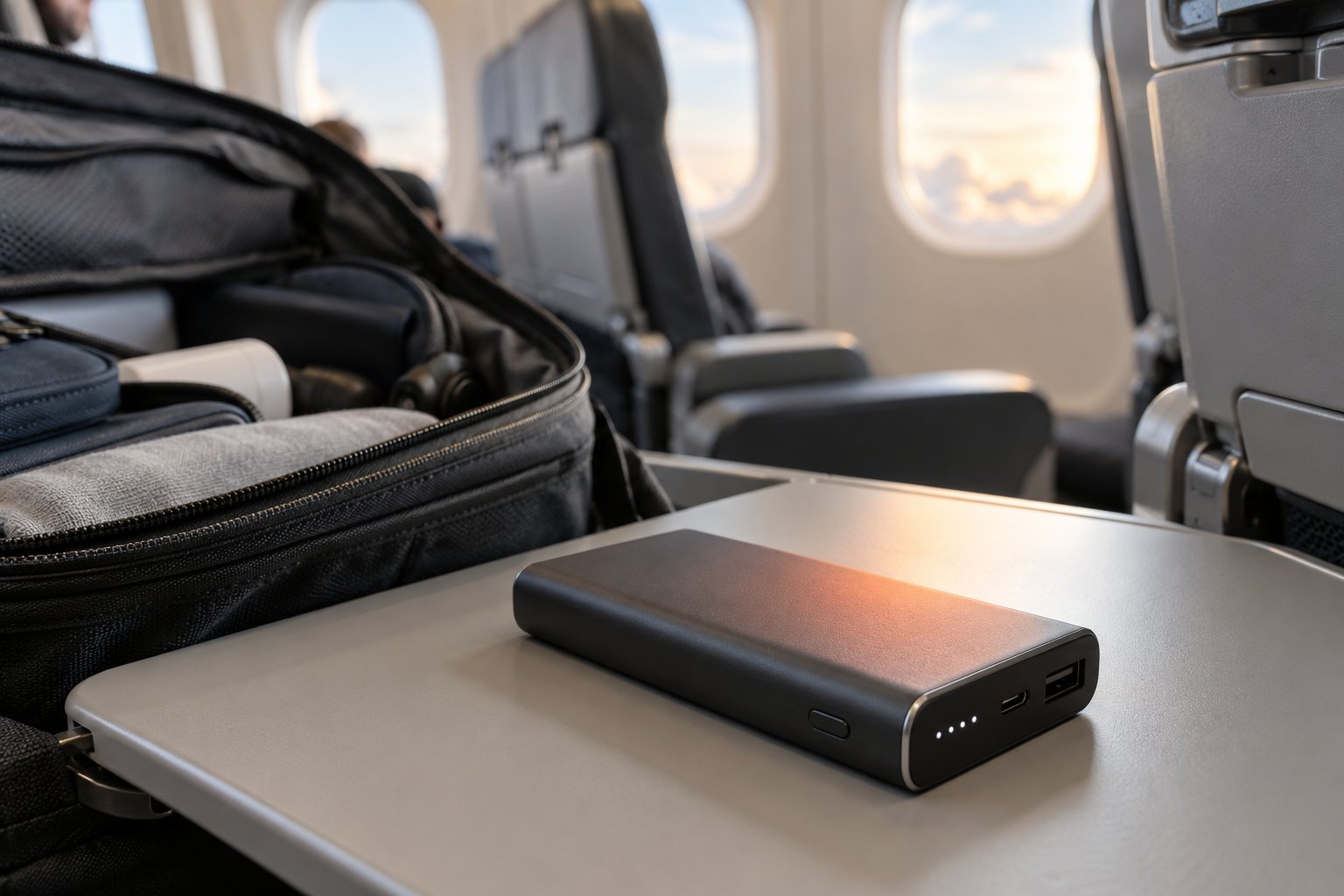
A lithium-ion power bank can fail through thermal runaway, a self-feeding build-up of heat that can end in fire or explosion. Air-safety rules treat such batteries as dangerous goods: in India they travel only in cabin baggage, out of overhead bins and unused in flight. A power bank fire diverted a Delhi-Chennai IndiGo flight to Hyderabad on 11 October 2026.
Syllabus: Prelims · Science & Technology; GS3 · Science & Technology; GS3 · Disaster Management
Why this matters for UPSC
GS3 science and technology, and disaster management: Prelims can ask how a lithium-ion cell works and fails through thermal runaway, and what the ICAO and the DGCA each regulate; Mains can ask about battery safety and aviation risk.
In short
A lithium-ion power bank packs energy-dense cells that can fail through thermal runaway; aviation therefore treats such batteries as dangerous goods, under ICAO standards the DGCA applies in India.
Cabin-only carriage and in-flight curbs keep a fire within the crew's reach; lasting safety needs certified cells, careful use and alert crews.
Why it matters
Almost every air passenger now carries a phone, a laptop and often a power bank, so the same energy-dense cells that make travel easy also put a possible fire in the cabin. A burning battery is hard to put out and can explode, and a fire in the cargo hold would be far harder to reach than one under a seat. That is why the rules keep batteries in the cabin, within the crew's sight. Cheap, counterfeit or recycled cells raise the risk further, as experts noted after the October fire. The larger issue is consumer product safety: India's regulator must match global aviation standards, and buyers need cells built and certified to a reliable standard.
Prelims pointers
- Lithium-ion cell: lithium ions move to the anode on charging and back to the cathode on discharge; the electrolyte is a lithium salt in a flammable organic solvent.
- Thermal runaway: a self-sustaining rise in a cell's temperature in which heat drives reactions that release more heat, flammable gas and fire.
- International Civil Aviation Organization (ICAO): UN specialised agency set up under the Chicago Convention, 1944; headquarters in Montreal; sets global aviation standards.
- Annex 18 to the Chicago Convention covers the safe transport of dangerous goods by air; ICAO's Technical Instructions give the detail.
- Directorate General of Civil Aviation (DGCA): India's civil aviation safety regulator, attached to the Ministry of Civil Aviation; it issued the November 2025 power bank advisory.
- International Air Transport Association (IATA): a trade association of airlines, not a UN agency or a regulator.
- Watt-hour (Wh) rating = nominal voltage × capacity in ampere-hours; a 20,000 mAh, 3.7 V power bank is about 74 Wh.
- Battery management system (BMS): electronics that guard a battery pack against overcharging, excessive discharge and overheating.
Practise a UPSC-style question
With reference to lithium-ion cells, consider the following statements:
1. During charging, lithium ions move from the anode to the cathode through the electrolyte.
2. In thermal runaway, heat from a failing cell drives reactions that release still more heat.
Which of the statements given above is/are correct?
- (a) 1 only
- (b) 2 only
- (c) Both 1 and 2
- (d) Neither 1 nor 2
Show the answer
Answer: (b) 2 only
1 is incorrect: during charging lithium ions move from the cathode to the anode; they flow back to the cathode on discharge. 2 is correct: thermal runaway is self-feeding, as heat triggers reactions that produce more heat and can end in fire.
More Explainers
- State Legislative Councils: Articles 168-172 and the graduates' and teachers' seats Polity
- Whales and dolphins in Indian waters: legal protection, IUCN status and strandings Environment
- The Aligarh Movement, AMU and the Article 30 minority test Polity
- Environmental clearance by States: SEIAA, SEAC and the EIA Notification, 2006 Environment
- Software vulnerabilities: CVE, CVSS, coordinated disclosure and CERT-In's role Sci-Tech
- Drug trafficking law in India: NDPS Act, PIT-NDPS, NCB and NCORD National
- Choosing the UN Secretary-General: Article 97, UNSC veto and straw polls World & IR
- UN Convention against Torture, and why India has not ratified it Polity
- NavIC: why India's navigation constellation cannot give a standalone position Sci-Tech
- International Energy Agency: membership, 90-day oil stocks and India's status World & IR
- PM Surya Ghar: Muft Bijli Yojana and the rooftop solar subsidy Economy
- HFSS foods: FSSAI's draft limits and front-of-pack warning labels National