
Leptospirosis: the rat-borne bacterial disease that rises with monsoon floods
Why in news: Kerala's health department reported two leptospirosis deaths and nine new cases on 29 June 2026, days after the Health Ministry's pre-monsoon advisory of 23 June.
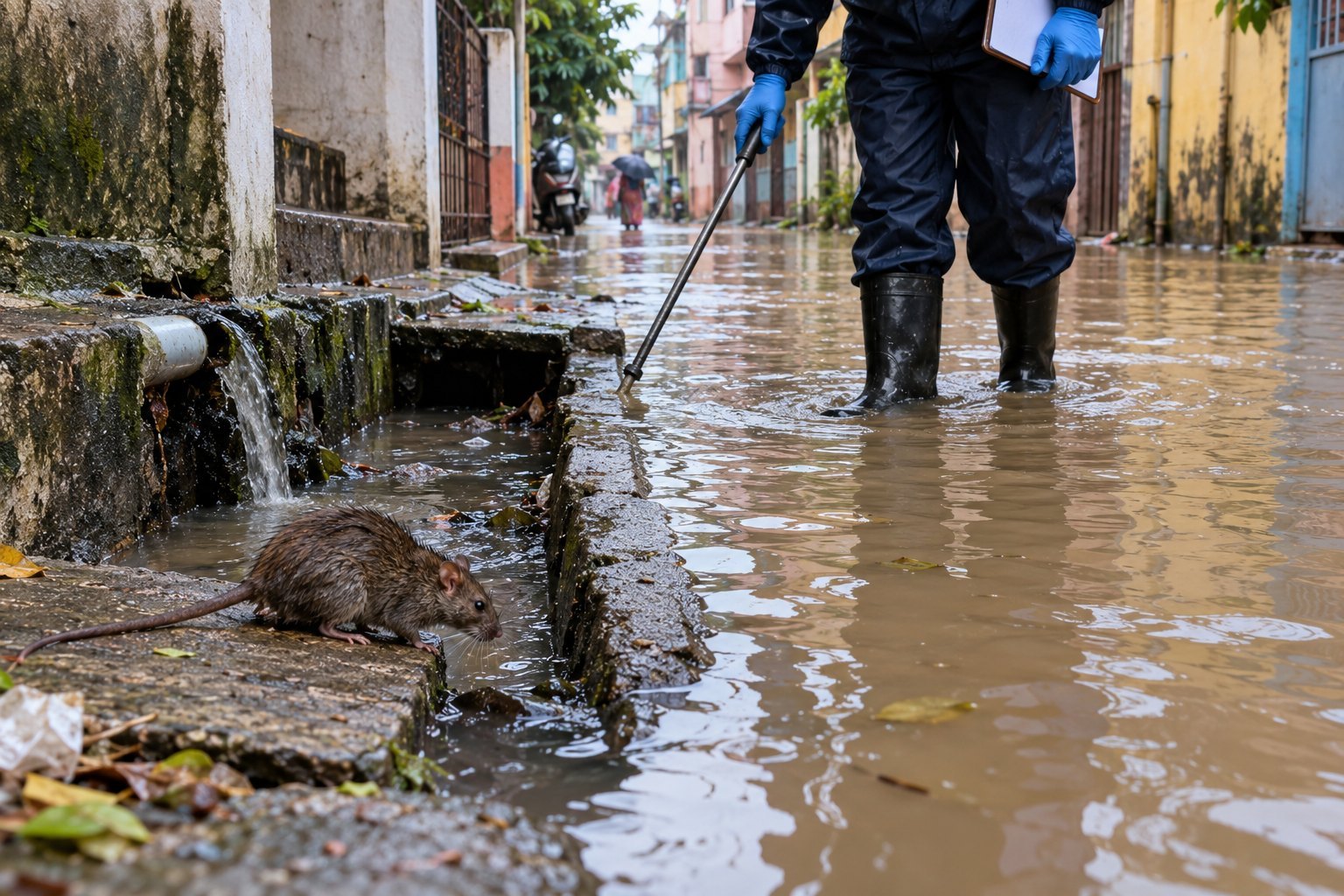
Leptospirosis is a zoonotic bacterial disease caused by Leptospira, caught when cuts or mucous membranes touch water or soil fouled by the urine of rats, cattle or pigs. Its severe form, Weil's disease, damages the liver and kidneys. Cases climb every monsoon, and a Health Ministry advisory of 23 June 2026 asked States to prepare outbreak plans.
Syllabus: Prelims · Science & Technology; GS2 · Health, Education & Human Resources; GS3 · Disaster Management
Why this matters for UPSC
Leptospirosis sits in GS III science and GS II health: Prelims can ask its cause, reservoirs, Weil's disease, doxycycline chemoprophylaxis or the PPCL; Mains, about zoonoses, monsoon disease surveillance and One Health.
In short
Leptospirosis is a zoonotic bacterial disease caused by Leptospira and spread through animal urine in water and soil; India fights it through NCDC's Programme for Prevention and Control of Leptospirosis.
Leptospirosis is cheap to treat yet deadly when missed; drainage, rodent control and early doxycycline in endemic districts must precede the monsoon.
Why it matters
A farmer planting paddy in a flooded field, a sewer worker or a family wading through a city's monsoon water can catch leptospirosis through a small cut. At first it looks like any monsoon fever, so a doctor may treat it as malaria or dengue and lose the days in which a cheap antibiotic works. Missed, it can shut down the kidneys or fill the lungs with blood within days. The disease also shows how health depends on things outside hospitals: blocked drains, rats near grain and waterlogged land. That is why its control needs civic bodies, farmers and veterinarians as much as doctors.
Prelims pointers
- Leptospira strains fall into 26 serogroups, two of them saprophytic; nearly 300 serovars are carried by more than a dozen species of rodents and animals.
- Incubation period of leptospirosis: 5 to 14 days on average, ranging from 2 to 30 days; case fatality rate 0-15%, per the 2015 national guidelines.
- More than 90% of leptospirosis deaths come from pulmonary alveolar haemorrhage and kidney complications, per India's national guidelines.
- A high serum CPK level suggests leptospirosis, while SGPT stays normal or mildly raised, unlike viral hepatitis where SGPT rises sharply.
- Under the national guidelines, children under eight get amoxycillin or ampicillin for seven days, and pregnant or lactating mothers get ampicillin 500 mg six-hourly.
- The PPCL's first five States were Gujarat, Kerala, Tamil Nadu, Maharashtra and Karnataka, with the Union Territory of Andaman and Nicobar Islands.
- Referral laboratories for leptospirosis include ICMR's Regional Medical Research Centre, Port Blair, NCDC Delhi and the National Institute of Epidemiology, Chennai.
Practise a UPSC-style question
With reference to leptospirosis, consider the following statements:
1. Leptospira biflexa contains the pathogenic serovars, while Leptospira interrogans contains the saprophytic strains.
2. Infection usually enters through abraded skin or mucous membranes exposed to water contaminated with animal urine.
3. Direct transmission of leptospirosis from one person to another is rare.
Which of the statements given above is/are correct?
- (a) 1 and 2 only
- (b) 2 and 3 only
- (c) 1 and 3 only
- (d) 1, 2 and 3
Show the answer
Answer: (b) 2 and 3 only
Answer: (b) 2 and 3 only. The two species are reversed in statement 1; the routes in statements 2 and 3 are right.
Statement 1: incorrect. Leptospira interrogans includes all the pathogenic serovars and Leptospira biflexa the saprophytic strains, per India's 2015 national guidelines.
Statement 2: correct. Leptospires enter through cuts, abrasions or the mucous membranes of the eyes, nose and mouth after contact with urine-contaminated water or soil.
Statement 3: correct. Humans catch it from animal urine or a contaminated environment; person-to-person spread is rare.
Eliminate: Judge statement 1 first: interrogans is the pathogenic species, so statement 1 is incorrect. Out: (a), (c), (d).
Trap: Look-alike names. The two Leptospira species are swapped, and a student who remembers only the genus cannot tell which is which.
Remember: L. interrogans causes disease; L. biflexa lives free in the environment.
More Explainers
- State Legislative Councils: Articles 168-172 and the graduates' and teachers' seats Polity
- Whales and dolphins in Indian waters: legal protection, IUCN status and strandings Environment
- The Aligarh Movement, AMU and the Article 30 minority test Polity
- Environmental clearance by States: SEIAA, SEAC and the EIA Notification, 2006 Environment
- Software vulnerabilities: CVE, CVSS, coordinated disclosure and CERT-In's role Sci-Tech
- Drug trafficking law in India: NDPS Act, PIT-NDPS, NCB and NCORD National
- Choosing the UN Secretary-General: Article 97, UNSC veto and straw polls World & IR
- UN Convention against Torture, and why India has not ratified it Polity
- NavIC: why India's navigation constellation cannot give a standalone position Sci-Tech
- International Energy Agency: membership, 90-day oil stocks and India's status World & IR
- PM Surya Ghar: Muft Bijli Yojana and the rooftop solar subsidy Economy
- HFSS foods: FSSAI's draft limits and front-of-pack warning labels National