
Jeypore ground gecko and the Eastern Ghats' bauxite hills
Why in news: The Hindu reported on 14 October 2026 that a bauxite mining project on the Balda hills of Odisha's Koraput district threatens the gecko.
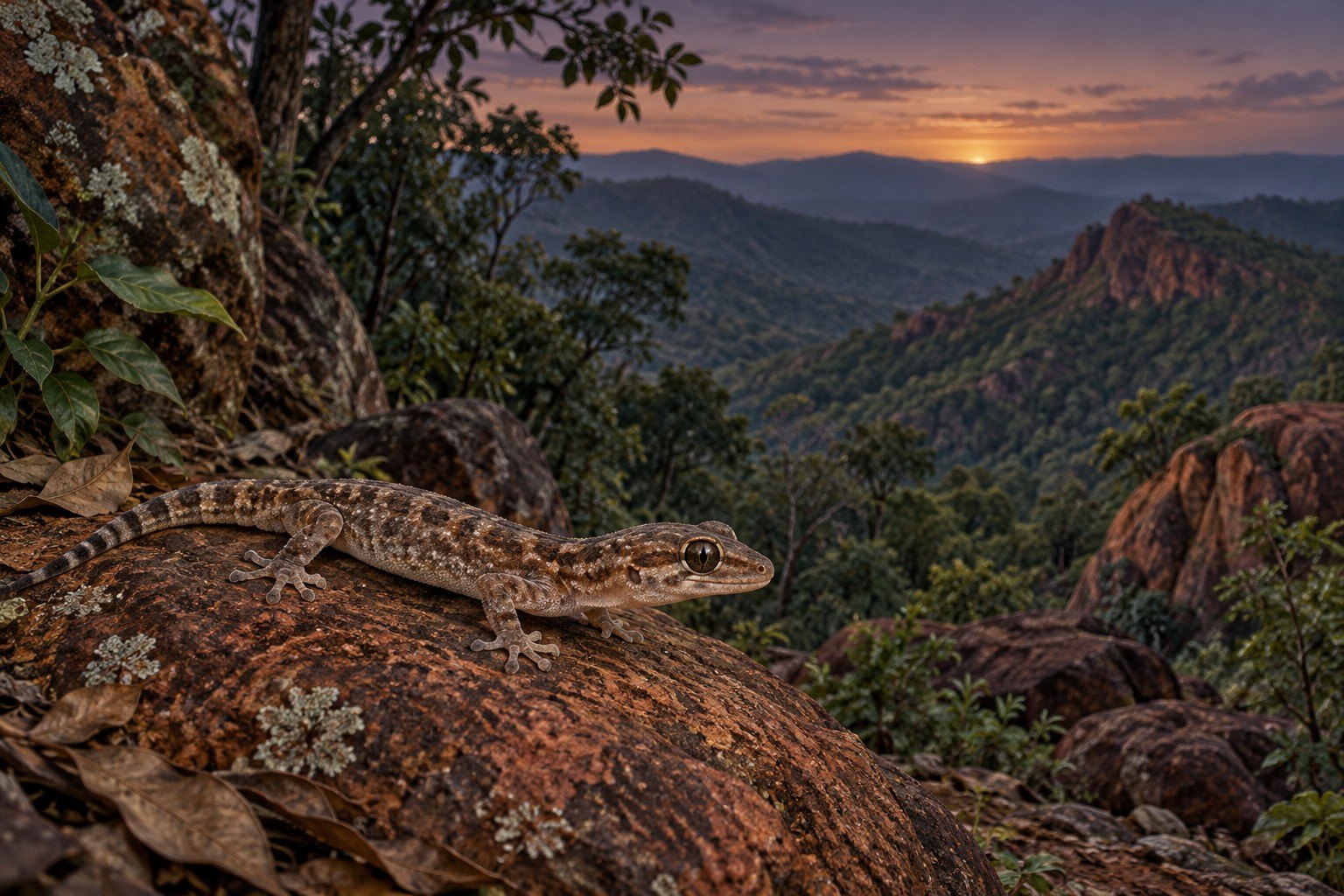
The Jeypore ground gecko (Cyrtodactylus jeyporensis) is a nocturnal gecko found only in high Eastern Ghats forests of southern Odisha and northern Andhra Pradesh. It is Endangered on the IUCN Red List, in CITES Appendix II and in Schedule I of the Wild Life (Protection) Act, 1972. A Koraput bauxite project threatens it, The Hindu reported on 14 October 2026.
Syllabus: Prelims · Geography; Prelims · Environment & Ecology; GS1 · Geophysical Phenomena
Why this matters for UPSC
GS3 conservation and GS1 geography: Prelims asks a species' IUCN, CITES and Schedule status and its range, and the Eastern Ghats' peaks, rivers and States; Mains asks how mining, habitat protection and Gram Sabha consent are balanced.
In short
The Jeypore ground gecko is a nocturnal, ground-dwelling gecko endemic to the high forests of the northern Eastern Ghats, a broken hill range that is also Odisha's bauxite belt.
Listing gave the gecko legal standing; its survival now rests on protecting its few high forests and on informed Gram Sabha decisions.
Why it matters
For the tribal villages around Koraput's hills, the same forests give water, forest produce and places of worship, and a mine changes all three at once. For the gecko, a handful of forested hilltops is its whole world: lose one and a share of a species found nowhere else goes with it. The case tests a wider question that every mining State faces: whether a law that protects an animal can work when nothing protects the place it lives, and whether the consent of forest communities is sought and recorded honestly. How Koraput is handled will shape the fate of other small endemics that sit on India's mineral belts.
Prelims pointers
- Jeypore ground gecko listings: IUCN Endangered (criterion B, assessed 2019); CITES Appendix II since CoP19, 2022, on India's proposal; Schedule I, Part C (Reptiles).
- CITES Appendix I lists species threatened with extinction; Appendix II, species not necessarily threatened whose trade is controlled so that they do not become so.
- Wild Life (Protection) Act after 2022: Schedules I and II protected animals (hunting barred, section 9), Schedule III plants, Schedule IV CITES-listed specimens.
- Eastern Ghats peaks (IISc): Jindhagada 1,690 m (highest), Arma Konda 1,680 m and Gali Konda 1,643 m in the Maliya-Madugula Konda ranges; Deomali 1,672 m tops Odisha.
- Eastern Ghats links: the Similipal massif is the northern extension; the Biligiri Rangan and Malai Mahadeshwara hills of Karnataka form a corridor to the Western Ghats.
- Eastern Ghats spread: Odisha, Andhra Pradesh, Telangana and Tamil Nadu, with parts of Karnataka; older than the Western Ghats, they meet them in the Nilgiris.
- Bauxite: the only ore of aluminium, formed by desilication of aluminium-bearing rocks in humid tropics; Panchpatmali in Koraput is NALCO's open-cast mine.
- PESA Act, 1996: extends Part IX of the Constitution (Panchayats) to Scheduled Areas; section 4(d) lets every Gram Sabha safeguard customs, cultural identity and community resources.
Practise a UPSC-style question
With reference to the Jeypore ground gecko, consider the following statements:
1. It is endemic to the Eastern Ghats of southern Odisha and northern Andhra Pradesh.
2. It is listed as Critically Endangered on the IUCN Red List.
3. It was included in Appendix II of CITES on a proposal made by India.
Which of the statements given above is/are correct?
- (a) 1 and 2 only
- (b) 2 and 3 only
- (c) 1 and 3 only
- (d) 1, 2 and 3
Show the answer
Answer: (c) 1 and 3 only
Answer: (c) 1 and 3 only. The gecko's IUCN category is Endangered, so statement 2 fails.
Statement 1: correct. India's CITES proposal records it only from the Eastern Ghats of southern Odisha and northern Andhra Pradesh.
Statement 2: incorrect. The IUCN assessment of 2019 lists it as Endangered under criteria B1ab(iii)+2ab(iii), not Critically Endangered.
Statement 3: correct. India proposed the listing, and CoP19 at Panama City in November 2022 placed it in Appendix II.
Eliminate: Judge statement 2 first: the current IUCN category is Endangered, so statement 2 is incorrect. Out: (a), (b), (d).
Trap: Look-alike names. Endangered and Critically Endangered are similar-sounding IUCN categories, and a 2017 news report gave the gecko the second.
Remember: Jeypore ground gecko: IUCN Endangered, CITES Appendix II, Schedule I.
More Explainers
- State Legislative Councils: Articles 168-172 and the graduates' and teachers' seats Polity
- Whales and dolphins in Indian waters: legal protection, IUCN status and strandings Environment
- The Aligarh Movement, AMU and the Article 30 minority test Polity
- Environmental clearance by States: SEIAA, SEAC and the EIA Notification, 2006 Environment
- Software vulnerabilities: CVE, CVSS, coordinated disclosure and CERT-In's role Sci-Tech
- Drug trafficking law in India: NDPS Act, PIT-NDPS, NCB and NCORD National
- Choosing the UN Secretary-General: Article 97, UNSC veto and straw polls World & IR
- UN Convention against Torture, and why India has not ratified it Polity
- NavIC: why India's navigation constellation cannot give a standalone position Sci-Tech
- International Energy Agency: membership, 90-day oil stocks and India's status World & IR
- PM Surya Ghar: Muft Bijli Yojana and the rooftop solar subsidy Economy
- HFSS foods: FSSAI's draft limits and front-of-pack warning labels National