
International Big Cat Alliance: India-headquartered treaty body for seven big cats
Why in news: On 12 October 2026 the Union Environment Minister inaugurated IBCA's new headquarters office at 55 Lodhi Estate, New Delhi.
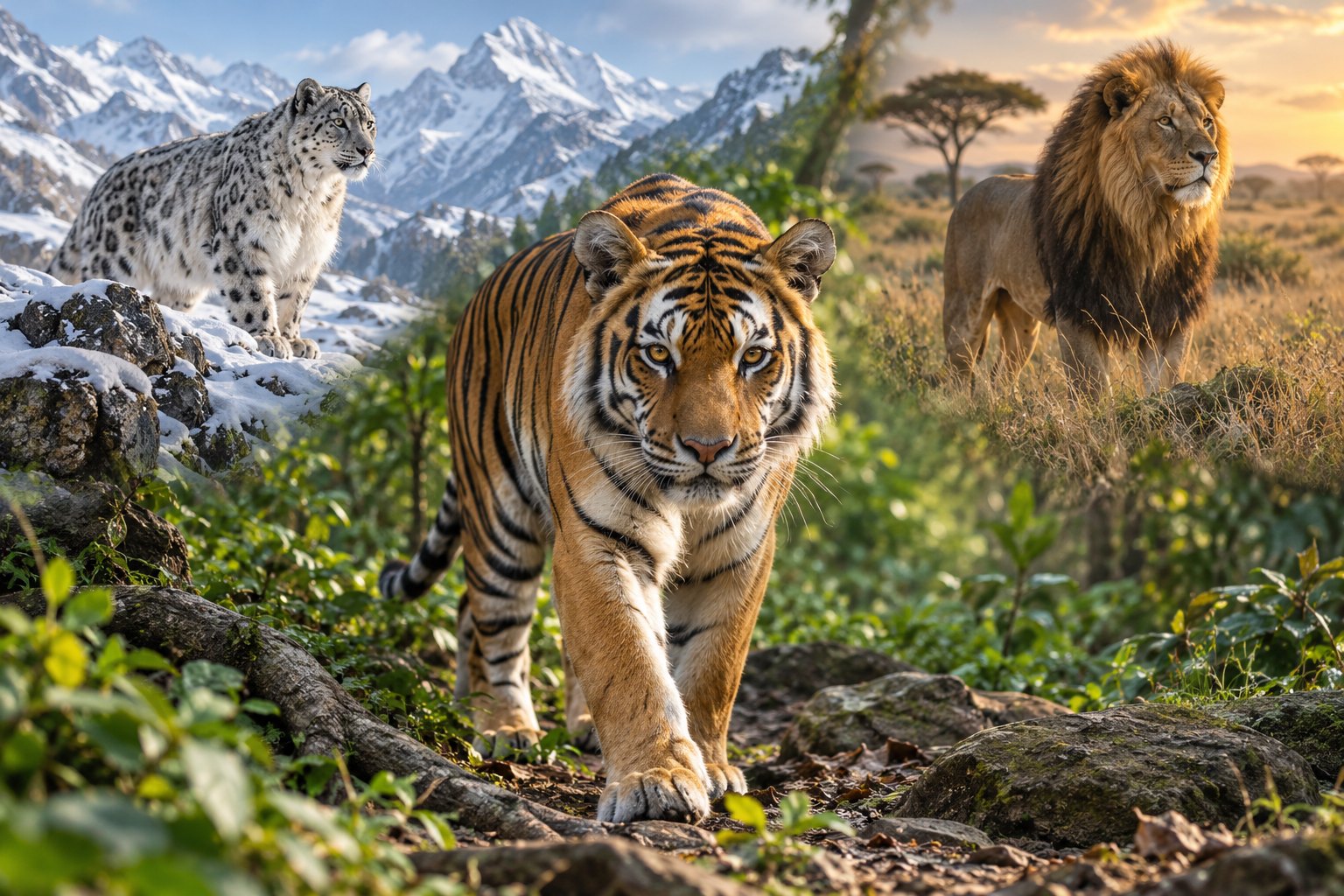
The International Big Cat Alliance (IBCA) is a treaty-based intergovernmental organisation, headquartered in India, that works to conserve seven big cats: tiger, lion, leopard, snow leopard, cheetah, jaguar and puma. PIB put its membership at 29 countries on 12 October 2026, the day the Union Environment Minister opened its new headquarters office at 55 Lodhi Estate, New Delhi.
Syllabus: Prelims · Environment & Ecology; GS3 · Environment & Conservation; GS2 · Groupings & Agreements
Why this matters for UPSC
GS2 (international institutions) and GS3 (biodiversity conservation). Prelims can ask which big cats the International Big Cat Alliance covers, which are found in India, who is the depository and how its Assembly decides; Mains, about India-led treaty bodies.
In short
The International Big Cat Alliance, a treaty-based intergovernmental organisation headquartered in India, works to conserve seven big cats; its Framework Agreement took effect in February 2025.
The IBCA gives India a lead in big cat diplomacy, but its worth will rest on members beyond India and funding beyond 2027-28.
Why it matters
Big cats live across many borders, so a poacher, a lost corridor or a disease in one country can undo work in the next. The IBCA gives foreign participants and veterinarians from many countries a common place to train and share methods: its health programme for big cats has trained vets from 20 countries. For India, it turns decades of tiger conservation experience into a lead role in a global body that sits in New Delhi, whose new office was opened with the heads of the alliances on solar power, biofuels and disaster-resilient infrastructure in attendance. The larger issue is whether such alliances can raise steady money and keep members active, so that protecting habitats also supports water security, livelihoods and climate adaptation.
Prelims pointers
- Framework Agreement, Article II: IBCA is an inter-governmental organisation; its headquarters, including the Secretariat, are in India under a separate Headquarters Agreement.
- Assembly: highest decision-making organ; one Representative and one vote per Party; Observers cannot vote; President elected for three years.
- Director-General: chief executive of IBCA, appointed by the Assembly for five years, extendable by not more than one term.
- Decisions: consensus first; otherwise simple majority for procedural issues, two-thirds of Parties present and voting for substantive issues and amendments.
- Depository of the Framework Agreement: Ministry of External Affairs, New Delhi.
- Big cats found in India: tiger, lion, leopard, snow leopard, cheetah; jaguar and puma, the other two of IBCA's seven, are not.
- IBCA's statute was modelled largely on the International Solar Alliance; the International Steering Committee was set up by a Republic of India Declaration of 12 March 2024.
Practise a UPSC-style question
With reference to the International Big Cat Alliance (IBCA), consider the following statements:
1. It was launched by India on the occasion commemorating 50 years of Project Tiger.
2. The Ministry of Environment, Forest and Climate Change is the depository of its Framework Agreement.
3. Its Framework Agreement places the Organization's headquarters, including the Secretariat, in India.
Which of the statements given above is/are correct?
- (a) 1 and 2 only
- (b) 2 and 3 only
- (c) 1 and 3 only
- (d) 1, 2 and 3
Show the answer
Answer: (c) 1 and 3 only
1 is correct: the Prime Minister formally announced the alliance on 9 April 2023, while commemorating 50 years of Project Tiger. 2 is incorrect: the Ministry of External Affairs, not the Environment Ministry, is the depository for instruments of ratification, acceptance, approval or accession. 3 is correct: Article II of the Framework Agreement locates the headquarters, including the Secretariat, in the Republic of India.
More Explainers
- State Legislative Councils: Articles 168-172 and the graduates' and teachers' seats Polity
- Whales and dolphins in Indian waters: legal protection, IUCN status and strandings Environment
- The Aligarh Movement, AMU and the Article 30 minority test Polity
- Environmental clearance by States: SEIAA, SEAC and the EIA Notification, 2006 Environment
- Software vulnerabilities: CVE, CVSS, coordinated disclosure and CERT-In's role Sci-Tech
- Drug trafficking law in India: NDPS Act, PIT-NDPS, NCB and NCORD National
- Choosing the UN Secretary-General: Article 97, UNSC veto and straw polls World & IR
- UN Convention against Torture, and why India has not ratified it Polity
- NavIC: why India's navigation constellation cannot give a standalone position Sci-Tech
- International Energy Agency: membership, 90-day oil stocks and India's status World & IR
- PM Surya Ghar: Muft Bijli Yojana and the rooftop solar subsidy Economy
- HFSS foods: FSSAI's draft limits and front-of-pack warning labels National