
Industrial pollution control under Namami Gange: GPIs, CETPs and charters
Why in news: On 13 October 2026 the Ministry of Jal Shakti reported Ganga-basin GPI compliance at 86% in 2025, up from 39% in 2017.
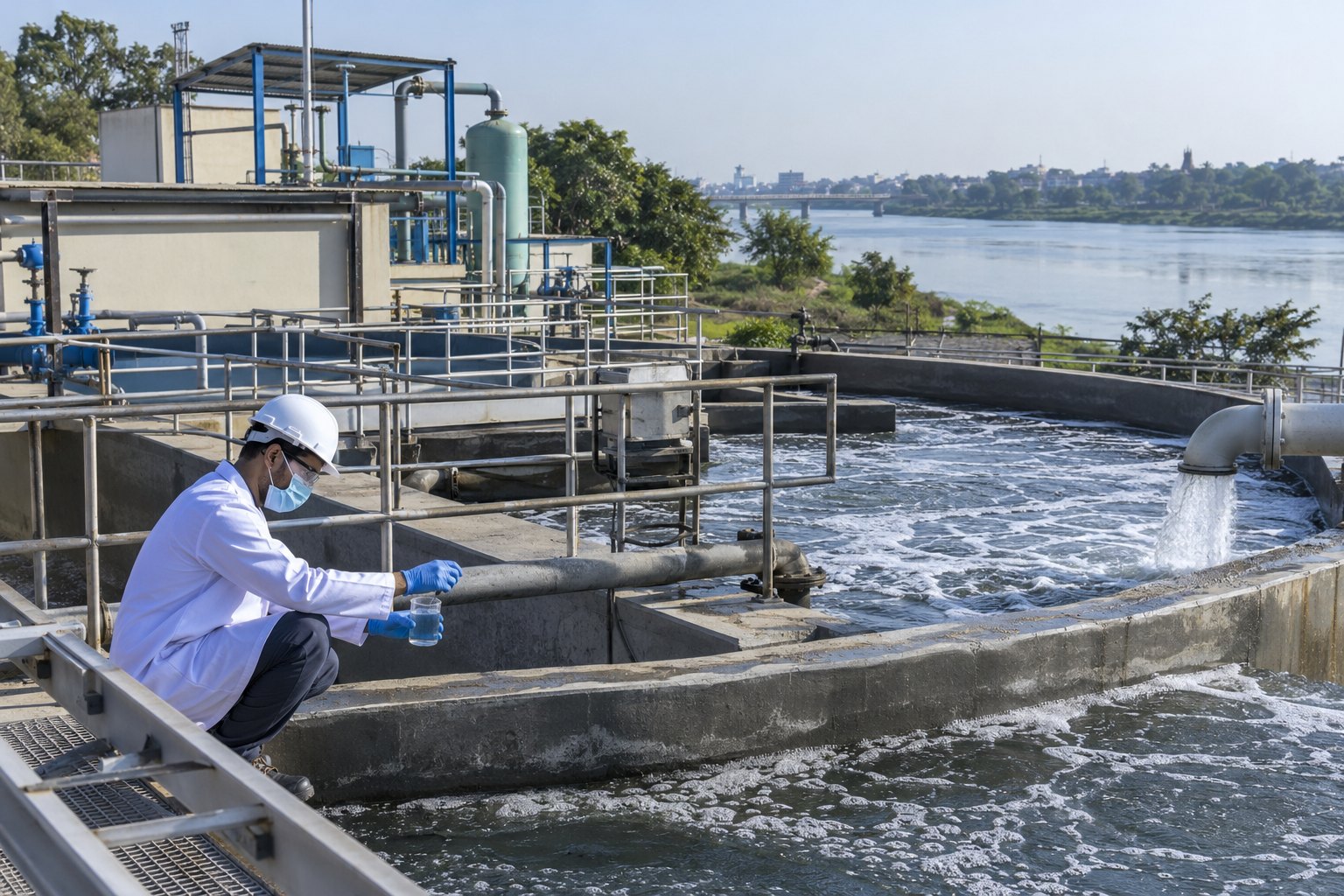
Under the Namami Gange Programme, Grossly Polluting Industries in the Ganga basin face yearly third-party inspection since 2017 with CPCB support, sector-specific charters for five polluting sectors, and checks on Common Effluent Treatment Plants serving industrial clusters. The Jal Shakti Ministry said on 13 October 2026 that Ganga-basin GPI compliance rose from 39% in 2017 to 86% in 2025.
Syllabus: Prelims · Environment & Ecology; GS2 · Government Policies; GS3 · Environment & Conservation
Why this matters for UPSC
GS3 environmental pollution: Prelims can ask what a Grossly Polluting Industry is, the CPCB's parent law, NMCG's status and what a CETP does; Mains can ask how industrial river pollution is regulated under the Namami Gange Programme.
In short
Untreated domestic and industrial wastewater chiefly pollutes the Ganga; the Namami Gange Programme tackles industry by policing Grossly Polluting Industries through inspection, charters and CETPs.
Inspection has proved itself; lasting gains need working CETPs and cleaner production that let small units comply rather than close.
Why it matters
Towns and villages along the Ganga and the Yamuna bathe, farm and fish in river water. A single tannery or paper mill that bypasses its treatment plant can turn a tributary dark and kill fish downstream, undoing what new sewage plants achieve. Yearly inspection by outside experts makes it harder to hide such discharges, and the charters push mills to use less fresh water, which also eases pressure on groundwater. For a sugar mill or a small dyeing unit, the system means real costs: upgrading treatment, joining a CETP, or facing closure. The larger issue is how India regulates industry: shifting from catching violators after the damage to preventing pollution at its source, without driving small units out of business.
Prelims pointers
- Grossly Polluting Industry: discharges over 100 KLD of wastewater and/or uses hazardous chemicals under the Manufacture, Storage and Import of Hazardous Chemical Rules, 1989.
- Central Pollution Control Board: statutory body constituted in September 1974 under the Water (Prevention and Control of Pollution) Act, 1974; also given functions under the Air Act, 1981.
- Consent to Operate for an individual industry is issued by the State Pollution Control Board, not by the CPCB.
- National Mission for Clean Ganga: registered as a society on 12 August 2011 under the Societies Registration Act, 1860; under the Ministry of Jal Shakti.
- National Ganga Council, constituted in October 2016 under the Environment (Protection) Act, 1986, is chaired by the Prime Minister; the Empowered Task Force by the Union Jal Shakti Minister.
- Five-tier Ganga structure: National Ganga Council, Empowered Task Force, NMCG, State Ganga Committees and District Ganga Committees.
- Namami Gange Programme is a Central Sector Scheme for the Ganga basin; the National River Conservation Plan covers rivers outside it.
- PRAYAG (Platform for Real-time Analysis of Yamuna, Ganga and their Tributaries), set up in April 2023, monitors river water, STPs and CETPs.
Practise a UPSC-style question
With reference to Grossly Polluting Industries (GPIs) in the Ganga basin, consider the following statements:
1. The annual GPI inspections are carried out by teams drawn from the Central Water Commission.
2. An industry discharging more than 100 kilolitres of wastewater a day can be classed as a GPI.
3. Annual inspection of GPIs under the Namami Gange Programme began in 2017.
Which of the statements given above is/are correct?
- (a) 1 and 2 only
- (b) 2 and 3 only
- (c) 1 and 3 only
- (d) 1, 2 and 3
Show the answer
Answer: (b) 2 and 3 only
1 is incorrect: the teams pair experts from technical institutes with State Pollution Control Board officers, not the Central Water Commission. 2 is correct: a GPI discharges over 100 KLD of wastewater and/or uses listed hazardous chemicals. 3 is correct: the annual inspection mechanism started in 2017 with CPCB support.
More Explainers
- State Legislative Councils: Articles 168-172 and the graduates' and teachers' seats Polity
- Whales and dolphins in Indian waters: legal protection, IUCN status and strandings Environment
- The Aligarh Movement, AMU and the Article 30 minority test Polity
- Environmental clearance by States: SEIAA, SEAC and the EIA Notification, 2006 Environment
- Software vulnerabilities: CVE, CVSS, coordinated disclosure and CERT-In's role Sci-Tech
- Drug trafficking law in India: NDPS Act, PIT-NDPS, NCB and NCORD National
- Choosing the UN Secretary-General: Article 97, UNSC veto and straw polls World & IR
- UN Convention against Torture, and why India has not ratified it Polity
- NavIC: why India's navigation constellation cannot give a standalone position Sci-Tech
- International Energy Agency: membership, 90-day oil stocks and India's status World & IR
- PM Surya Ghar: Muft Bijli Yojana and the rooftop solar subsidy Economy
- HFSS foods: FSSAI's draft limits and front-of-pack warning labels National