
India's TB elimination drive: NTEP, TB Mukt Bharat and BPaLM
Why in news: PIB's explainer 'Towards a TB-Free India' of 13 October 2026 reviewed NTEP's progress as the JOSH youth awareness campaign began in 55 districts.
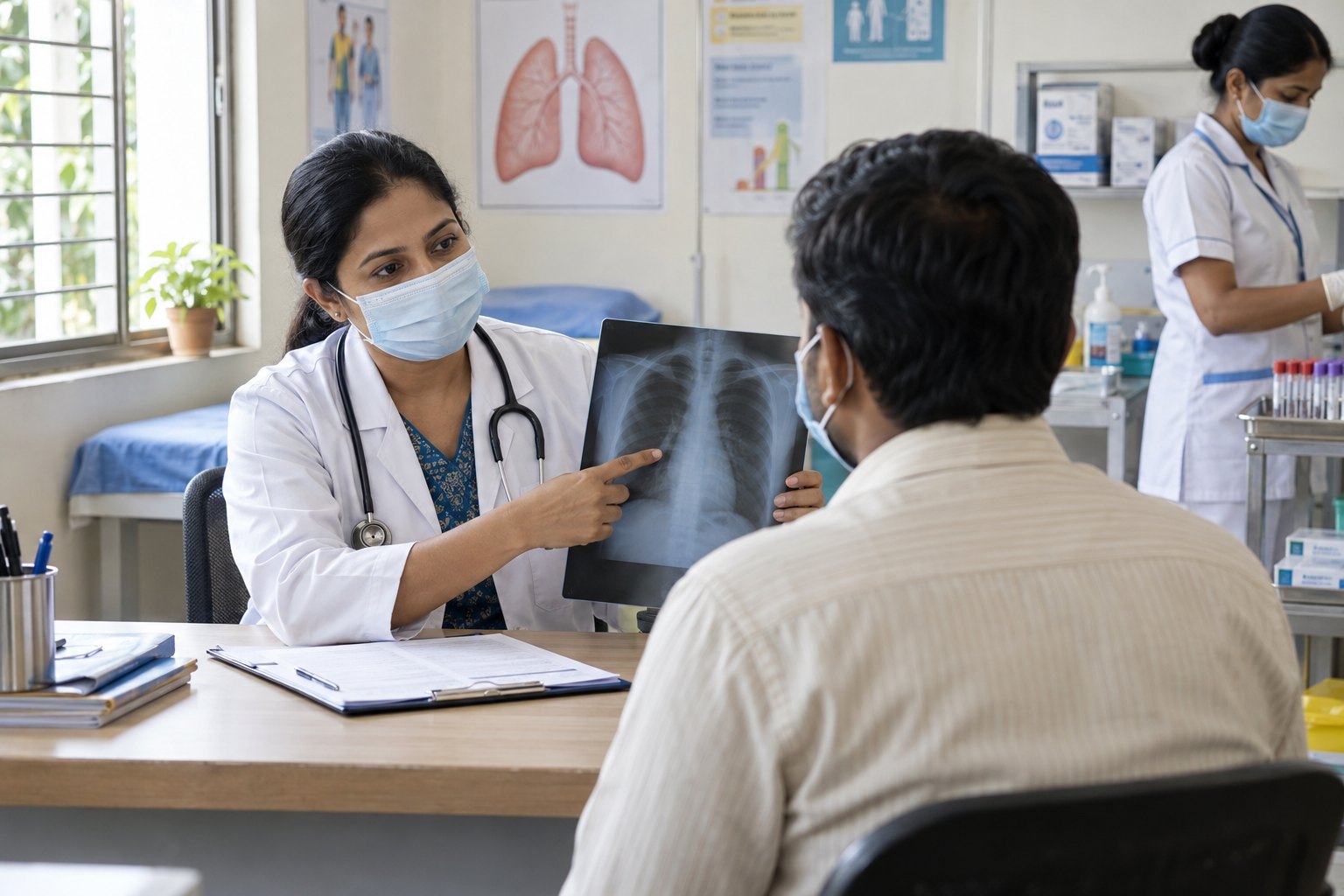
The National Tuberculosis Elimination Programme (NTEP) of the Health Ministry aims to end tuberculosis in India before the global 2030 target, through early detection, free treatment, prevention and patient support such as Ni-kshay Poshan Yojana cash aid. A PIB explainer of 13 October 2026 reviewed its progress, citing WHO's figure of a 21% fall in TB incidence over 2015-2024.
Syllabus: Prelims · Economy & Social Development; GS2 · Government Policies; GS2 · Welfare of Vulnerable Sections
Why this matters for UPSC
GS2 health and welfare schemes: Prelims can ask NTEP's ministry, what Ni-kshay Poshan Yojana pays, and what BPaLM contains; Mains can ask about nutrition, drug resistance and community participation in TB elimination.
In short
India's National Tuberculosis Elimination Programme (NTEP), under the Health Ministry, aims to end TB before the global 2030 target, pairing medicines with nutrition and primary care.
India's faster-than-global decline will hold only if every drug-resistant, undernourished or hidden patient is found early, fed and kept on treatment.
Why it matters
TB is curable, yet treatment lasts at least six months, and a patient who stops early can develop drug-resistant disease that is harder and costlier to cure. Poor families also lose wages and spend on food and travel. NTEP tackles each link: free diagnosis close to home at Ayushman Arogya Mandirs, a monthly cash transfer for nutrition, food baskets from Ni-kshay Mitras, and the shorter BPaLM regimen that cuts the time drug-resistant patients spend on toxic drugs. India carried about a quarter of the world's new TB cases in 2024, by WHO's count, so progress here moves the global figure. The larger issue is health as a development goal: undernutrition, diabetes and HIV raise TB risk, so elimination depends on nutrition and primary care as much as on medicines.
Prelims pointers
- NTEP: the Revised National Tuberculosis Control Programme (RNTCP) was renamed the National Tuberculosis Elimination Programme in 2020; it runs under the Ministry of Health and Family Welfare.
- National Strategic Plan to End TB in India 2020-25 rests on four pillars: Detect, Treat, Prevent and Build.
- Ni-kshay Poshan Yojana (2018): Rs 1,000 a month by Direct Benefit Transfer to each notified TB patient for the whole treatment, raised from Rs 500.
- Pradhan Mantri TB Mukt Bharat Abhiyaan (September 2022): more support for patients, community involvement through Ni-kshay Mitras, and use of Corporate Social Responsibility.
- BPaLM: bedaquiline, pretomanid, linezolid and moxifloxacin; a six-month all-oral regimen for drug-resistant TB, prioritised in WHO guidelines of 2022.
- Multidrug-resistant TB (MDR-TB) does not respond to rifampicin and isoniazid, the two most effective first-line drugs.
- End TB Strategy: adopted by the World Health Assembly in 2014; 2030 milestones are an 80% drop in incidence and a 90% drop in deaths.
- SDG target 3.3 seeks to end the epidemics of AIDS, tuberculosis, malaria and neglected tropical diseases by 2030.
Practise a UPSC-style question
With reference to support for tuberculosis patients in India, consider the following statements:
1. Ni-kshay Poshan Yojana is run by the Ministry of Women and Child Development.
2. Ni-kshay Poshan Yojana pays each notified TB patient Rs 1,000 a month by Direct Benefit Transfer during treatment.
3. Under the Pradhan Mantri TB Mukt Bharat Abhiyaan, individuals, NGOs and companies can serve as Ni-kshay Mitras for patients.
Which of the statements given above is/are correct?
- (a) 1 and 2 only
- (b) 2 and 3 only
- (c) 1 and 3 only
- (d) 1, 2 and 3
Show the answer
Answer: (b) 2 and 3 only
1 is incorrect: it is a scheme of the Ministry of Health and Family Welfare. 2 is correct: the scheme pays Rs 1,000 a month by DBT for the full treatment, raised from Rs 500. 3 is correct: individuals, NGOs, corporations and community groups can volunteer as Ni-kshay Mitras.
In the news
More Explainers
- State Legislative Councils: Articles 168-172 and the graduates' and teachers' seats Polity
- Whales and dolphins in Indian waters: legal protection, IUCN status and strandings Environment
- The Aligarh Movement, AMU and the Article 30 minority test Polity
- Environmental clearance by States: SEIAA, SEAC and the EIA Notification, 2006 Environment
- Software vulnerabilities: CVE, CVSS, coordinated disclosure and CERT-In's role Sci-Tech
- Drug trafficking law in India: NDPS Act, PIT-NDPS, NCB and NCORD National
- Choosing the UN Secretary-General: Article 97, UNSC veto and straw polls World & IR
- UN Convention against Torture, and why India has not ratified it Polity
- NavIC: why India's navigation constellation cannot give a standalone position Sci-Tech
- International Energy Agency: membership, 90-day oil stocks and India's status World & IR
- PM Surya Ghar: Muft Bijli Yojana and the rooftop solar subsidy Economy
- HFSS foods: FSSAI's draft limits and front-of-pack warning labels National