
India's non-fossil power targets: 500 GW, 50% and 60%, and what counts
Why in news: On 19 October 2026, newsonair revisited India's non-fossil capacity crossing 300 GW, a milestone MNRE announced on 9 August 2026.
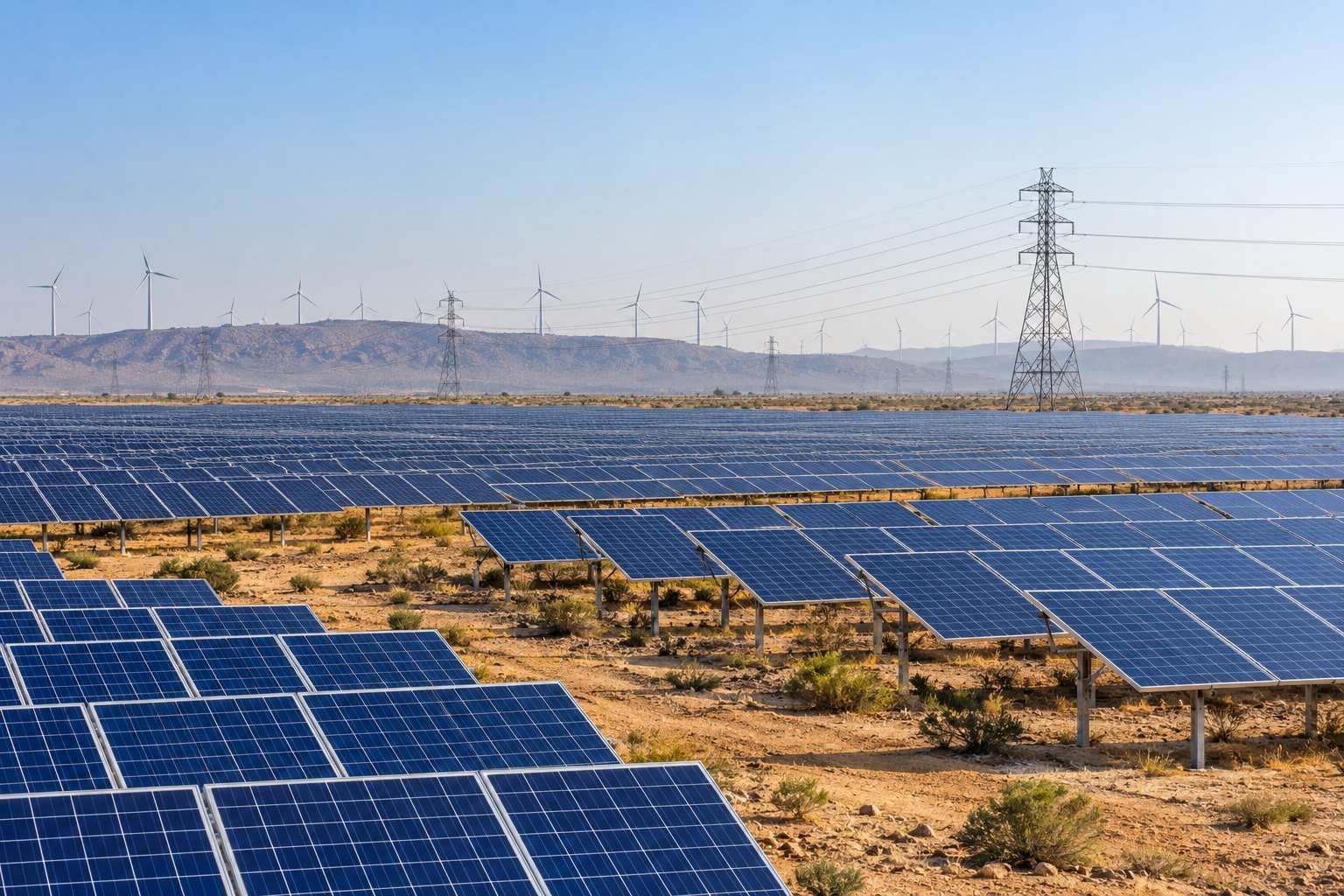
Non-fossil power capacity is installed electricity capacity that burns no fossil fuel: solar, wind, large and small hydro, bio-power and nuclear. India targets 500 GW by 2030 and about 60% of total capacity by 2035. It stood at 300.50 GW, over 54% of capacity, as on 31 July 2026, per the Ministry of New and Renewable Energy.
Syllabus: Prelims · Environment & Ecology; GS3 · Infrastructure; GS3 · Environment & Conservation
Why this matters for UPSC
GS3 energy infrastructure and climate change: Prelims asks which sources count as non-fossil and what each NDC and Panchamrit pledge sets; Mains asks whether India can meet its 2030 and 2035 goals and why capacity outruns generation.
In short
Non-fossil power capacity is installed electricity capacity that burns no fossil fuel: solar, wind, hydro, bio-power and nuclear. India's climate pledges set its targets as gigawatts and as shares.
India met its capacity-share pledges early; the harder test is turning gigawatts into round-the-clock clean electricity through storage, transmission and firm supply.
Why it matters
A farmer with a PM-KUSUM solar pump or a family with rooftop panels under PM Surya Ghar: Muft Bijli Yojana now makes part of its own power and pays less for it. For everyone else, the night-time and evening supply still comes mostly from coal, so smoke and carbon emissions fall more slowly than the capacity numbers suggest. Whether the next 200 GW comes with storage decides if clean power reaches people after sunset. The larger issue is how a fast-growing economy keeps lights on and industry running while meeting climate pledges it set for itself, without depending on imported fuel or imported batteries.
Prelims pointers
- MNRE counting rule: 'Total RE' covers solar, wind, bio-power, small hydro and large hydro; nuclear is added only in the non-fossil total.
- Large hydro in MNRE's progress table includes pumped storage capacity; small hydro is reported separately within renewables.
- Small Hydro Power Development Scheme (FY 2026-27 to 2030-31): outlay Rs 2,584.60 crore, about 1,500 MW, projects of 1-25 MW.
- Updated NDC (submitted 26 August 2022): 45% emissions-intensity cut from 2005 and about 50% non-fossil installed capacity, both by 2030.
- NDC 2031-35 (April 2026): carbon sink of 3.5-4.0 billion tonnes CO2 equivalent through forest and tree cover by 2035, against 2005.
- Apex Committee for Implementation of Paris Agreement (AIPA): inter-ministerial group set up on 27 November 2020 to coordinate and report India's NDC.
- India submitted its Long-Term Low Carbon Development Strategy to the UNFCCC on 14 November 2022.
Practise a UPSC-style question
With reference to how India counts its non-fossil power capacity, consider the following statements:
1. Nuclear power is counted in the non-fossil total, though it is left out of MNRE's renewable energy total.
2. Large hydro capacity is left out of MNRE's renewable energy total and is added only to the non-fossil total.
3. Pumped storage capacity is counted under small hydro power in MNRE's progress tables.
Which of the statements given above is/are correct?
- (a) 1 only
- (b) 2 only
- (c) 3 only
- (d) 1, 2 and 3
Show the answer
Answer: (a) 1 only
Answer: (a) 1 only. Only nuclear sits outside the renewable total; large hydro, pumped storage included, is inside it.
Statement 1: correct. MNRE's table lists Total RE first and then adds nuclear power to reach the Total Non-Fossil figure.
Statement 2: incorrect. MNRE's Total RE includes large hydro; the sub-total without large hydro is shown separately.
Statement 3: incorrect. Pumped storage is counted inside large hydro, as a note to MNRE's table states.
Eliminate: Judge statement 2 first: large hydro is part of MNRE's renewable total. Out: (b), (d).
Eliminate: Judge statement 3: pumped storage sits under large hydro, not small hydro. Out: (c).
Trap: Look-alike names. Renewable and non-fossil sound the same, and large and small hydro are easily swapped.
Remember: Non-fossil = renewable (including large hydro and pumped storage) + nuclear.
More Explainers
- State Legislative Councils: Articles 168-172 and the graduates' and teachers' seats Polity
- Whales and dolphins in Indian waters: legal protection, IUCN status and strandings Environment
- The Aligarh Movement, AMU and the Article 30 minority test Polity
- Environmental clearance by States: SEIAA, SEAC and the EIA Notification, 2006 Environment
- Software vulnerabilities: CVE, CVSS, coordinated disclosure and CERT-In's role Sci-Tech
- Drug trafficking law in India: NDPS Act, PIT-NDPS, NCB and NCORD National
- Choosing the UN Secretary-General: Article 97, UNSC veto and straw polls World & IR
- UN Convention against Torture, and why India has not ratified it Polity
- NavIC: why India's navigation constellation cannot give a standalone position Sci-Tech
- International Energy Agency: membership, 90-day oil stocks and India's status World & IR
- PM Surya Ghar: Muft Bijli Yojana and the rooftop solar subsidy Economy
- HFSS foods: FSSAI's draft limits and front-of-pack warning labels National