
Human-leopard conflict in India and how it is managed
Why in news: Leopards killed several people in sugarcane fields of Bijnor and Moradabad, western Uttar Pradesh, in August 2026, despite repeated capture operations.
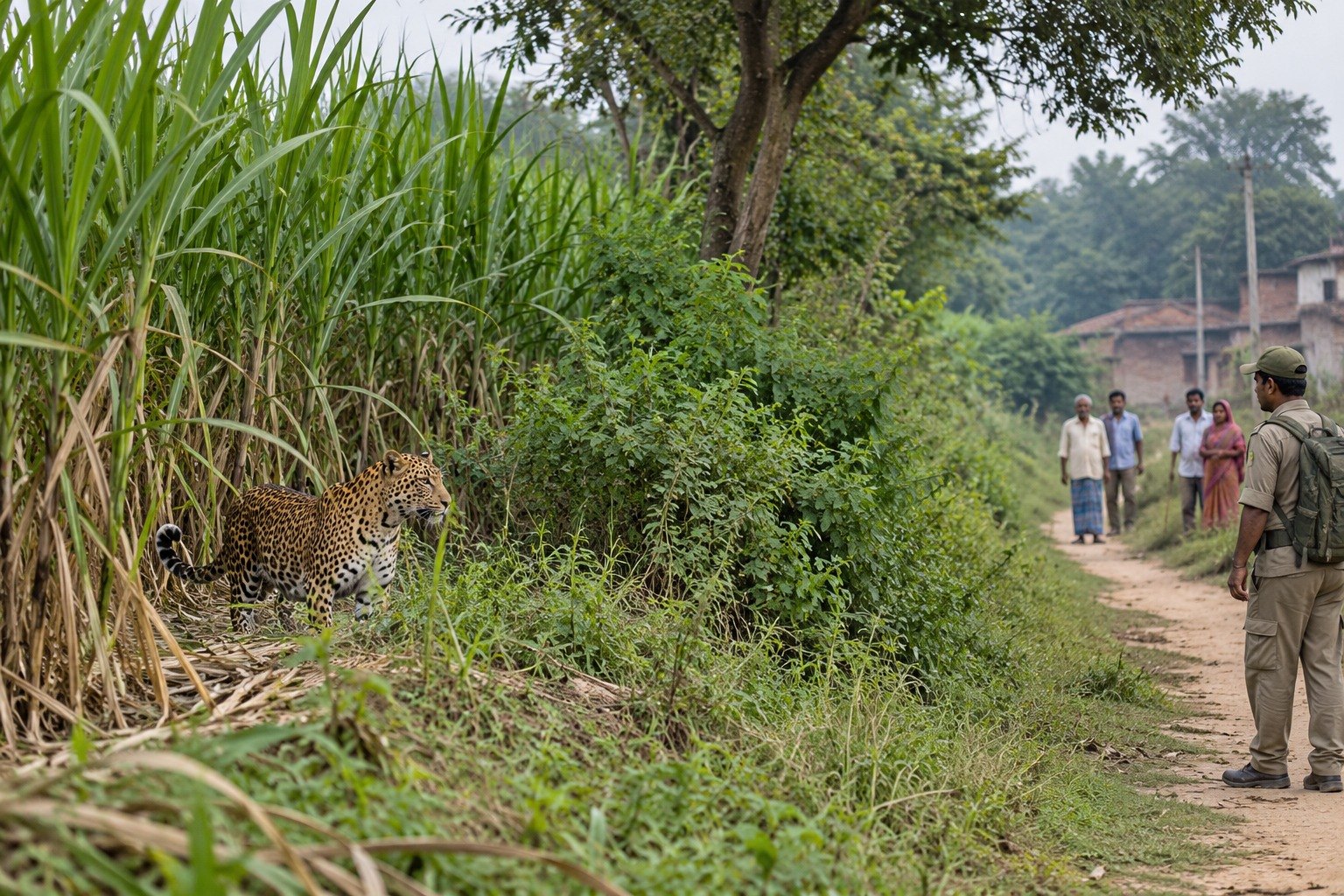
Human-leopard conflict is the harm leopards and people do each other where forests, farms and villages meet. The leopard is a Schedule I animal under the Wild Life (Protection) Act, 1972, and MoEFCC's 2023 guidelines stress prevention, not just capture. Fatal attacks in western Uttar Pradesh's sugarcane belt in August 2026 have brought it back.
Syllabus: Prelims · Environment & Ecology; GS3 · Environment & Conservation
Why this matters for UPSC
GS3 conservation and environmental degradation: Prelims can ask the leopard's Schedule I and IUCN status, section 11 powers and who publishes the Status of Leopards in India 2022; Mains, how human-wildlife conflict should be managed.
In short
Human-leopard conflict is the set of negative interactions in which leopards kill or injure people and livestock, and people capture, injure or kill leopards in retaliation.
Leopards now live in India's farmlands; policy must shift from capturing individuals to prevention, reliable counts and community action, testing fertility control only on evidence.
Why it matters
For a farming family in Bijnor or Junnar, a leopard in the cane field means a child at risk on the walk home, a goat lost overnight and fieldwork that no longer feels safe. When the only answer is a cage, attacks often continue, anger grows and leopards are killed in retaliation, which harms a protected species and the trust between villagers and forest staff. How the State responds decides whether families are paid quickly, whether crop losses are insured and whether people and a large predator can share the same land. The same choices, between removal and prevention, apply to the other animals named in the 2023 guidelines, from elephants to wild pigs.
Prelims pointers
- Section 11(1)(b) of the Wild Life (Protection) Act lets the Chief Wild Life Warden or an authorised officer permit hunting a Schedule II animal dangerous to life or property.
- The Wild Life (Protection) Amendment Act, 2022 (No. 18 of 2022) got assent on 19 December 2022 and defines vermin as a wild animal notified under section 62.
- Leopard abundance is estimated from camera-trap photographs with spatially explicit capture-recapture models, combined with prey, habitat and human-disturbance data.
- The 2022 estimate sampled forested habitats in 18 tiger States; non-forested habitats, arid areas and the high Himalayas above 2,000 m, about 30% of the area, were left out.
- MoEFCC's 2023 set has 14 guidelines: 10 species-specific (including gaur, rhesus macaque, blue bull and blackbuck) and 4 on cross-cutting issues such as crowd management.
- The 2023 guidelines were pilot-tested with the forest departments of Karnataka, Uttarakhand and West Bengal between 2018 and 2022.
- Centrally Sponsored Schemes 'Development of Wildlife Habitats' and 'Project Tiger and Elephant' fund solar-powered fences, bio-fencing with cactus and compensation.
Practise a UPSC-style question
With reference to the leopard in India, consider the following statements:
1. It is listed in Schedule I of the Wild Life (Protection) Act, 1972.
2. It is classified as Endangered on the IUCN Red List.
3. Section 11(1)(a) of the Act lets the State Chief Wild Life Warden permit hunting of a Schedule I animal dangerous to human life.
Which of the statements given above is/are correct?
- (a) 1 and 2 only
- (b) 2 and 3 only
- (c) 1 and 3 only
- (d) 1, 2 and 3
Show the answer
Answer: (c) 1 and 3 only
Answer: (c) 1 and 3 only. The leopard is a Schedule I animal rated Vulnerable, not Endangered, so only statement 2 fails.
Statement 1: correct. The Status of Leopards in India 2022 notes that the leopard is listed in Schedule I of the Wild Life (Protection) Act, 1972, the highest protection.
Statement 2: incorrect. The IUCN Red List classifies the leopard as Vulnerable, not Endangered.
Statement 3: correct. Section 11(1)(a) empowers the State Chief Wild Life Warden to permit hunting a Schedule I animal that has become dangerous to human life.
Eliminate: Judge statement 2 first: the leopard is Vulnerable on the IUCN Red List, so statement 2 is incorrect. Out: (a), (b), (d).
Trap: Look-alike names. Endangered and Vulnerable are neighbouring IUCN categories, and a protected big cat feels as if it ought to be Endangered.
Remember: Leopard: Schedule I of the 1972 Act, IUCN Vulnerable, section 11(1)(a) for a dangerous animal.
More Explainers
- State Legislative Councils: Articles 168-172 and the graduates' and teachers' seats Polity
- Whales and dolphins in Indian waters: legal protection, IUCN status and strandings Environment
- The Aligarh Movement, AMU and the Article 30 minority test Polity
- Environmental clearance by States: SEIAA, SEAC and the EIA Notification, 2006 Environment
- Software vulnerabilities: CVE, CVSS, coordinated disclosure and CERT-In's role Sci-Tech
- Drug trafficking law in India: NDPS Act, PIT-NDPS, NCB and NCORD National
- Choosing the UN Secretary-General: Article 97, UNSC veto and straw polls World & IR
- UN Convention against Torture, and why India has not ratified it Polity
- NavIC: why India's navigation constellation cannot give a standalone position Sci-Tech
- International Energy Agency: membership, 90-day oil stocks and India's status World & IR
- PM Surya Ghar: Muft Bijli Yojana and the rooftop solar subsidy Economy
- HFSS foods: FSSAI's draft limits and front-of-pack warning labels National