
Heatwaves in India: IMD criteria, Heat Action Plans and SDRF relief
Why in news: On 4 August 2026 the Home Ministry told the Lok Sabha that heatwaves and lightning are now notified calamities under SDRF/NDRF guidelines for 2026-31.
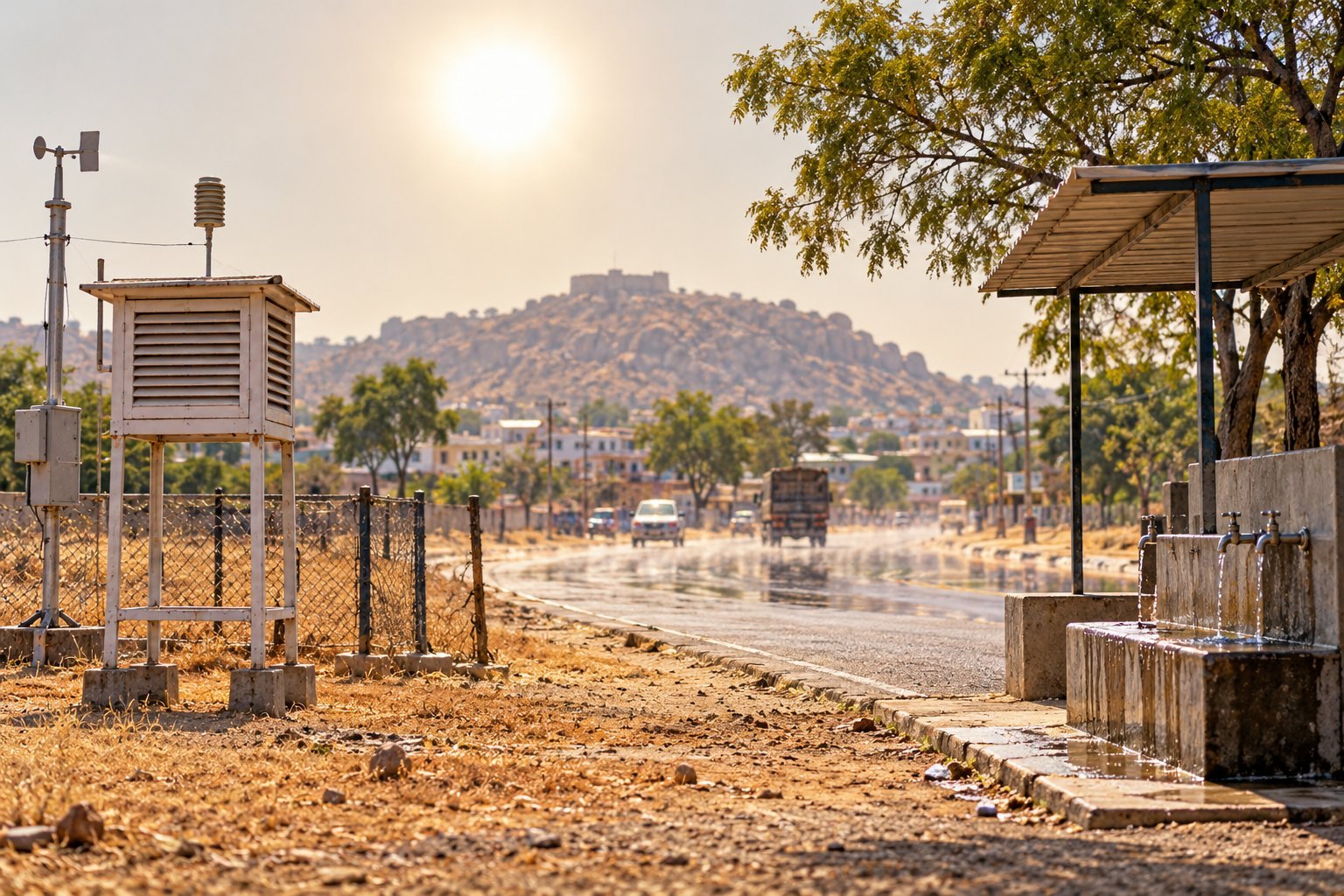
The India Meteorological Department (IMD) declares a heatwave when a plains station of 40°C or more runs 4.5°C above normal, or touches 45°C, at two stations of a sub-division on two consecutive days. States respond through Heat Action Plans under NDMA guidelines. For 2026-31, heatwaves are a notified calamity for SDRF and NDRF relief.
Syllabus: Prelims · Environment & Ecology; GS1 · Geophysical Phenomena; GS3 · Disaster Management
Why this matters for UPSC
Heatwaves sit in GS3 disaster management and GS1 climate. Prelims can ask IMD's heatwave thresholds or what the SDRF and NDRF cover; GS3 Mains, how Heat Action Plans and the 16th Finance Commission's change shape India's response to extreme heat.
In short
A heatwave is a spell of abnormally high temperature judged against a place's normal; India meets it with IMD warnings, NDMA-guided Heat Action Plans and, from 2026, SDRF/NDRF relief.
Listing heatwaves for relief closes a funding gap; lives will be saved only when local thresholds, enforced Heat Action Plans and cooler cities follow.
Why it matters
A farm labourer, a street vendor or a construction worker cannot stay indoors on a scorching afternoon. Heat cramps can turn into heatstroke within hours, and a hot night leaves the body no time to recover. Once a heatwave is declared, a working Heat Action Plan should bring drinking water, shade and shifted working hours to such people and get hospitals ready to cool patients fast. Until now a family that lost its earner to heat had a weak claim on disaster relief; with heat on the notified list, States have a clear fund to draw on. As a warming climate makes hot seasons longer and harsher, how India counts heat deaths and pays for heat losses becomes a real test of its disaster management.
Prelims pointers
- IMD heatwave thresholds: departure 4.5-6.4°C above normal is a heatwave, above 6.4°C a severe heatwave; actual maximum 45°C a heatwave, 47°C severe.
- Declaration test: criteria met at two or more stations of one meteorological sub-division for two consecutive days; declared on the second day.
- Coastal stations: a heatwave may be described at a 4.5°C departure if the actual maximum is 37°C or more; hilly regions need at least 30°C.
- IMD colour codes, issued with NDMA: green no action, yellow be updated, orange be prepared, red take action.
- Season: March to June, rarely July, peaking in May; heatwaves usually start over northwest India and spread east and south, not west.
- NDMA: created by the Disaster Management Act, 2005, headed by the Prime Minister; State Disaster Management Authorities are headed by Chief Ministers.
- Disaster Management Act, 2005, section 2(d): a disaster is a grave occurrence, natural or man-made, beyond the affected area's coping capacity.
Practise a UPSC-style question
With reference to the India Meteorological Department's criteria for declaring a heatwave, consider the following statements:
1. A heatwave is considered only once a plains station's maximum temperature reaches at least 40°C.
2. A departure of 4.5°C to 6.4°C above the normal maximum temperature marks a severe heatwave.
3. The criteria must be met at two or more stations of a meteorological sub-division on two consecutive days.
Which of the statements given above is/are correct?
- (a) 1 and 2 only
- (b) 2 and 3 only
- (c) 1 and 3 only
- (d) 1, 2 and 3
Show the answer
Answer: (c) 1 and 3 only
Answer: (c) 1 and 3 only. The 4.5-6.4°C band is an ordinary heatwave, not a severe one.
Statement 1: correct. IMD considers a heatwave only when a station reaches 40°C in the plains or 30°C in hilly regions.
Statement 2: incorrect. A 4.5-6.4°C departure is a heatwave; a severe heatwave needs a departure above 6.4°C.
Statement 3: correct. The test must hold at two stations of a meteorological sub-division for two consecutive days, and is declared on the second.
Eliminate: Judge statement 2 first: 4.5-6.4°C is the heatwave band, so statement 2 is incorrect. Out: (a), (b), (d).
Trap: Look-alike names. The heatwave and severe heatwave bands sit side by side, so the lower band is easily read as the severe one.
Remember: Departure 4.5-6.4°C heatwave, above 6.4°C severe; actual 45°C heatwave, 47°C severe.
More Explainers
- State Legislative Councils: Articles 168-172 and the graduates' and teachers' seats Polity
- Whales and dolphins in Indian waters: legal protection, IUCN status and strandings Environment
- The Aligarh Movement, AMU and the Article 30 minority test Polity
- Environmental clearance by States: SEIAA, SEAC and the EIA Notification, 2006 Environment
- Software vulnerabilities: CVE, CVSS, coordinated disclosure and CERT-In's role Sci-Tech
- Drug trafficking law in India: NDPS Act, PIT-NDPS, NCB and NCORD National
- Choosing the UN Secretary-General: Article 97, UNSC veto and straw polls World & IR
- UN Convention against Torture, and why India has not ratified it Polity
- NavIC: why India's navigation constellation cannot give a standalone position Sci-Tech
- International Energy Agency: membership, 90-day oil stocks and India's status World & IR
- PM Surya Ghar: Muft Bijli Yojana and the rooftop solar subsidy Economy
- HFSS foods: FSSAI's draft limits and front-of-pack warning labels National