
Green hydrogen, the National Green Hydrogen Mission and green steel
Why in news: Union Minister Pralhad Joshi launched MNRE's Green Hydrogen Certification Portal of India on 17 June 2026.
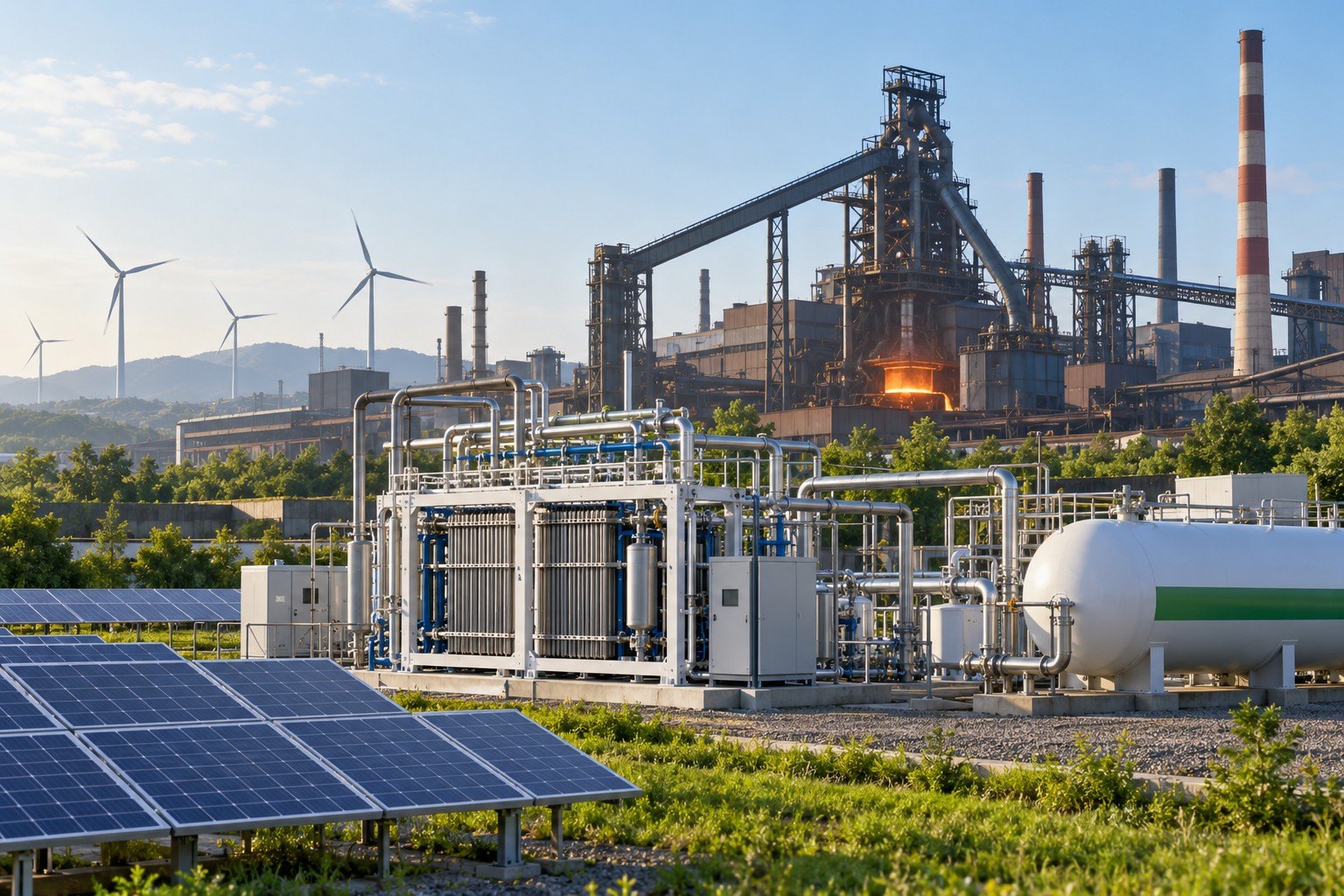
Green hydrogen is hydrogen made by splitting water with renewable electricity, or from biomass, emitting at most 2 kg CO2 equivalent per kg. The National Green Hydrogen Mission, run by the Ministry of New and Renewable Energy, backs its use in steel and other hard-to-abate industries. Steel pilots and a June 2026 certification portal keep it in the news.
Syllabus: Prelims · Environment & Ecology; GS3 · Infrastructure; GS3 · Science & Technology
Why this matters for UPSC
GS3 energy, infrastructure and environment: Prelims asks what grey, blue and green hydrogen are, how electrolysis works and the Mission's ministry and SIGHT; Mains asks how to decarbonise hard-to-abate sectors like steel.
In short
Green hydrogen is hydrogen produced by electrolysis of water with renewable electricity, or from biomass; the National Green Hydrogen Mission (2023) seeks to scale it for hard-to-abate industries.
Green hydrogen can decarbonise Indian steel only if certified, affordable supply and assured demand arrive before coal-based plants lock in decades of emissions.
Why it matters
A steel plant that switches from coal to green hydrogen can make the same girders and car bodies with a fraction of the carbon. That matters to workers and towns built around steel, because Indian steel sold to buyers who count carbon will need a certificate showing how it was made. Fertiliser plants and refineries already use hydrogen made from imported natural gas; making it at home from sunlight and wind keeps that money in India and shields farmers from gas price swings. The catch is cost: until green hydrogen is cheap, plants will keep burning coal, and every new coal-based furnace runs for decades. The larger issue is how a growing economy builds its infrastructure without locking in emissions.
Prelims pointers
- Blue hydrogen: fossil hydrogen whose carbon dioxide is captured and stored or used; grey hydrogen releases it.
- Bureau of Energy Efficiency: set up on 1 March 2002 under the Energy Conservation Act, 2001, under the Ministry of Power.
- Mission governance: an Empowered Group chaired by the Cabinet Secretary; an Advisory Group chaired by the Principal Scientific Adviser.
- Hydrogen Valley Innovation Clusters: Jodhpur, Odisha, Pune and Kerala hydrogen valleys were awarded under the Mission.
- Sponge iron: another name for direct reduced iron, from its spongy structure; melted in electric arc or induction furnaces.
- Green steel certificates: NISST issues them yearly, per financial year, or more often if a plant opts for more frequent verification.
- Green Hydrogen Policy, February 2022: 25-year waiver of inter-state transmission charges for projects commissioned before 30 June 2025.
Practise a UPSC-style question
With reference to the methods of producing hydrogen, consider the following statements:
1. Grey hydrogen is produced mainly by steam methane reforming of natural gas.
2. Blue hydrogen is produced by electrolysis of water using electricity from nuclear power plants.
3. Under India's Green Hydrogen Standard, hydrogen produced from biomass can also qualify as green hydrogen.
Which of the statements given above is/are correct?
- (a) 1 and 2 only
- (b) 2 and 3 only
- (c) 1 and 3 only
- (d) 1, 2 and 3
Show the answer
Answer: (c) 1 and 3 only
Answer: (c) 1 and 3 only. Grey hydrogen is fossil-based, and India's green definition covers biomass as well as electrolysis.
Statement 1: correct. Steam methane reforming of natural gas, a carbon-intensive process, is the main grey route; coal gasification is another fossil route.
Statement 2: incorrect. Blue hydrogen comes from natural gas or coal gasification combined with carbon capture, storage or use, not from electrolysis.
Statement 3: correct. The Green Hydrogen Standard notified by MNRE in 2023 covers both electrolysis-based and biomass-based production.
Eliminate: statement 2 is the surest, since blue hydrogen is a fossil route with carbon capture. Out: (a), (b), (d).
Trap: Look-alike names. The hydrogen colours are easily mixed up; blue is fossil hydrogen with carbon capture, not low-carbon electrolysis.
Remember: Grey is fossil; blue is fossil plus carbon capture; green is renewable electrolysis or biomass.
More Explainers
- State Legislative Councils: Articles 168-172 and the graduates' and teachers' seats Polity
- Whales and dolphins in Indian waters: legal protection, IUCN status and strandings Environment
- The Aligarh Movement, AMU and the Article 30 minority test Polity
- Environmental clearance by States: SEIAA, SEAC and the EIA Notification, 2006 Environment
- Software vulnerabilities: CVE, CVSS, coordinated disclosure and CERT-In's role Sci-Tech
- Drug trafficking law in India: NDPS Act, PIT-NDPS, NCB and NCORD National
- Choosing the UN Secretary-General: Article 97, UNSC veto and straw polls World & IR
- UN Convention against Torture, and why India has not ratified it Polity
- NavIC: why India's navigation constellation cannot give a standalone position Sci-Tech
- International Energy Agency: membership, 90-day oil stocks and India's status World & IR
- PM Surya Ghar: Muft Bijli Yojana and the rooftop solar subsidy Economy
- HFSS foods: FSSAI's draft limits and front-of-pack warning labels National