
Gram Panchayat Development Plans and the People's Plan Campaign
Why in news: The People's Plan Campaign 2026-27, for 2027-28 village plans, was set to open at special Gram Sabhas on 2 October 2026, the government said.
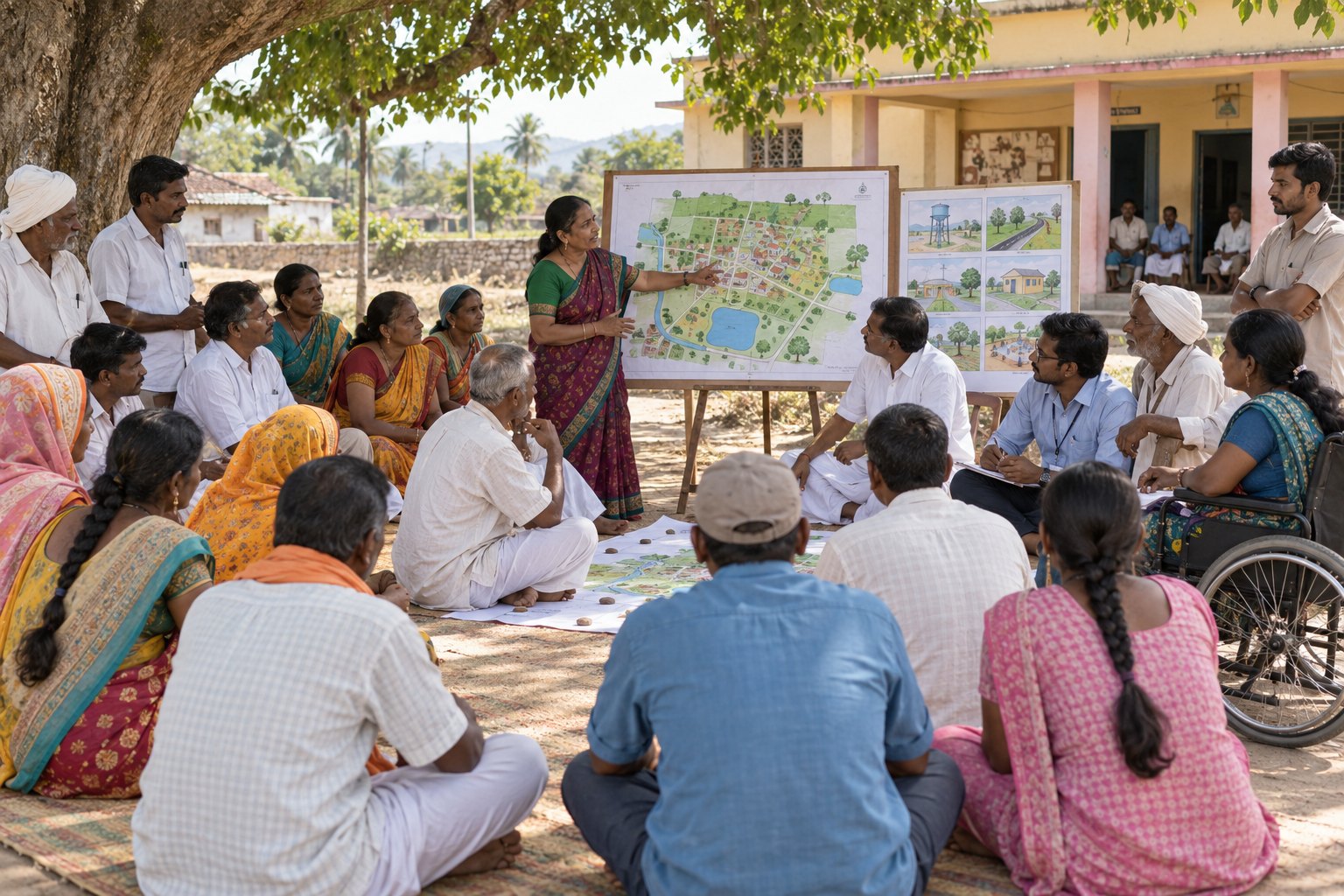
A Gram Panchayat Development Plan (GPDP) is a village panchayat's yearly plan for economic development and social justice, prepared with the Gram Sabha and matched to Finance Commission grants, own revenue and scheme funds. It rests on Article 243G of the Constitution. Special Gram Sabhas on 2 October 2026 were set to open the People's Plan Campaign for 2027-28 plans.
Syllabus: GS2 · Federalism & Local Government; Prelims · Polity & Governance; GS2 · Governance & e-Governance
In short
A Gram Panchayat Development Plan (GPDP) is a village panchayat's yearly plan for economic development and social justice, made with the Gram Sabha under Article 243G.
GPDPs become genuine local self-government only when States devolve functions, funds and functionaries together and untied money lets Gram Sabhas choose.
Why it matters
A villager who needs a drain, a tap connection or a repaired school roof gets it through the panchayat's plan. Finance Commission grants are spent and booked against the works listed in the GPDP, and uploading the plan on eGramSwaraj is a condition for receiving them, so a weak plan costs a village money and services. The larger issue is federal. Panchayats can plan only for what their State has devolved, and a large share of their Finance Commission money comes as tied grants for water and sanitation, so the Gram Sabha's real choice is narrow. Training of elected members under the Rashtriya Gram Swaraj Abhiyan helps, but a plan becomes genuine local self-government only when functions, funds and functionaries reach the panchayat together.
Prelims pointers
- Article 243A: a Gram Sabha exercises the powers and functions the State Legislature provides by law; the Constitution fixes no number of Gram Sabha meetings.
- Article 243G: the State Legislature may, by law, endow panchayats with powers to prepare plans and implement schemes for economic development and social justice, including Eleventh Schedule subjects.
- Article 243B: three tiers (village, intermediate, district); a State whose population does not exceed 20 lakh need not have the intermediate tier.
- Article 243H: a State may authorise panchayats to levy taxes, duties, tolls and fees; Article 243I: the Governor constitutes a State Finance Commission every five years.
- Article 243K: the State Election Commission superintends and conducts panchayat elections; Article 243ZD: the District Planning Committee consolidates panchayat and municipal plans.
- Article 280(3)(bb): the Union Finance Commission recommends measures to supplement panchayat resources, on the basis of the State Finance Commission's recommendations.
- eGramSwaraj, launched on 24 April 2020 under the e-Panchayat Mission Mode Project, handles panchayat planning, accounts and payments; AuditOnline audits panchayat accounts.
- Revamped RGSA is a centrally sponsored scheme: central components fully funded; State components 60:40, 90:10 for North-Eastern and hill States and Jammu and Kashmir, 100% for other UTs.
Practise a UPSC-style question
With reference to the Gram Sabha under the Constitution of India, consider the following statements:
1. Article 243A fixes the number of Gram Sabha meetings to be held in a year.
2. The Gram Sabha consists of persons registered in the electoral rolls of a village within the area of a village panchayat.
Which of the statements given above is/are correct?
- (a) 1 only
- (b) 2 only
- (c) Both 1 and 2
- (d) Neither 1 nor 2
Show the answer
Answer: (b) 2 only
1 is incorrect: Article 243A only says a Gram Sabha may exercise the powers and functions the State Legislature provides by law; meeting days are set by State law or practice, not the Constitution. 2 is correct: Article 243(b) defines the Gram Sabha as the persons on the electoral rolls of a village within the village panchayat's area.
More Explainers
- State Legislative Councils: Articles 168-172 and the graduates' and teachers' seats Polity
- Whales and dolphins in Indian waters: legal protection, IUCN status and strandings Environment
- The Aligarh Movement, AMU and the Article 30 minority test Polity
- Environmental clearance by States: SEIAA, SEAC and the EIA Notification, 2006 Environment
- Software vulnerabilities: CVE, CVSS, coordinated disclosure and CERT-In's role Sci-Tech
- Drug trafficking law in India: NDPS Act, PIT-NDPS, NCB and NCORD National
- Choosing the UN Secretary-General: Article 97, UNSC veto and straw polls World & IR
- UN Convention against Torture, and why India has not ratified it Polity
- NavIC: why India's navigation constellation cannot give a standalone position Sci-Tech
- International Energy Agency: membership, 90-day oil stocks and India's status World & IR
- PM Surya Ghar: Muft Bijli Yojana and the rooftop solar subsidy Economy
- HFSS foods: FSSAI's draft limits and front-of-pack warning labels National