
Glacial lake outburst floods (GLOFs) and India's early-warning push
Why in news: Uttarakhand announced a pilot GLOF warning system at Vasundhara Tal on 13 October 2026; Himachal reported one at Ghepan Gath on 16 October.
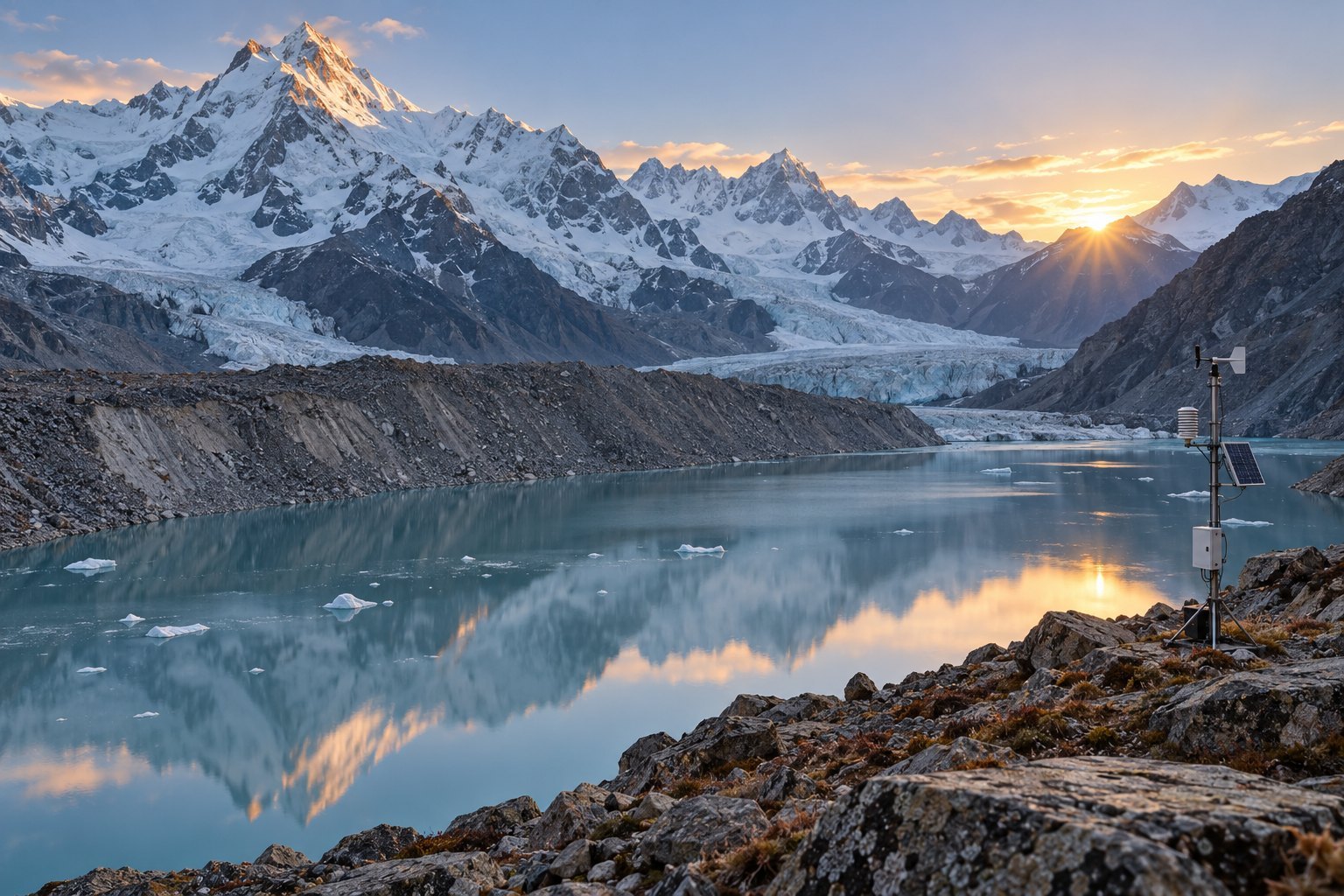
A glacial lake outburst flood (GLOF) is the sudden release of water from a lake held behind a glacier or loose moraine, sending water and debris rushing downstream. NDMA has listed 195 potentially high-risk Himalayan lakes. In October 2026, Uttarakhand and Himachal Pradesh reported early-warning systems at Vasundhara Tal and Ghepan Gath lakes.
Syllabus: Prelims · Environment & Ecology; GS1 · Geophysical Phenomena; GS3 · Disaster Management
Why this matters for UPSC
GLOFs sit in GS3 disaster management and GS1 physical geography. Prelims can ask how moraine dams fail, what NDMA's guidelines say and which States the National GLOF Risk Mitigation Programme covers; Mains, about Himalayan disaster preparedness.
In short
A glacial lake outburst flood (GLOF) is the sudden release of water held behind a glacier or moraine, sending water and debris far downstream in minutes.
India has moved from relief to mapping and warning; the test now is lowering dangerous lakes and keeping construction out of flood paths.
Why it matters
A glacial lake can hold millions of cubic metres of water behind a pile of loose rock. When it gives way, a wall of water, mud and boulders can hit a village, a bridge or a hydropower dam far below within minutes, sometimes with no rain falling. People in Sikkim's Teesta valley, Uttarakhand's Chamoli or Himachal's Lahaul cannot see the lake from their homes. A warning system that measures the lake and sends an alert to officials and phones can give families the few minutes they need to reach higher ground. The larger question is how a warming Himalaya can keep its roads, power projects and towns safe.
Prelims pointers
- State Disaster Management Authorities are headed by the respective Chief Ministers, as the Disaster Management Act, 2005 envisaged.
- NDMA's GLOF guidelines (October 2020) proposed the Ministry of Jal Shakti as nodal ministry and CWC as nodal agency for glacial studies.
- Moraine dams are the commonest glacial lake dam type in the Himalaya; moraine-dammed lakes at a glacier's snout carry high breach probability.
- Early warning, per UNISDR, has four elements: risk knowledge, monitoring and warning service, dissemination and communication, and response capability.
- Early warning matches Priority 4 of the Sendai Framework for Disaster Risk Reduction and SDG target 13.3, per NDMA's GLOF guidelines.
- The National Disaster Management Plan, 2019 recognises GLOFs as a potential climatological disaster.
- Lake-lowering options in the 2020 guidelines: controlled breaching, an outlet control structure, pumping or siphoning, and a tunnel through the moraine.
Practise a UPSC-style question
With reference to glacial lakes in the Himalaya, consider the following statements:
1. Bedrock is the most common type of dam holding back glacial lakes in the Himalayan region.
2. Moraine-dammed lakes located at the snout of a glacier have a high probability of breaching.
Which of the statements given above is/are correct?
- (a) 1 only
- (b) 2 only
- (c) Both 1 and 2
- (d) Neither 1 nor 2
Show the answer
Answer: (b) 2 only
Answer: (b) 2 only. Moraine, not bedrock, is the commonest and weakest Himalayan lake dam.
Statement 1: incorrect. NDMA's 2020 GLOF guidelines name moraine as the most common dam type in the Himalaya; rock-dammed lakes rarely breach.
Statement 2: correct. Moraine-dammed lakes at a glacier's snout have a high breach probability and high hazard potential, per the 2020 guidelines.
Eliminate: statement 1 is wrong because rock dams are the strong, rare-breach type. Out: (a), (c).
Eliminate: statement 2 is right because loose moraine can fail suddenly. Out: (d).
Trap: Look-alike names. Bedrock, moraine and ice dams all hold glacial lakes; the question swaps the strongest type for the commonest one.
Remember: Himalayan GLOFs come mostly from loose moraine dams, not bedrock.
More Explainers
- State Legislative Councils: Articles 168-172 and the graduates' and teachers' seats Polity
- Whales and dolphins in Indian waters: legal protection, IUCN status and strandings Environment
- The Aligarh Movement, AMU and the Article 30 minority test Polity
- Environmental clearance by States: SEIAA, SEAC and the EIA Notification, 2006 Environment
- Software vulnerabilities: CVE, CVSS, coordinated disclosure and CERT-In's role Sci-Tech
- Drug trafficking law in India: NDPS Act, PIT-NDPS, NCB and NCORD National
- Choosing the UN Secretary-General: Article 97, UNSC veto and straw polls World & IR
- UN Convention against Torture, and why India has not ratified it Polity
- NavIC: why India's navigation constellation cannot give a standalone position Sci-Tech
- International Energy Agency: membership, 90-day oil stocks and India's status World & IR
- PM Surya Ghar: Muft Bijli Yojana and the rooftop solar subsidy Economy
- HFSS foods: FSSAI's draft limits and front-of-pack warning labels National