
Genome-edited crops: SDN categories and India's biosafety rules
Why in news: On 15 October 2026 ICAR said its two genome-edited rice varieties will feature at ESTIC 2026, 27-29 October, Bharat Mandapam.
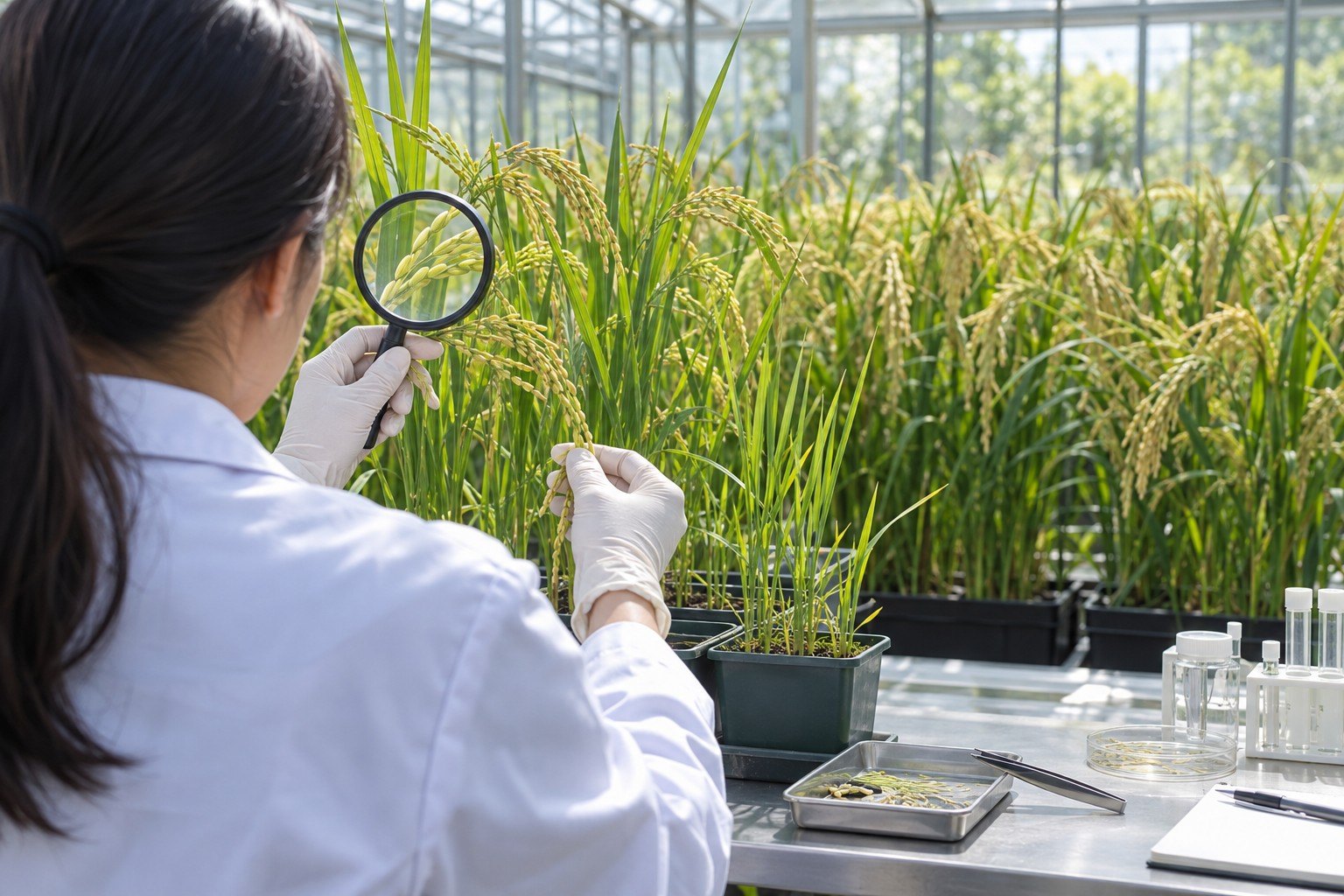
Genome editing uses site-directed nucleases such as CRISPR-Cas to change a plant's own DNA at a chosen spot. India exempts SDN-1 and SDN-2 plants free of foreign DNA from the GM approval rules, while SDN-3 plants are regulated like GM crops. Two ICAR rice varieties made this way go on show at a national science conclave opening on 27 October.
Syllabus: GS3 · Agriculture & Irrigation; Prelims · Science & Technology; GS3 · Science & Technology
Why this matters for UPSC
GS3 science and technology and agriculture: Prelims can ask how SDN-1, SDN-2 and SDN-3 differ and what the IBSC, RCGM and GEAC do; Mains, whether genome-edited crops should be regulated like GM crops.
In short
Genome editing changes a plant's own DNA at a chosen site using site-directed nucleases such as CRISPR-Cas; India regulates it by whether foreign DNA remains in the final plant.
Genome editing can speed climate-ready breeding, but its exemption is credible only if the foreign-DNA test, trial data and SDN-3 oversight stay transparent.
Why it matters
A rice farmer on salty or alkaline land in Andhra Pradesh or Tamil Nadu could grow a familiar variety that loses less grain to the soil, or one that is harvested weeks earlier and needs fewer irrigations. That is the promise of genome editing: improving the seeds farmers already trust instead of replacing them. Because these plants are exempt from the long GM approval chain, they can reach fields years sooner than a transgenic crop. The risk is the other side of that speed: if the checks that a plant carries no foreign DNA are weak, or trial results are disputed, public trust in all new seeds suffers, as the long fight over GM mustard shows.
Prelims pointers
- Rules, 1989: the 'Rules for the Manufacture, Use/Import/Export and Storage of Hazardous Micro-organisms, Genetically Engineered Organisms or Cells', framed under the Environment (Protection) Act, 1986.
- MoEFCC Office Memorandum of 30 March 2022: SDN-1 and SDN-2 plants free of exogenous DNA exempted from Rules 7 to 11, using Rule 20 of the Rules, 1989.
- RCGM approved the genome-editing guidelines at its 231st meeting on 28 April 2022; DBT notified them on 17 May 2022.
- SOPs for SDN-1 and SDN-2 plants, notified 4 October 2022: the IBSC reviews the data, RCGM accepts its minutes, and the IBSC conveys the exemption.
- CRISPR/Cas9: adapted from a bacterial immune system that cuts viral DNA; Emmanuelle Charpentier and Jennifer Doudna won the 2020 Nobel Prize in Chemistry for it.
- Department of Biotechnology sits in the Ministry of Science and Technology; GEAC is the committee of MoEFCC.
- AICRPR, in operation since 1965, is the nodal agency that evaluates and recommends rice varieties for release; varieties are then released and notified through central and State committees.
- AICRPR rule for edited lines: equal to the parent variety in yield and quality, superior in the improved trait, in its target performance environments.
Practise a UPSC-style question
With reference to genome editing using site-directed nucleases, consider the following statements:
1. In SDN-1 editing, an externally supplied DNA template guides the repair to write a chosen change at the cut.
2. In SDN-3 editing, a long template carrying a whole gene introduces that gene at a chosen site in the genome.
Which of the statements given above is/are correct?
- (a) 1 only
- (b) 2 only
- (c) Both 1 and 2
- (d) Neither 1 nor 2
Show the answer
Answer: (b) 2 only
Answer: (b) 2 only. SDN-1 uses no template; SDN-3 uses a long template to insert a gene.
Statement 1: incorrect. SDN-1 has no repair template: the plant's own repair of the cut leaves a small mutation. A supplied template marks SDN-2.
Statement 2: correct. DBT's 2022 guidelines describe SDN-3 as template-guided insertion of an entire gene or longer genetic element at the target site.
Eliminate: Statement 1 is wrong, since SDN-1 works without any template. Out: (a), (c).
Eliminate: Statement 2 is right, since SDN-3 is the class that inserts whole genes. Out: (d).
Trap: Look-alike names. SDN-1 and SDN-2 differ only in the template; the question pins SDN-2's template on SDN-1.
Remember: SDN-1 no template; SDN-2 small template edit; SDN-3 inserts a whole gene.
More Explainers
- State Legislative Councils: Articles 168-172 and the graduates' and teachers' seats Polity
- Whales and dolphins in Indian waters: legal protection, IUCN status and strandings Environment
- The Aligarh Movement, AMU and the Article 30 minority test Polity
- Environmental clearance by States: SEIAA, SEAC and the EIA Notification, 2006 Environment
- Software vulnerabilities: CVE, CVSS, coordinated disclosure and CERT-In's role Sci-Tech
- Drug trafficking law in India: NDPS Act, PIT-NDPS, NCB and NCORD National
- Choosing the UN Secretary-General: Article 97, UNSC veto and straw polls World & IR
- UN Convention against Torture, and why India has not ratified it Polity
- NavIC: why India's navigation constellation cannot give a standalone position Sci-Tech
- International Energy Agency: membership, 90-day oil stocks and India's status World & IR
- PM Surya Ghar: Muft Bijli Yojana and the rooftop solar subsidy Economy
- HFSS foods: FSSAI's draft limits and front-of-pack warning labels National