
Ganges river dolphin: status, range and Project Dolphin
Why in news: A Wildlife Institute of India acoustic study in the Rupnarayan river, reported on 12 October 2026, links dolphin detections to time, tides and the moon.
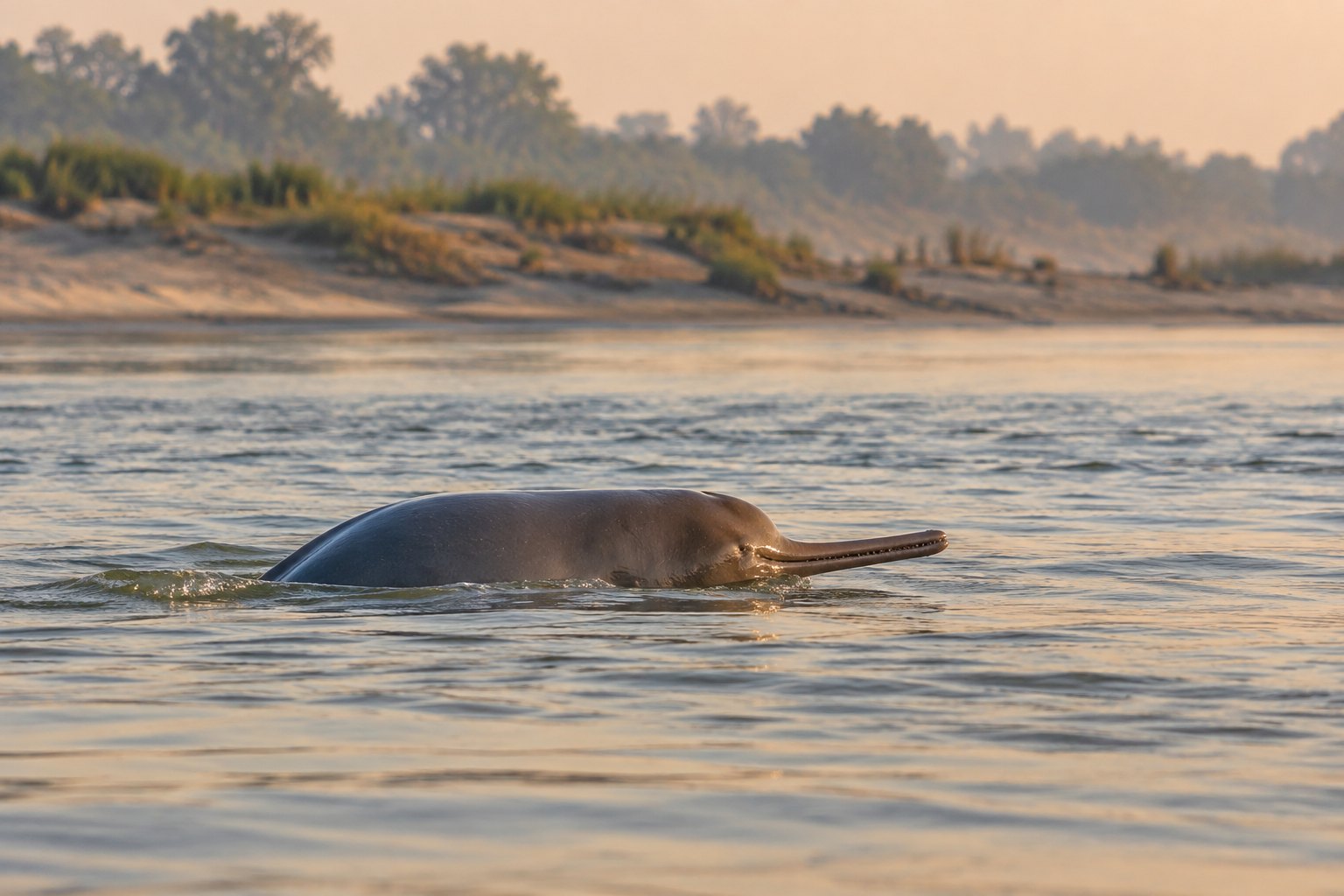
The Ganges river dolphin (Platanista gangetica) is India's National Aquatic Animal, listed in Schedule I of the Wild Life (Protection) Act, 1972. It lives in the Ganga and Brahmaputra systems and is counted under Project Dolphin, whose second range-wide estimation began in January 2026. A new acoustic study links its acoustic detections to time of day and tides.
Syllabus: Prelims · Current Affairs & IR; Prelims · Environment & Ecology; GS3 · Environment & Conservation
In short
The Ganges river dolphin (Platanista gangetica) is India's National Aquatic Animal, an Endangered freshwater mammal whose survival tracks the health of the Ganga and Brahmaputra.
Schedule I status alone has not halted decline in tributaries; standardised counts and community curbs on bycatch must guide protection.
Why it matters
For a fisher on the Ganga or the Brahmaputra, the dolphin is a neighbour that shares the same nets and the same fish. Because the dolphin needs clean, flowing water with enough prey, a river that keeps its dolphins is usually healthy for people too: this is why it is called a bio-indicator and an umbrella species. Counting it well matters: if a survey boat passes at high tide or at midday, it may record fewer dolphins and wrongly suggest a decline. Good numbers decide where sanctuaries, fishing rules and boat-traffic limits go, under Project Dolphin and the 2022–2047 action plan.
Prelims pointers
- Wild Life (Protection) Act, 1972, Schedule I: the highest degree of protection; it lists the Ganges river dolphin.
- National Aquatic Animal of India: the Ganges river dolphin.
- Project Dolphin: Ministry of Environment, Forest and Climate Change; covers riverine and estuarine dolphins; the count is coordinated by the Wildlife Institute of India.
- Wildlife Institute of India (WII): Dehradun-based institute of the Environment Ministry that coordinates the range-wide dolphin estimation.
- Vikramshila Dolphin Sanctuary: a notified Protected Area for the Ganges river dolphin, in Bihar.
- Three dolphins in the second estimation: Ganges river dolphin, Indus river dolphin (Beas) and Irrawaddy dolphin (Sundarbans, Odisha).
- Development of Wildlife Habitats: a Centrally sponsored scheme; the Ganges river dolphin is one of its 22 critically endangered species for State funding.
- Echolocation: river dolphins find their way and prey by the echoes of their own clicks, which hydrophones can record.
Practise a UPSC-style question
Consider the following statements about the Ganges river dolphin:
1. It is listed in Schedule I of the Wild Life (Protection) Act, 1972.
2. It has been designated the National Aquatic Animal of India.
3. Vikramshila Dolphin Sanctuary in Bihar is a notified Protected Area for its habitat.
Which of the statements given above is/are correct?
- (a) 1 and 2 only
- (b) 2 and 3 only
- (c) 1 and 3 only
- (d) 1, 2 and 3
Show the answer
Answer: (d) 1, 2 and 3
1 is correct: Schedule I of the Wild Life (Protection) Act, 1972 lists it and gives it the highest protection. 2 is correct: it is India's National Aquatic Animal. 3 is correct: Vikramshila Dolphin Sanctuary, in Bihar, protects its habitat on the Ganga.
More Explainers
- State Legislative Councils: Articles 168-172 and the graduates' and teachers' seats Polity
- Whales and dolphins in Indian waters: legal protection, IUCN status and strandings Environment
- The Aligarh Movement, AMU and the Article 30 minority test Polity
- Environmental clearance by States: SEIAA, SEAC and the EIA Notification, 2006 Environment
- Software vulnerabilities: CVE, CVSS, coordinated disclosure and CERT-In's role Sci-Tech
- Drug trafficking law in India: NDPS Act, PIT-NDPS, NCB and NCORD National
- Choosing the UN Secretary-General: Article 97, UNSC veto and straw polls World & IR
- UN Convention against Torture, and why India has not ratified it Polity
- NavIC: why India's navigation constellation cannot give a standalone position Sci-Tech
- International Energy Agency: membership, 90-day oil stocks and India's status World & IR
- PM Surya Ghar: Muft Bijli Yojana and the rooftop solar subsidy Economy
- HFSS foods: FSSAI's draft limits and front-of-pack warning labels National