
Ganga Water Treaty, 1996: sharing at Farakka and renewal
Why in news: On 9 October 2026 the MEA said river matters run through the Joint Rivers Commission, a day after Dhaka sought a new or revised treaty.
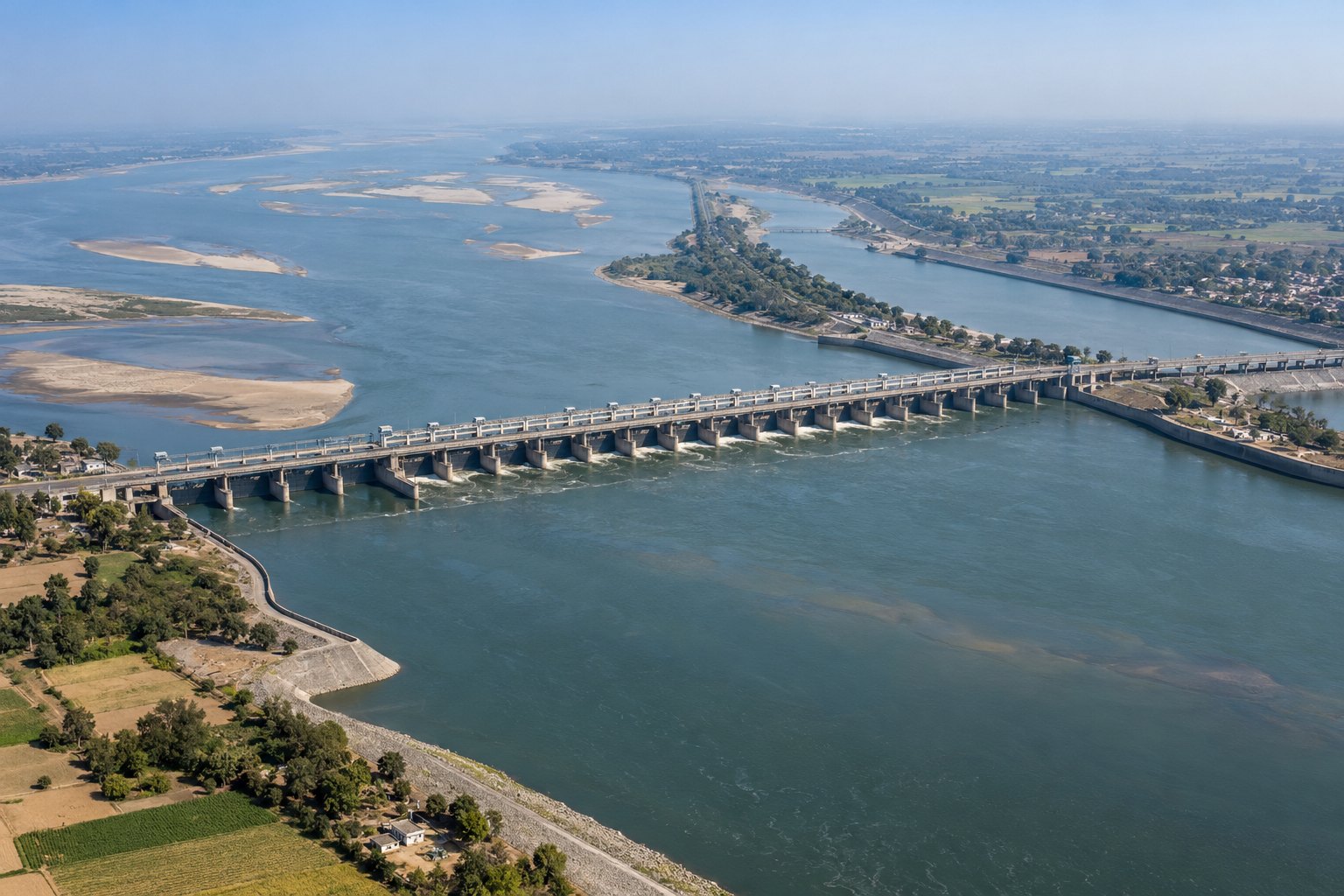
The Ganga Water Treaty of 12 December 1996 shares the river's flow at Farakka Barrage between India and Bangladesh in ten-day periods from 1 January to 31 May, assuring each 35,000 cusecs in turns during the driest weeks. Renewable only by mutual consent, it expires in December 2026, and no renewal had been signed by 14 October 2026.
Syllabus: GS2 · Federalism & Local Government; GS2 · India & its Neighbourhood; GS2 · Groupings & Agreements
Why this matters for UPSC
GS2 international relations (India and its neighbourhood, bilateral agreements) and federalism. Prelims can ask the Farakka sharing formula, the 50,000-cusec trigger, the Joint Rivers Commission and Seventh Schedule entries; Mains, about renewing the treaty and sharing transboundary rivers.
In short
The Ganga Water Treaty, signed by India and Bangladesh in 1996, shares the river's lean-season flow at Farakka, balancing upstream India's needs with downstream Bangladesh's.
Renewal should keep the treaty's joint measurement and lean-season safeguards while updating its flow data and bringing West Bengal and Bihar along.
Why it matters
A farmer in Bangladesh, a port worker in Kolkata and a family in Bihar all depend on the same river in the same dry months. From January to May the Ganga runs low, and water held back upstream cannot reach the fields downstream. The treaty turned that contest into a written rule that engineers from both countries check together, instead of a fresh bargain every year. If it lapsed with nothing in its place, Bangladesh would have no fixed share in the driest weeks, and a quarrel over water could strain wider ties with an eastern neighbour. Renewal also tests whether the Centre, which makes treaties, can carry with it the States that use the water.
Prelims pointers
- Article II(iii): if flow at Farakka falls below 50,000 cusecs in any ten-day period, the two governments consult at once, guided by equity, fair play and no harm.
- Article II(ii): India, as upper riparian, is to make every effort to protect Farakka's flows at the forty-year (1949-88) average.
- Articles X and XI: reviews every five years, the first possible after two; without agreement, India releases at least 90% of Bangladesh's share.
- Article III: below Farakka, India's reasonable uses of the released water may not exceed 200 cusecs before both banks of the river lie in Bangladesh.
- Farakka Barrage Project (Murshidabad district, West Bengal; Ministry of Jal Shakti): main barrage, head regulator, navigation lock, feeder canal and Jangipur Barrage.
- Joint Rivers Commission: India and Bangladesh share 54 rivers; 7 were identified for priority sharing frameworks, and 8 more were added for data exchange in 2022.
- Seventh Schedule: Union List Entry 14 covers treaties with foreign countries, Entry 56 inter-State rivers; State List Entry 17 covers water, subject to Entry 56.
- Kushiyara MoU, 6 September 2022 (Ministry of Jal Shakti and Bangladesh's Ministry of Water Resources): up to 153 cusecs each, 1 November-31 May; Assam draws India's share.
Practise a UPSC-style question
With reference to the India-Bangladesh Ganga Water Treaty of 1996, consider the following statements:
1. The treaty's trigger for immediate consultations between the two governments is a flow at Farakka below 30,000 cusecs in any ten-day period.
2. Each country receives a guaranteed 35,000 cusecs in alternate three ten-day periods between 11 March and 10 May.
3. The treaty is renewable on the basis of mutual consent of the two governments.
Which of the statements given above is/are correct?
- (a) 1 and 2 only
- (b) 2 and 3 only
- (c) 1 and 3 only
- (d) 1, 2 and 3
Show the answer
Answer: (b) 2 and 3 only
Answer: (b) 2 and 3 only. The treaty's consultation trigger is 50,000 cusecs, not 30,000; the other two statements follow its text.
Statement 1: incorrect. Article II(iii) sets the trigger at 50,000 cusecs in any ten-day period; the governments then consult to adjust on an emergency basis.
Statement 2: correct. Annexure I guarantees India and Bangladesh 35,000 cusecs each in alternate three ten-day periods from 11 March to 10 May.
Statement 3: correct. Article XII keeps the treaty in force for thirty years and makes it renewable on the basis of mutual consent.
Eliminate: Judge statement 1 first: the low-flow figure in Article II(iii) is 50,000 cusecs, so statement 1 is incorrect. Out: (a), (c), (d).
Trap: Near-miss figure. 30,000 cusecs sits close to the 35,000-cusec guarantee and feels familiar, but the treaty's trigger is 50,000.
Remember: Ganga treaty: consult below 50,000 cusecs; 35,000 in turns, 11 March-10 May; renewal by mutual consent.
In the news
More Explainers
- State Legislative Councils: Articles 168-172 and the graduates' and teachers' seats Polity
- Whales and dolphins in Indian waters: legal protection, IUCN status and strandings Environment
- The Aligarh Movement, AMU and the Article 30 minority test Polity
- Environmental clearance by States: SEIAA, SEAC and the EIA Notification, 2006 Environment
- Software vulnerabilities: CVE, CVSS, coordinated disclosure and CERT-In's role Sci-Tech
- Drug trafficking law in India: NDPS Act, PIT-NDPS, NCB and NCORD National
- Choosing the UN Secretary-General: Article 97, UNSC veto and straw polls World & IR
- UN Convention against Torture, and why India has not ratified it Polity
- NavIC: why India's navigation constellation cannot give a standalone position Sci-Tech
- International Energy Agency: membership, 90-day oil stocks and India's status World & IR
- PM Surya Ghar: Muft Bijli Yojana and the rooftop solar subsidy Economy
- HFSS foods: FSSAI's draft limits and front-of-pack warning labels National