
Gaganyaan: orbital module, test sequence and crew safety systems
Why in news: On 16 October 2026 ISRO said it completed Crew Module-Service Module separation tests at VSSC, Thiruvananthapuram, ahead of the uncrewed G1 mission.
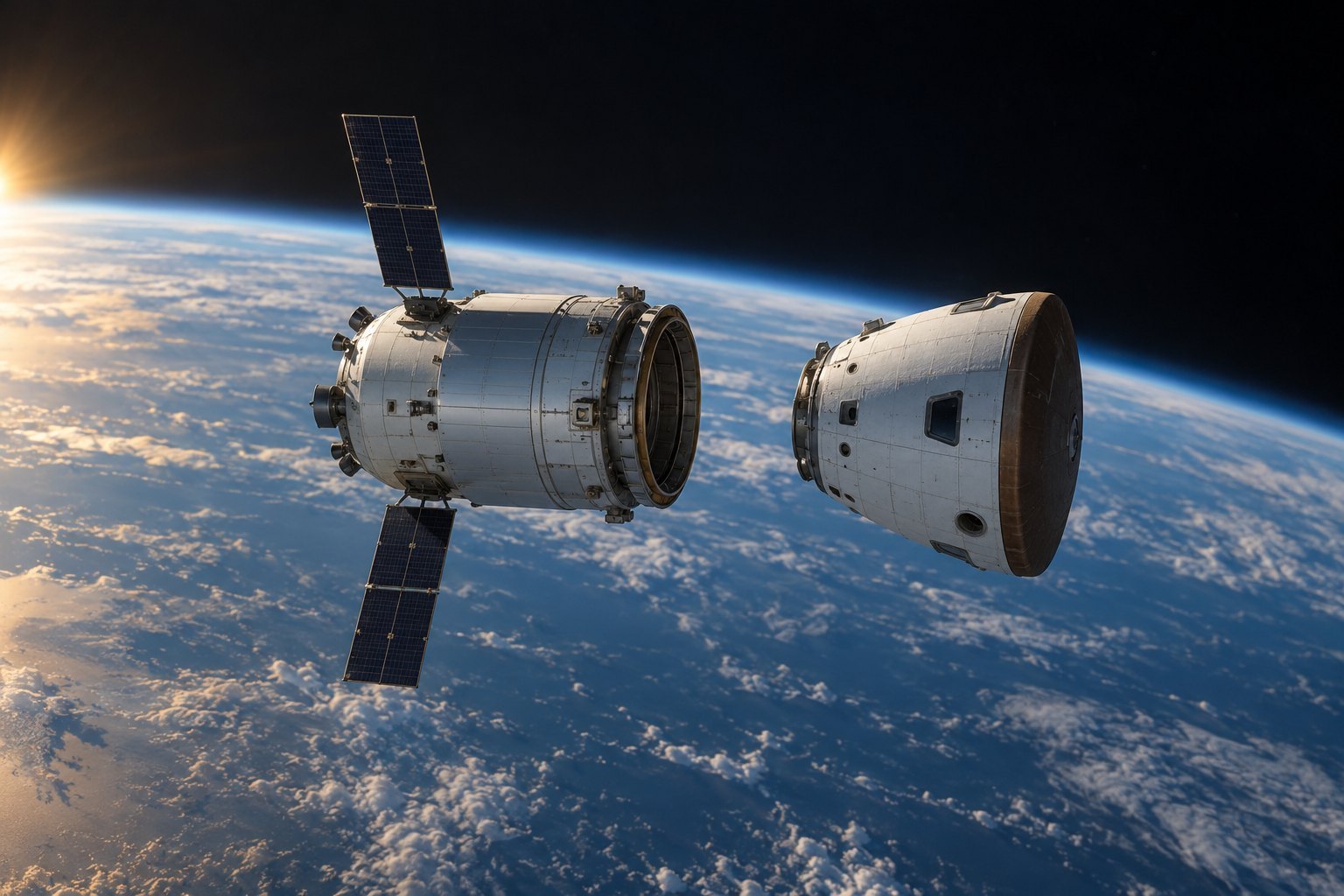
Gaganyaan is ISRO's human spaceflight programme, which aims to carry three crew to a 400 km orbit for three days and land them in Indian sea waters. Its Orbital Module joins a habitable Crew Module to a Service Module. On 16 October 2026, ISRO said it had completed tests at VSSC of how the two separate before re-entry.
Syllabus: Prelims · Current Affairs & IR; GS3 · Indian Achievements in S&T; GS3 · IT, Space, Biotech & IPR
Why this matters for UPSC
GS3 science and technology (awareness in space, indigenisation of technology): Prelims can ask what the Crew Module, Service Module, Crew Escape System and HLVM3 are; Mains, the technologies and safety tests that human spaceflight needs.
In short
Gaganyaan is ISRO's programme to demonstrate human spaceflight: carrying a crew of three to a 400 km low Earth orbit for three days and landing them in Indian sea waters.
Gaganyaan will be judged by safety, not speed: each system must prove itself in uncrewed flight before ISRO puts three people aboard.
Why it matters
A person launched into orbit has to survive three moments that machines alone can tolerate failing: a rocket going wrong at lift-off, the heat of re-entry, and a landing at sea. Gaganyaan's design answers each one with a separate system, and every system has to be proven on the ground and in uncrewed flights before anyone flies. That is why the programme moves through a long ladder of tests rather than a single launch. If it succeeds, India gains the skills to keep people alive in space, which a space station and longer missions will need. It also builds testing and recovery work across the armed forces, DRDO laboratories and Indian industry.
Prelims pointers
- HLVM3 has three stages: two S200 solid boosters, the L110 liquid stage and the C32 cryogenic upper stage.
- HLVM3 stands about 53 m tall, weighs about 640 tonnes and can lift about 10 tonnes to low Earth orbit, per ISRO.
- The escape system stays active from the launch pad until it separates after the vehicle leaves the dense atmosphere.
- ISRO's precursor missions include the Integrated Air Drop Test, the Pad Abort Test and Test Vehicle flights.
- ISRO's Astronaut Training Facility is in Bengaluru; training includes parabolic flights for microgravity, simulators and survival drills.
- The Terminal Ballistics Research Laboratory, Chandigarh and the Aerial Delivery Research and Development Establishment are DRDO laboratories.
- Crew Module integration happens at VSSC, while Service Module and Orbital Module integration happen at URSC, Bengaluru.
Practise a UPSC-style question
With reference to the Orbital Module of the Gaganyaan programme, consider the following statements:
1. The Crew Module has a pressurised metallic inner structure and an unpressurised external structure.
2. The Service Module stays attached to the Crew Module through re-entry and is separated just before splashdown.
Which of the statements given above is/are correct?
- (a) 1 only
- (b) 2 only
- (c) Both 1 and 2
- (d) Neither 1 nor 2
Show the answer
Answer: (a) 1 only
Answer: (a) 1 only. The Crew Module is double-walled, and the Service Module is dropped before re-entry begins.
Statement 1: correct. ISRO describes the Crew Module as double-walled: a pressurised metallic inner structure and an unpressurised external structure carrying the Thermal Protection System.
Statement 2: incorrect. ISRO separates the Crew Module from the Service Module before re-entry into the atmosphere begins; only the Crew Module re-enters and lands.
Eliminate: Statement 2 is the surer call, since a module without a heat shield cannot ride through re-entry. Out: (b), (c).
Eliminate: Statement 1 matches the double-walled design. Out: (d).
Trap: Half-true statement. Statement 2 rightly says the modules separate but moves the separation from before re-entry to just before splashdown.
Remember: Gaganyaan's Service Module is discarded before re-entry; only the Crew Module comes home.
More Explainers
- State Legislative Councils: Articles 168-172 and the graduates' and teachers' seats Polity
- Whales and dolphins in Indian waters: legal protection, IUCN status and strandings Environment
- The Aligarh Movement, AMU and the Article 30 minority test Polity
- Environmental clearance by States: SEIAA, SEAC and the EIA Notification, 2006 Environment
- Software vulnerabilities: CVE, CVSS, coordinated disclosure and CERT-In's role Sci-Tech
- Drug trafficking law in India: NDPS Act, PIT-NDPS, NCB and NCORD National
- Choosing the UN Secretary-General: Article 97, UNSC veto and straw polls World & IR
- UN Convention against Torture, and why India has not ratified it Polity
- NavIC: why India's navigation constellation cannot give a standalone position Sci-Tech
- International Energy Agency: membership, 90-day oil stocks and India's status World & IR
- PM Surya Ghar: Muft Bijli Yojana and the rooftop solar subsidy Economy
- HFSS foods: FSSAI's draft limits and front-of-pack warning labels National