
EWS reservation: the 103rd Amendment and Articles 15(6), 16(6)
Why in news: Jammu and Kashmir's Assembly, in its recently concluded session, heard that about 91% of the UT's EWS certificates in two years went to Jammu division.
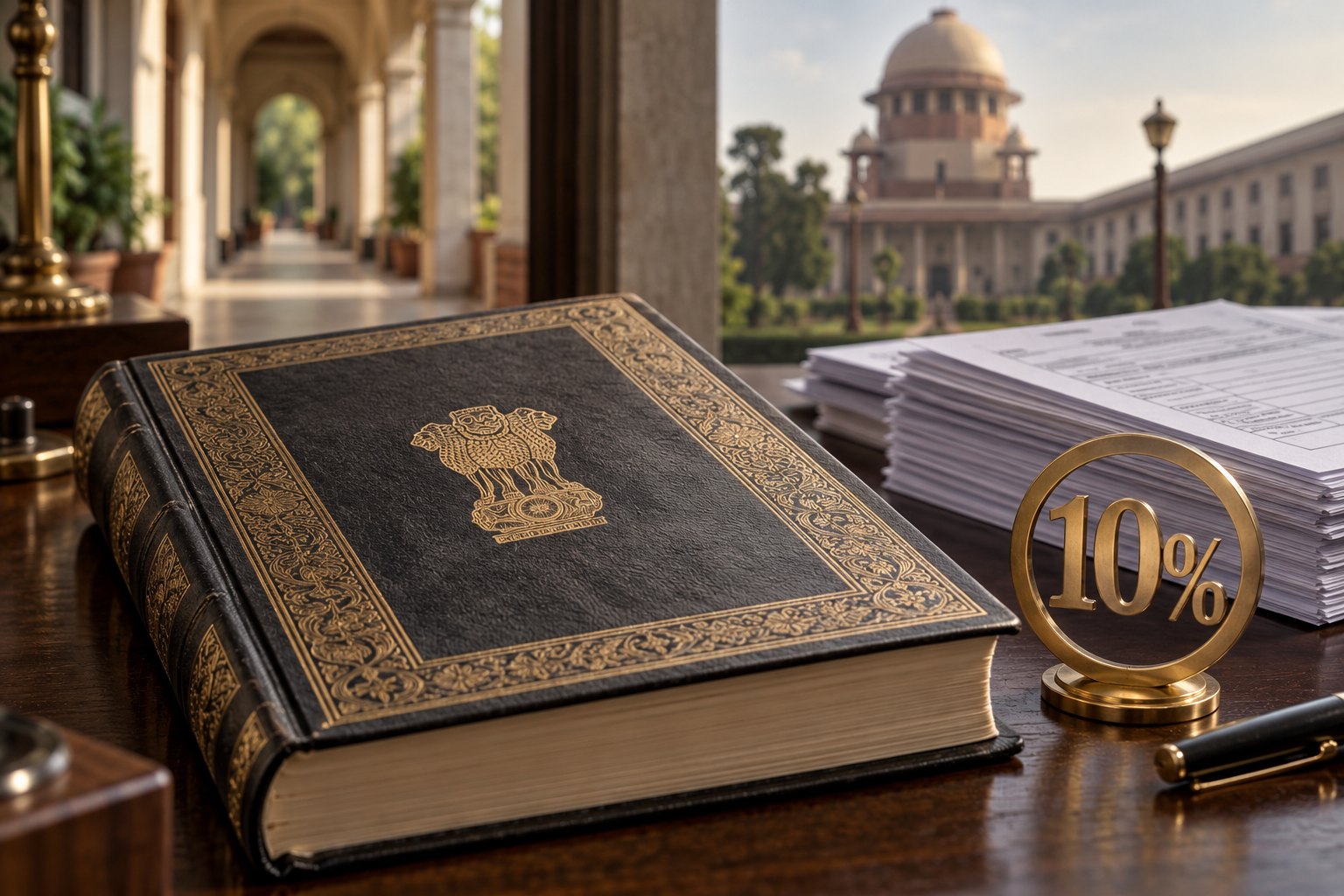
The Constitution (103rd Amendment) Act, 2019 added Articles 15(6) and 16(6), letting the State reserve up to 10% of seats and posts for economically weaker sections outside the SC, ST and OBC quotas. The Supreme Court upheld it 3:2 in 2022. Jammu and Kashmir's EWS criteria are now questioned over a sharp regional imbalance in certificates.
Syllabus: GS2 · Constitution; Prelims · Polity & Governance; GS2 · Welfare of Vulnerable Sections
In short
The Constitution (103rd Amendment) Act, 2019 added Articles 15(6) and 16(6), allowing up to 10% reservation for economically weaker sections outside existing quotas, on economic criteria alone.
Narrowly upheld, EWS reservation will reach the poor only if its eligibility tests fit local land records and agree with other poverty measures.
Why it matters
A family's claim to one in ten seats in central jobs and colleges now turns on a certificate built from income and property tests. Because the Constitution lets each State write its own tests, a family can qualify in one State and not in another, and a central test drawn up in square feet and square yards may not suit local land records. The quota also changed the basis of reservation: it is the first to rest on economic disadvantage alone and the first closed to SC, ST and OBC families, a design the Supreme Court upheld only by 3:2. How the tests are drawn decides whether it reaches the poor it was meant for.
Prelims pointers
- Article 15(6) overrides Articles 19(1)(g) and 29(2), so private unaided institutions can be required to admit EWS students; minority institutions under Article 30(1) are excepted.
- The 10% is a maximum ('subject to a maximum of ten per cent'), not a fixed share that every State must provide.
- EWS excludes, by the text, the classes under Articles 15(4) and 15(5) and, for posts, Article 16(4): SCs, STs and socially and educationally backward classes.
- The Explanation makes EWS whatever 'the State' notifies on family income and other indicators, so the Centre, States and UTs each set criteria.
- Janhit Abhiyan majority: economic criteria alone, and the exclusion of SC, ST and OBC classes, do not breach the basic structure; the 50% ceiling is not inflexible.
- Janhit Abhiyan dissent: economic criteria are permissible in themselves, but excluding the poor among SCs, STs and OBCs violates the equality code.
- Indra Sawhney v Union of India (1992) struck down a 1991 executive order giving 10% to economically backward sections of non-reserved classes.
- Article 46, a Directive Principle, asks the State to promote the educational and economic interests of the weaker sections.
Practise a UPSC-style question
With reference to the Constitution (One Hundred and Third Amendment) Act, 2019, consider the following statements:
1. It inserted a new clause in both Article 15 and Article 16 for economically weaker sections.
2. It fixed EWS reservation at ten per cent, which every State is bound to provide.
Which of the statements given above is/are correct?
- (a) 1 only
- (b) 2 only
- (c) Both 1 and 2
- (d) Neither 1 nor 2
Show the answer
Answer: (a) 1 only
1 is correct: it inserted clause (6) in Article 15 and clause (6) in Article 16. 2 is incorrect: the reservation is 'subject to a maximum of ten per cent', a ceiling the State may use, not a fixed share it must provide.
More Explainers
- State Legislative Councils: Articles 168-172 and the graduates' and teachers' seats Polity
- Whales and dolphins in Indian waters: legal protection, IUCN status and strandings Environment
- The Aligarh Movement, AMU and the Article 30 minority test Polity
- Environmental clearance by States: SEIAA, SEAC and the EIA Notification, 2006 Environment
- Software vulnerabilities: CVE, CVSS, coordinated disclosure and CERT-In's role Sci-Tech
- Drug trafficking law in India: NDPS Act, PIT-NDPS, NCB and NCORD National
- Choosing the UN Secretary-General: Article 97, UNSC veto and straw polls World & IR
- UN Convention against Torture, and why India has not ratified it Polity
- NavIC: why India's navigation constellation cannot give a standalone position Sci-Tech
- International Energy Agency: membership, 90-day oil stocks and India's status World & IR
- PM Surya Ghar: Muft Bijli Yojana and the rooftop solar subsidy Economy
- HFSS foods: FSSAI's draft limits and front-of-pack warning labels National