
Disaster Management Act, 2005 and its 2025 amendment
Why in news: On 1 August 2026 the Union Home Minister approved advance release of ₹2,117.85 crore from the Central share of SDRF to flood-affected States.
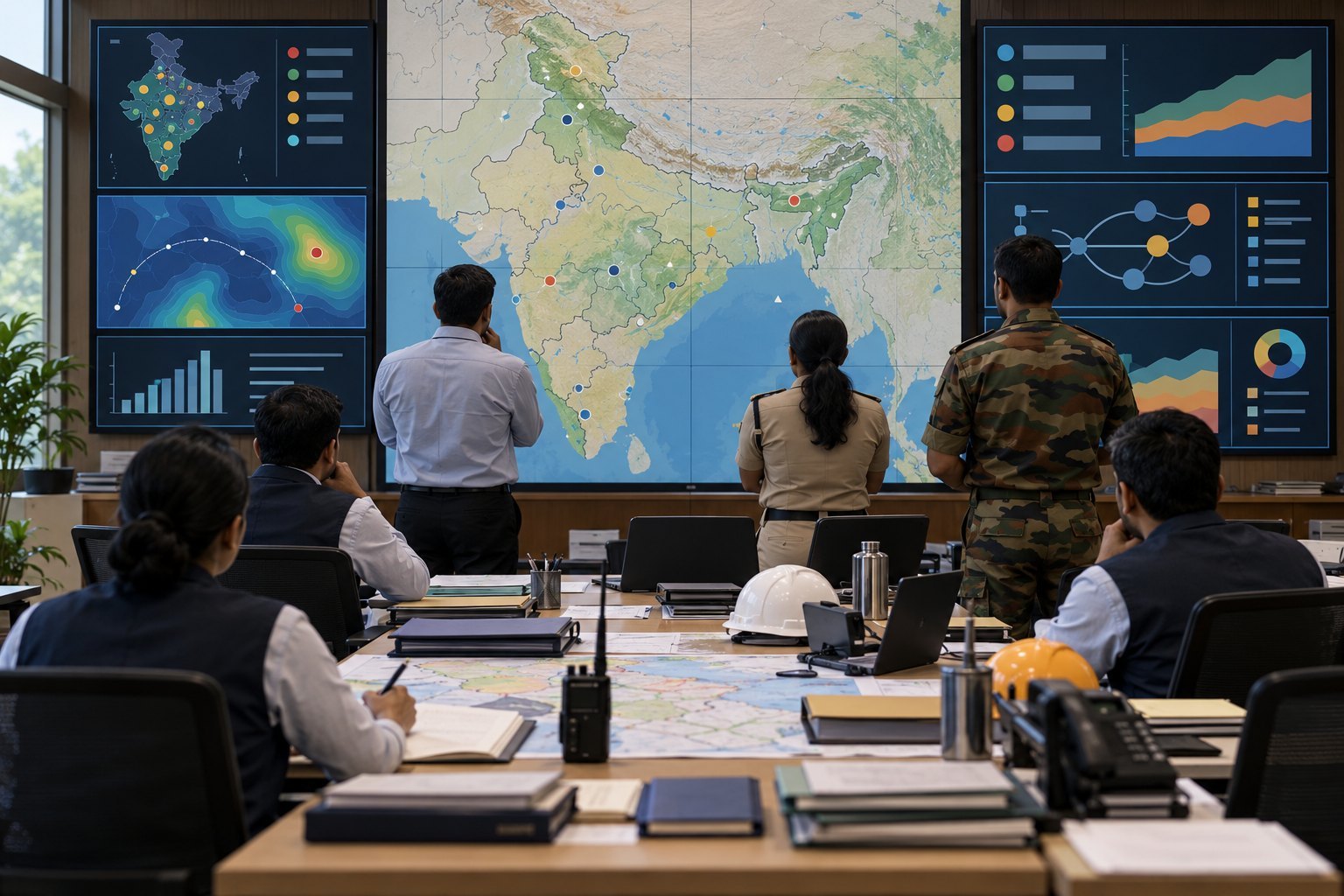
The Disaster Management Act, 2005 builds India's disaster governance in tiers: the NDMA under the Prime Minister, State authorities under Chief Ministers and district authorities under Collectors, backed by a response force and dedicated funds. Its 2025 amendment made the NCMC and HLC statutory. On 1 August 2026, ₹2,117.85 crore of SDRF advances was approved for flood-hit States.
Syllabus: GS2 · Federalism & Local Government; Prelims · Economy & Social Development; GS3 · Disaster Management
Why this matters for UPSC
GS3 disaster management: Prelims asks who chairs the NDMA, SDMA, DDMA, NCMC and HLC and how the response and mitigation funds work; Mains asks how the 2025 amendment changes urban disaster risk and Centre-State relief.
In short
The Disaster Management Act, 2005 is India's legal framework for disasters, setting up authorities from nation to district and funds for response and mitigation, beyond mere relief.
The 2025 amendment completes the legal architecture; its value depends on States forming urban authorities and using disaster data to fund prevention.
Why it matters
A family whose house floods in Assam or a farmer whose crop is washed away in Odisha depends on this law for rescue teams, relief camps and cash help. The Act decides who acts first, the district, the State or the Centre, and where the money comes from. When the system works, teams are already in place before a cyclone lands and relief reaches people within days. When it fails, money waits for paperwork while people wait in camps. Cities are a growing gap: urban floods and heatwaves need city-level plans, and most cities still lack the authority the 2025 law allows. The larger issue is moving from relief after a disaster to reducing risk before it.
Prelims pointers
- Section 3, DM Act: the NDMA has the Prime Minister as ex officio Chairperson and up to nine members nominated by the Chairperson.
- Section 20: the State Executive Committee is chaired by the Chief Secretary; the 2025 amendment added the State's Director General of Police as an ex officio member.
- Section 25: in Sixth Schedule tribal areas, the Chief Executive Member of the autonomous district council is co-chairperson of the DDMA.
- Section 41A: the Urban Disaster Management Authority has the Municipal Commissioner as Chairperson and the District Collector as Vice Chairperson, and may have a separate Secretariat.
- Section 45: superintendence of the National Disaster Response Force vests in the NDMA; its command vests in a Director General appointed by the Centre.
- Section 8B: the High Level Committee is chaired by the Union minister in charge of the ministry administering disaster management.
- Section 42: the National Institute of Disaster Management is constituted under the DM Act, with a governing body.
Practise a UPSC-style question
With reference to the Disaster Management Act, 2005, consider the following statements:
1. The National Disaster Management Authority is chaired by the Prime Minister, ex officio.
2. The State Disaster Management Authority is chaired by the Governor of the State, ex officio.
3. The District Disaster Management Authority is chaired by the Collector, with the local authority's elected representative as co-chairperson.
Which of the statements given above is/are correct?
- (a) 1 and 2 only
- (b) 2 and 3 only
- (c) 1 and 3 only
- (d) 1, 2 and 3
Show the answer
Answer: (c) 1 and 3 only
Answer: (c) 1 and 3 only. The Chief Minister, not the Governor, chairs a State Disaster Management Authority.
Statement 1: correct. Section 3 of the Act makes the Prime Minister the ex officio Chairperson of the NDMA, with up to nine other members.
Statement 2: incorrect. Section 14 makes the Chief Minister the ex officio Chairperson of the SDMA; the Chief Secretary chairs its State Executive Committee.
Statement 3: correct. Section 25 makes the Collector, District Magistrate or Deputy Commissioner Chairperson and the local authority's elected representative co-chairperson.
Eliminate: Statement 2 is the surest: the State tier mirrors the national one, with the head of government as chair. Out: (a), (b), (d).
Trap: Swapped attribution. The Governor heads the State formally, so pinning the SDMA on the Governor sounds natural, though the Act names the Chief Minister.
Remember: Prime Minister, Chief Minister, Collector: the three chairs of the NDMA, SDMA and DDMA.
In the news
More Explainers
- State Legislative Councils: Articles 168-172 and the graduates' and teachers' seats Polity
- Whales and dolphins in Indian waters: legal protection, IUCN status and strandings Environment
- The Aligarh Movement, AMU and the Article 30 minority test Polity
- Environmental clearance by States: SEIAA, SEAC and the EIA Notification, 2006 Environment
- Software vulnerabilities: CVE, CVSS, coordinated disclosure and CERT-In's role Sci-Tech
- Drug trafficking law in India: NDPS Act, PIT-NDPS, NCB and NCORD National
- Choosing the UN Secretary-General: Article 97, UNSC veto and straw polls World & IR
- UN Convention against Torture, and why India has not ratified it Polity
- NavIC: why India's navigation constellation cannot give a standalone position Sci-Tech
- International Energy Agency: membership, 90-day oil stocks and India's status World & IR
- PM Surya Ghar: Muft Bijli Yojana and the rooftop solar subsidy Economy
- HFSS foods: FSSAI's draft limits and front-of-pack warning labels National