
Kolkata pandal stampede: NDMA's crowd management guide and what failed
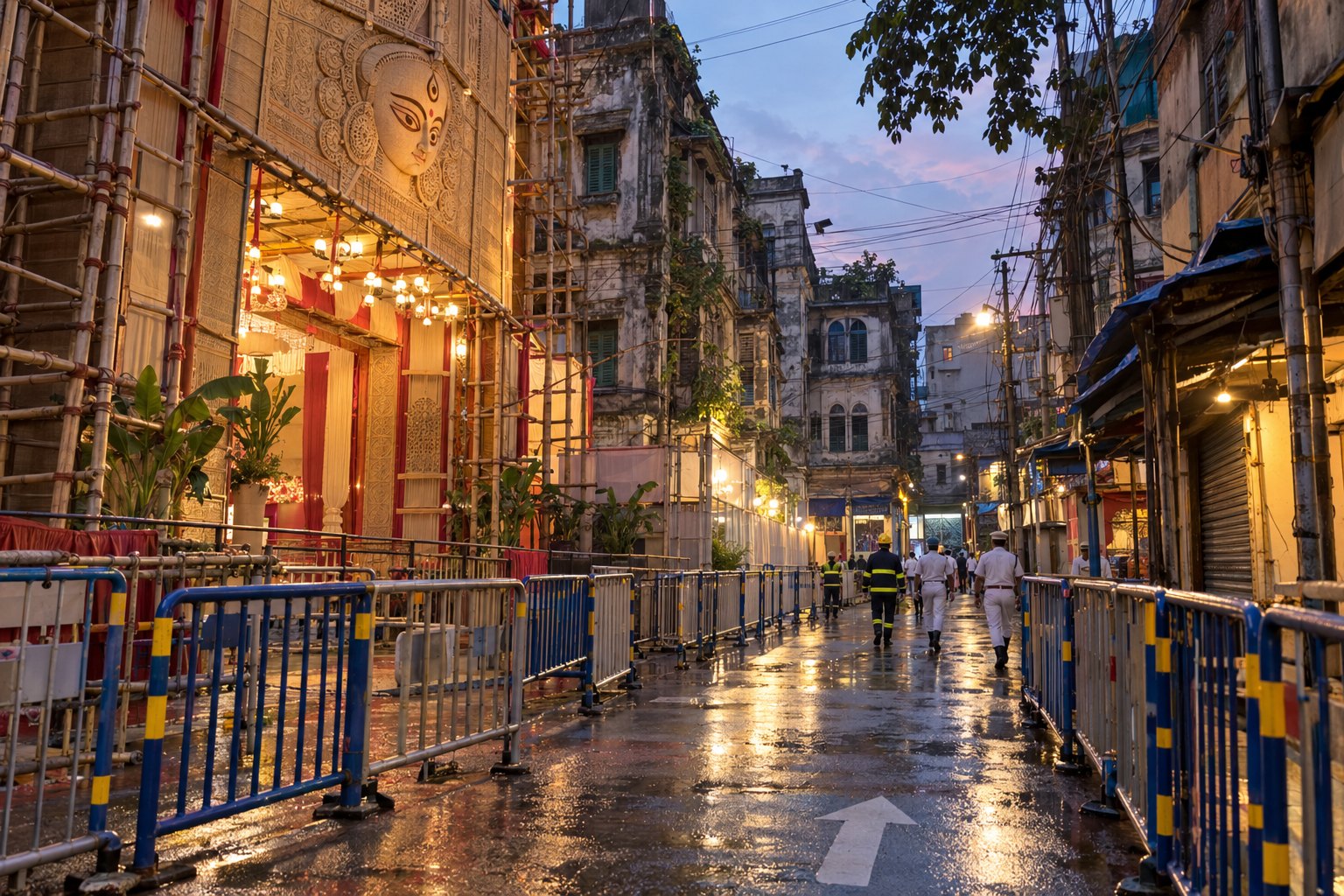
A crush at the Chorbagan Sarbojanin Durga Puja pandal in north Kolkata on 17 October 2026 killed at least 19 people and injured 25. A preliminary police probe found that an organisers' announcement that the pandal would collapse set off the rush amid rain. Seven people were arrested; the State plans to set up a judge-led Special Investigation Team.
Syllabus: GS4 · Ethics in Public Administration; GS2 · Governance & e-Governance; GS3 · Disaster Management
Why this matters for UPSC
GS III disaster management and GS II governance: Prelims can ask what the Disaster Management Act, 2005 counts as a disaster and who chairs the District Disaster Management Authority; Mains, how NDMA's crowd guide and district powers can prevent stampedes.
Why it matters
For the crowds who walk from pandal to pandal in Durga Puja, safety rests on things no visitor can see: how many people a lane can hold, whether people enter and leave by separate ways, and whether anyone is counting. When those checks are missing, one alarming announcement in a packed space can start a rush that crushes people who did nothing wrong. Open festivals have no tickets or time slots, so the burden falls on organisers and officials to plan before the crowd arrives. The case will show whether a permission for a big gathering means a checked crowd plan or only paperwork, and whether anyone answers for the gap.
Prelims pointers
- Disaster Management Act, 2005, section 2(d): a disaster may arise from natural or man-made causes, or by accident or negligence, beyond the affected community's coping capacity.
- Disaster Management (Amendment) Act, 2025: an Explanation to section 2(d) says 'man made causes' exclude law-and-order matters.
- Section 3 of the DM Act: the Prime Minister chairs the NDMA ex officio, with up to nine other members nominated by the Chairperson.
- Section 25, DM Act: the Collector (District Magistrate) chairs the district authority; the local authority's elected representative co-chairs, or in Sixth Schedule areas the district council's Chief Executive Member.
- Section 34 of the DM Act: facing a disaster, the district authority may restrict entry into, movement within and exit from a vulnerable area, and control traffic.
- BNS section 106(1): causing death by a rash or negligent act not amounting to culpable homicide carries up to five years; section 105 allows up to life imprisonment.
- BNS section 110: attempt to commit culpable homicide carries up to three years, or up to seven if hurt is caused.
- PMNRF: set up in January 1948 on the then Prime Minister's appeal; it takes only voluntary public contributions and gets no budgetary support.
Practise a UPSC-style question
With reference to the Disaster Management Act, 2005, consider the following statements:
1. The National Disaster Management Authority is chaired ex officio by the Union Home Minister.
2. The Act's definition of a disaster covers a grave occurrence arising from accident or negligence.
3. The National Disaster Management Authority is responsible for laying down policies, plans and guidelines for disaster management.
Which of the statements given above is/are correct?
- (a) 1 and 2 only
- (b) 2 and 3 only
- (c) 1 and 3 only
- (d) 1, 2 and 3
Show the answer
Answer: (b) 2 and 3 only
Answer: (b) 2 and 3 only. The Prime Minister, not the Home Minister, chairs the NDMA, so only statement 1 is wrong.
Statement 1: incorrect. Section 3 of the Act makes the Prime Minister the ex officio Chairperson of the National Disaster Management Authority, with up to nine other members.
Statement 2: correct. Section 2(d) defines a disaster as a catastrophe, mishap, calamity or grave occurrence from natural or man-made causes, or by accident or negligence.
Statement 3: correct. Section 6(1) gives the NDMA the responsibility for laying down the policies, plans and guidelines for disaster management.
Eliminate: Judge statement 1 first: the Prime Minister chairs the NDMA, so statement 1 is incorrect. Out: (a), (c), (d).
Trap: Swapped attribution. The chair is pinned on the Union Home Minister instead of the Prime Minister, the Act's ex officio Chairperson.
Remember: NDMA: the Prime Minister chairs it (section 3); it lays down national guidelines (section 6), such as the 2014 crowd guide.
Explainers on this topic
More from the 19 October 2026 edition
- Pakistan NOTAM extends airspace ban on Indian aircraft to 24 November World & IR
- Supreme Court orders portal and rules protocol on autism stem-cell therapy Sci-Tech
- Police accountability: Supreme Court panel opens portal on Jantar Mantar violence Polity
- Gwalior temple truck crash: CSP removed, eight police suspended, inquiry ordered National
- CAQM orders PTZ cameras with live feeds at polluting NCR industries Environment
- Section 44A: RBI sanctions Emirates NBD branches' merger with RBL Bank Economy
- FSSAI issues notices over misleading labels on coffee-flavoured milk drinks National
- India–New Zealand FTA due in force on 20 October; origin rules notified Economy
- Section 125A: Supreme Court allows private complaints over false nomination affidavits Polity